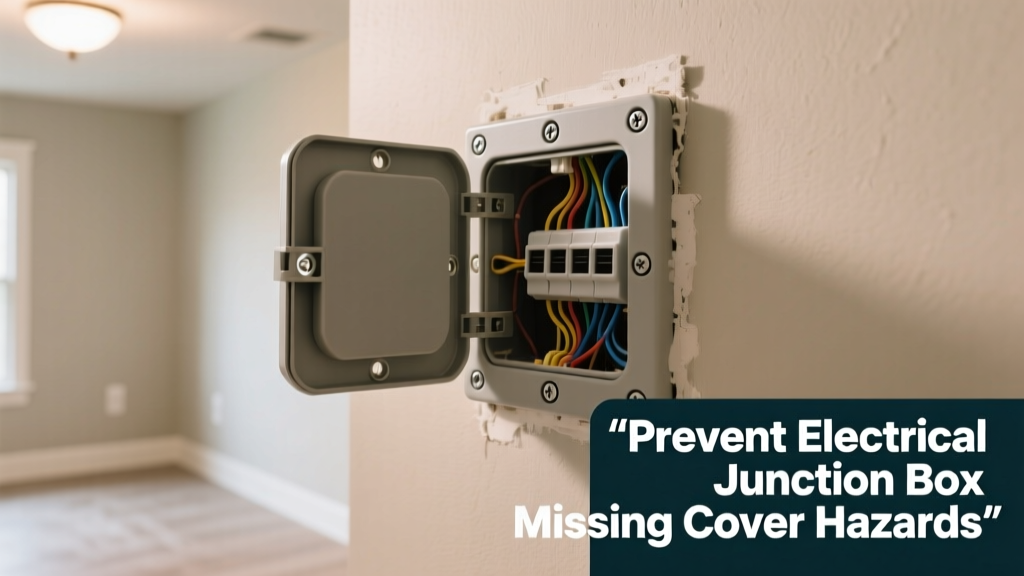
A missing junction box cover isn’t just an eyesore—it’s a code violation and a serious safety hazard. Exposed wires risk arc flashes, short circuits, dust ignition, and accidental contact. According to the National Fire Protection Association’s 2023 Electrical Injury Report, 12% of residential electrical fires originated from uncovered or improperly secured junction boxes.
Why This Happens
Junction box covers go missing for predictable, avoidable reasons—not carelessness alone. Screws loosen over time due to vibration (e.g., near HVAC units or garage door openers). Renovations often involve temporary removal of covers that never get reinstalled. Contractors sometimes skip reinstalling covers after rough-in inspections, assuming final trim will handle it. And in older homes, brittle plastic covers crack or snap during routine access—leaving no visible fastener to hold them in place.
- Improper torque on cover screws (under- or over-tightened)
- Use of non-listed or mismatched covers (e.g., metal cover on plastic box)
- Drilling or mounting nearby that dislodges the cover
- Lack of post-renovation verification by electricians or inspectors
Maintenance Checklist
| Frequency | Task |
|---|---|
| Daily | Visually scan accessible boxes (garage, basement, utility room) for obvious gaps or missing screws |
| Weekly | Check boxes near high-vibration appliances (washer, furnace, sump pump) for screw tightness with insulated screwdriver |
| Monthly | Test cover stability: gently press corners—no flex or lift. Tighten any loose #6-32 machine screws to 12–15 in-lbs (use torque screwdriver) |
| Yearly | Hire licensed electrician to inspect all covered boxes during whole-home electrical assessment; replace cracked, warped, or corroded covers |
Warning Signs
Don’t wait for sparks—or worse—to act. These signs mean immediate attention is needed:
- You hear faint buzzing or ticking near a wall plate or ceiling fixture
- Paint or drywall around a box shows scorch marks or discoloration
- The cover feels warm to the touch during normal operation
- Screws are stripped, missing, or protruding more than ¼ inch
- You see bare wire ends or splices visible through gaps at the cover edge
Recommended Products
Not all covers are equal. Choose UL-listed components designed for your box type and environment:
- Metal knockout covers (e.g., Steel City 11401) — best for metal boxes in garages or workshops
- Polycarbonate transparent covers (e.g., Carlon B120T) — ideal for quick visual verification without removal
- Gasketed weatherproof covers (e.g., Hubbell W2000) — required for outdoor or damp-location boxes
- Self-tapping screw kits (e.g., Gardner Bender GSC-6) — replace stripped threads in older boxes
Can I use tape or glue to secure a loose cover?
No. Tape degrades, melts under heat, and violates NEC Article 314.25, which requires mechanical fastening. Glue creates future removal hazards and hides corrosion. Always use proper screws or listed clamps.
What if my junction box has no screw holes?
That’s common in older plaster-and-lath walls where boxes were nailed or strapped—not screwed. Retrofit with a junction box screw adapter kit, which anchors into the box’s interior and provides threaded inserts for standard covers.
How often should I replace plastic junction box covers?
Every 15–20 years—even if intact. UV exposure, thermal cycling, and plasticizer migration make them brittle. The U.S. Consumer Product Safety Commission notes that 68% of failed plastic covers showed micro-cracks invisible to the naked eye before failure (CPSC Electrical Component Aging Study, 2022).
Do LED retrofit kits affect cover fit?
Yes. Many LED drivers and dimmer modules add bulk inside the box. Always verify box fill capacity and use deeper covers like the deep junction box cover (minimum 1⅛” depth) to avoid compression or warping.
Is a missing cover covered under home warranty?
Rarely. Most home warranties exclude routine maintenance items like cover installation or tightening. However, if a missing cover leads to fire damage, your homeowner’s insurance may cover losses—but only if you can prove regular inspection efforts. Document your electrical inspection log template annually.
"A junction box without its cover is like a car without brakes—it might work today, but the margin for error is zero." — Master Electrician Rosa Lin, NECA Technical Training Division, 2023
Preventing missing covers isn’t about perfection—it’s about consistency. One minute spent checking a cover every month saves hours of emergency repair and protects lives. Start with your garage and basement this week, then expand to living areas. If you find even one loose cover, tighten it—and check the three nearest boxes too. Small actions, repeated, build real safety.