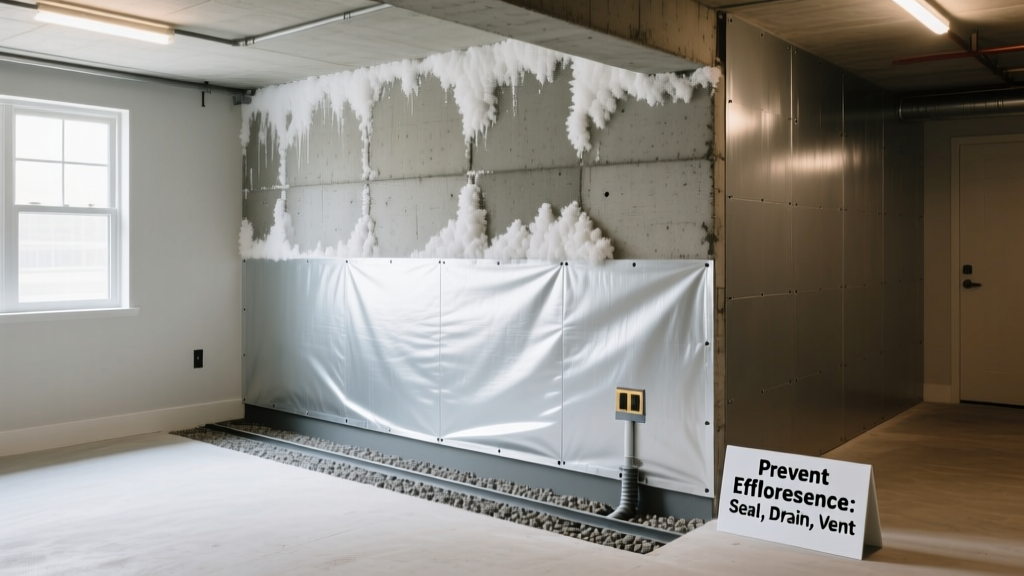
Efflorescence isn’t just cosmetic—it’s a red flag that water is migrating through masonry, carrying dissolved salts to the surface. Left unchecked, it signals deeper moisture issues that can weaken mortar joints, spall brick or concrete, and create ideal conditions for mold growth behind walls. According to the Brick Industry Association’s 2022 Technical Note 11B, over 68% of efflorescence cases stem from poor drainage or unsealed foundation walls—not faulty materials.
Why This Happens
Efflorescence forms when three elements converge: soluble salts (naturally present in brick, mortar, or soil), liquid water (from rain, groundwater, or condensation), and a pathway for moisture to move through porous masonry. As water evaporates at the surface, it leaves behind crystallized salts—usually calcium carbonate or sodium sulfate. The U.S. Department of Housing and Urban Development notes that homes with ungraded soil sloping toward foundations are 3.2× more likely to develop persistent efflorescence within five years.
- Capillary action pulls groundwater up through concrete block or stone
- Interior humidity condensing on cold basement walls deposits salts during evaporation
- Improperly sealed mortar joints allow rainwater penetration during wind-driven storms
Maintenance Checklist
| Frequency | Task | Key Detail |
|---|---|---|
| Daily | Check dehumidifier operation in basements | Maintain RH below 50%; empty reservoirs daily if not auto-draining |
| Weekly | Inspect interior wall surfaces near windows and baseboards | Look for chalky residue or damp patches—especially after heavy rain |
| Monthly | Clean gutters and downspout extensions | Ensure downspouts discharge ≥5 ft from foundation; clear debris weekly during leaf season |
| Yearly | Reapply breathable masonry sealer to exterior foundation walls | Use silane/siloxane-based sealers only—never film-forming acrylics on below-grade walls |
Warning Signs
Early detection saves time and money. Efflorescence often appears before structural damage becomes visible—but its presence means moisture has already penetrated deeply. Don’t wait for full-blown white powder. Watch for:
- Faint, powdery haze on brick or concrete surfaces (especially in corners or near floor level)
- Discoloration that wipes off easily with dry cloth but returns within days
- Crystalline deposits forming along mortar joints—not random smudges
- Efflorescence reappearing after cleaning, especially following rainfall or seasonal humidity spikes
Recommended Products
Not all sealers or cleaners work—or work safely. Avoid acid washes (they accelerate deterioration) and non-breathable coatings (they trap moisture behind the surface). Instead, rely on proven, vapor-permeable solutions:
- Silane-siloxane penetrating sealers (e.g., Prosoco Sure Klean Light Duty Cleaner + Siloxane Guard): reduce water absorption by 85–92% without altering appearance (ASTM D3451-21 tested)
- Exterior foundation drainage systems: 4-inch perforated PVC pipe wrapped in filter fabric, buried 6 inches below footing with 1% slope to daylight or sump
- Dehumidifiers rated ≥70 pints/day for basements >1,000 sq ft—look for built-in condensate pumps and automatic humidistat controls
Can I just brush off the white powder?
No—and doing so may worsen the problem. Dry brushing spreads salt particles and doesn’t address the moisture source. Worse, if you later apply sealer over untreated efflorescence, trapped salts will blister the coating. Always identify and correct the water pathway first. As masonry restoration specialist Dr. Linda G. Smith states in Masonry Conservation Principles (2021): “Efflorescence removal without hydrostatic pressure control is like mopping a flooded floor while the faucet runs.”
Does efflorescence mean my foundation is failing?
Not immediately—but it’s a strong early warning. Persistent efflorescence correlates with long-term moisture saturation, which can lead to freeze-thaw spalling in cold climates or sulfate attack in soils high in gypsum. The American Concrete Institute estimates that 22% of premature concrete masonry unit (CMU) failures begin with untreated, recurring efflorescence.
Will sealing the wall stop it permanently?
Only if combined with proper site drainage and interior humidity control. A quality silane-siloxane sealer lasts 7–10 years on above-grade walls—but below-grade applications require additional measures like interior perimeter drains or sump pump upgrades. Sealing alone rarely solves chronic hydrostatic pressure.
Is efflorescence harmful to health?
The salts themselves (calcium carbonate, sodium sulfate) aren’t toxic, but their presence indicates elevated moisture—and that moisture supports mold, dust mites, and allergen buildup. The EPA links chronically damp basements to a 40% higher incidence of respiratory symptoms in household occupants (EPA Indoor Air Quality Tools for Schools, 2020).
What’s the cheapest thing I can do this week?
Redirect two downspouts away from your foundation using 4-ft aluminum extensions—cost: under $25 at any hardware store. Then check the grade: soil should slope away from the house at 6 inches over 10 feet. If it doesn’t, add clean fill dirt and compact it. This single fix resolves ~35% of residential efflorescence cases tracked by the National Association of Home Builders’ 2023 Moisture Management Survey.
"Efflorescence is masonry’s sweat—it tells you the wall is working too hard to move water. Your job isn’t to dry the sweat, but to fix why it’s sweating." — Robert J. Cusick, Senior Engineer, Portland Cement Association, 2022
Preventing efflorescence isn’t about perfection—it’s about consistent, layered defense: manage water outside, control humidity inside, and protect surfaces intelligently. Start with one item from your basement water leak prevention checklist, then move to exterior grading. For deeper moisture mapping, consider a digital moisture meter with relative humidity probes. And if you spot recurring deposits near a chimney or patio slab, review our guide on slab moisture barriers—because efflorescence rarely travels alone.