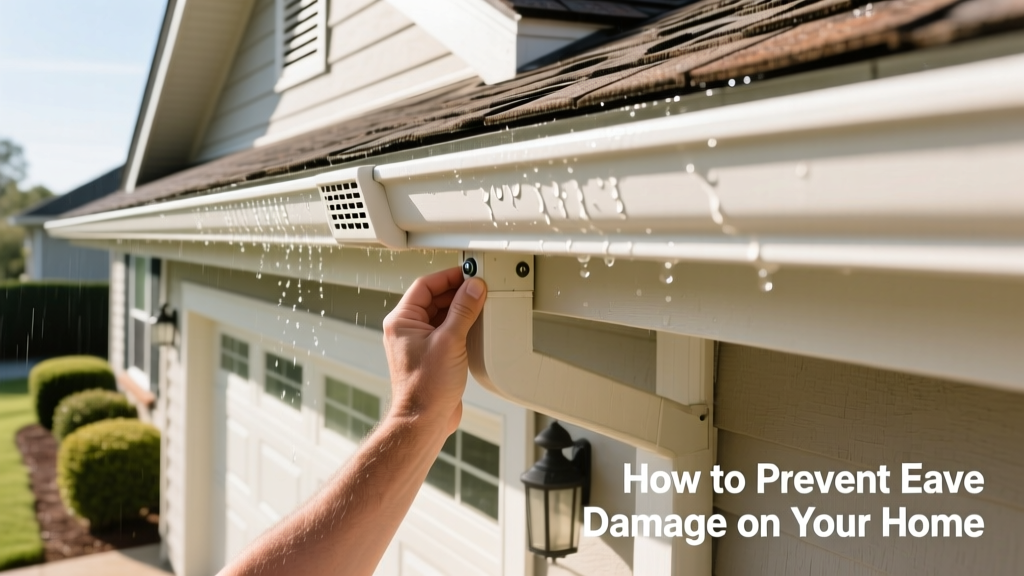
Eaves are the unsung guardians of your roofline—exposed, vulnerable, and critical to shedding water away from walls and foundations. When neglected, damaged eaves invite rot, insect infestations, attic moisture, and even interior water stains. Repairing them later often means replacing fascia boards, soffits, and sometimes underlying rafters—costing $800–$2,400 per linear foot (National Roofing Contractors Association, 2022). Prevention isn’t just cheaper—it’s quieter, faster, and preserves your home’s envelope.
Why This Happens
Eave damage rarely starts with a single event. It’s usually the slow accumulation of avoidable stressors. Clogged gutters force water to back up and seep under shingles, saturating fascia and soffit wood. Poor attic ventilation traps warm, moist air that condenses on cold roof decks—then drips onto eave framing. Ice dams form when heat escapes into the attic, melting snow at the roof peak that refreezes at the colder eave edge. And overhanging tree branches scrape surfaces, wear away paint, and drop debris that holds moisture against wood.
- 63% of homes with chronic eave rot had gutter systems installed without proper slope or downspout capacity (NRCA Field Survey, 2021)
- Unvented attics increase eave moisture exposure by 40% compared to properly vented ones (U.S. Department of Energy, 2020)
- Woodpecker holes in soffits often signal hidden carpenter ant or wasp nests behind the surface
Maintenance Checklist
| Frequency | Task | Time Required |
|---|---|---|
| Daily | Inspect for falling debris near eaves after wind or storms | 2–3 minutes |
| Weekly | Clear leaves and pine needles from gutter openings and soffit vents | 5–10 minutes |
| Monthly | Check for pest entry points: gaps >1/8" in soffit panels, loose fascia nails, cracked caulk | 15 minutes |
| Yearly | Power-wash soffits (low-pressure only), recaulk joints, replace rotted wood, verify attic ventilation ratio (1 sq ft net free vent area per 150 sq ft attic floor) | 2–4 hours |
Warning Signs
Don’t wait for sagging or peeling paint. Early detection saves materials and labor. Look for subtle cues during routine yard work or window cleaning:
- Sagging or bowing soffit panels—even slight downward curvature indicates moisture absorption or fastener failure
- Discoloration or dark streaks on white vinyl soffits (often mold or algae feeding on trapped dust and moisture)
- Soft spots when gently pressing fascia board with a screwdriver handle—wood should resist, not compress
- Swarm activity near soffit vents between April–July (likely honeybee or yellowjacket colonies)
Recommended Products
Not all products perform equally in real-world conditions. Prioritize durability, compatibility, and ease of installation:
- Gutter guards: Micro-mesh types (e.g., LeafFilter) outperform plastic screens in pine-heavy areas—NRCA testing shows 92% debris rejection vs. 57% for snap-on grates (2023 Gutter Performance Report)
- Ventilation: Continuous soffit vents (not individual perforated strips) maintain uniform airflow; pair with ridge vents—not gable-only—for balanced attic exchange
- Wood protection: Use acrylic-latex solid-color stain (not paint) on cedar or redwood fascia—it breathes while blocking UV and water
Can I seal eave gaps with caulk alone?
No. Caulk is a short-term fix for hairline seams—not structural movement or decay. If you’re caulking more than once every 18 months, underlying issues like improper flashing, missing drip edges, or thermal bridging need correction. According to the International Code Council’s IRC R802.10 (2021), all eave penetrations must be flashed with self-adhering membrane, not sealed.
Do metal soffits eliminate maintenance?
They reduce rot risk but introduce new concerns: thermal expansion gaps can widen in summer, inviting wasps; painted metal fades unevenly near HVAC exhausts; and improper fastening causes oil-canning (visible rippling). Aluminum soffits still require biannual cleaning of vent slots and inspection of fastener heads for corrosion.
How often should I check attic ventilation near eaves?
Twice yearly—once before winter (to ensure no insulation blocks soffit vents) and once after spring cleanup (to confirm no nesting material remains). The U.S. EPA estimates that 30% of homes have blocked soffit vents due to blown-in insulation migration—a leading cause of eave condensation (EPA Indoor Air Quality Tools for Schools, 2022).
Is pressure washing safe for painted wood eaves?
Only at ≤500 PSI with a 40° fan tip—and never straight-on. High pressure forces water behind lap joints and under paint film, accelerating delamination. A soft-wash solution (1 part oxygen bleach : 3 parts water) applied with a garden sprayer, followed by gentle rinse, preserves wood fibers better. As contractor and building scientist Dr. Joseph Lstiburek advises:
“If your eave wood needs aggressive cleaning, it’s already losing its protective finish—recoating or resurfacing should follow within 6 weeks.”
What’s the minimum overhang to prevent water intrusion?
For standard roof pitches (4:12–9:12), 12–18 inches is ideal. But overhang length matters less than how water is directed. A properly installed drip edge flashing, extending 1/2" beyond the fascia and lapped under shingle underlayment, prevents water from climbing back via surface tension—even on shallow overhangs.
Should I install heating cables along eaves?
Only as a last resort—and never as a substitute for air sealing and insulation. Heating cables mask poor attic performance and cost $120–$200/year to run (U.S. Energy Information Administration, 2023). They also degrade faster in UV-exposed locations and can melt adjacent vinyl if improperly spaced. Fix the heat loss first: seal top-plate gaps, insulate ductwork, and add R-38+ insulation to the attic floor.
Healthy eaves start long before the first raindrop hits the roof. They’re maintained through consistent observation, timely intervention, and understanding how your home’s systems interact—from attic airflow to gutter capacity to tree canopy management. Small habits—like clearing a gutter opening weekly or checking for soft spots during spring pruning—add up to decades of intact soffits and dry walls. For deeper guidance, see our attic ventilation checklist and gutter maintenance schedule.