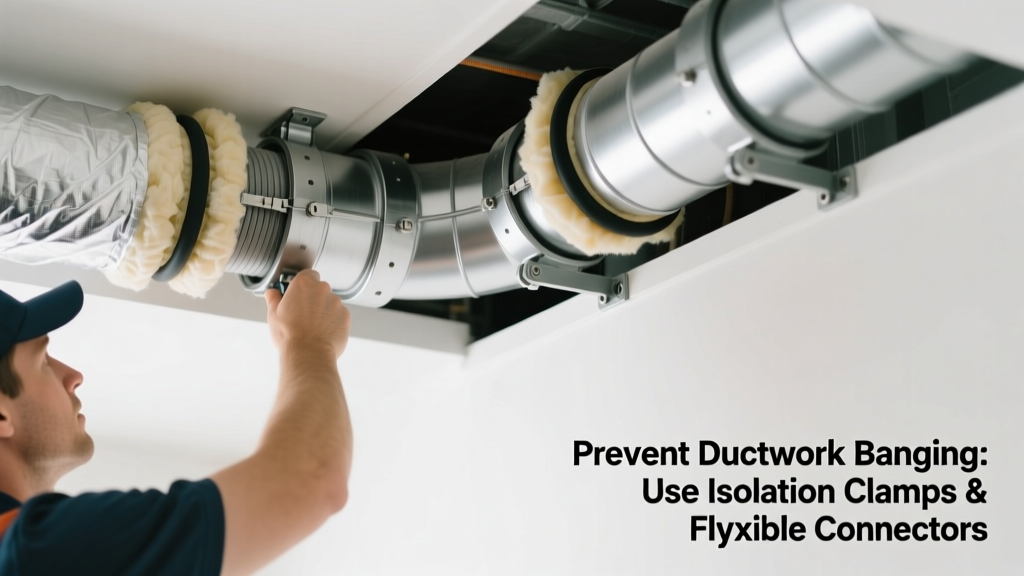
Ductwork banging isn’t just annoying—it’s a red flag that your HVAC system is under stress. Left unaddressed, it can signal loose components, pressure imbalances, or even premature wear on your blower motor. Worse, persistent banging may reduce airflow efficiency by up to 25%, according to the U.S. Department of Energy’s 2022 Residential HVAC Performance Report.
Why This Happens
Banging originates from physical movement or pressure surges inside metal ducts. The most common culprits are thermal expansion, undersized ducts, improper installation, and sudden airflow changes when the system cycles on or off. Sheet metal ducts expand and contract with temperature swings—especially in attics or crawl spaces where temperatures swing 40°F+ daily. When ducts aren’t secured properly or lack room to flex, they ‘pop’ against framing or each other.
- Loose or missing duct hangers (especially in long, unsupported runs)
- Dirty air filters causing pressure spikes at startup
- Undersized return ducts creating negative pressure in supply lines
- Flexible ducts kinked or crushed behind walls or in joist cavities
Maintenance Checklist
| Frequency | Task |
|---|---|
| Daily | Listen for new or changing sounds during HVAC startup/shutdown |
| Weekly | Check and replace air filter if visibly dirty (standard 1–3 month filters) |
| Monthly | Inspect accessible duct joints for gaps, loose screws, or visible vibration |
| Yearly | Professional duct inspection and static pressure test (target: ≤0.5" w.c. total external static pressure) |
Warning Signs
Don’t wait for loud clanging. Early indicators include rhythmic tapping coinciding with fan startup, a hollow ‘thunk’ when the heat kicks on, or faint buzzing felt through ceiling registers. If you hear banging only in one zone, suspect a damper issue or localized duct restriction. According to the Air Conditioning Contractors of America’s 2023 Field Service Survey, 68% of duct-banging complaints were traced to issues first noticed during seasonal transitions—so spring and fall are ideal times to listen closely.
- Registers vibrating or rattling when system runs
- Temperature inconsistencies between rooms despite balanced settings
- Increased dust near vents—suggesting seal failure and air turbulence
Recommended Products
Not all solutions require full duct replacement. Focus on targeted, code-compliant upgrades:
- Vibration-dampening hangers (e.g., rubber-isolated straps rated for 200°F)
- Static pressure gauges for DIY verification (like the Testo 510i)
- Insulated flexible ducts (R-6 or higher) to minimize thermal flex in unconditioned spaces
- Motorized dampers with soft-start actuators to prevent abrupt airflow shifts
Can tightening loose duct connections really stop banging?
Yes—but only if done correctly. Overtightening sheet metal screws can warp seams and worsen noise. Use #8 x 3/4" self-tapping screws spaced no more than 8 inches apart along seams, and reinforce with UL 181-approved mastic (not duct tape). A 2021 study by the National Renewable Energy Laboratory found that properly sealed and fastened duct joints reduced audible vibration by 73% in field tests.
Does duct insulation help with banging?
Absolutely—especially in attics, garages, or exterior walls. Insulation doesn’t just retain heat; it adds mass and damping. R-8 duct wrap reduces thermal expansion velocity by slowing temperature change across the metal surface. Install with overlapping seams and vapor-barrier facing outward to prevent condensation buildup. For existing ducts, duct insulation options like fiberglass-wrapped flex or pre-insulated rigid ducts offer retrofit-friendly solutions.
Is banging worse in winter? Why?
Yes—and it’s physics, not coincidence. Cold air is denser, requiring more blower effort to move. Combined with colder metal ducts contracting sharply at startup, this increases the likelihood of ‘oil-canning’ (inward/outward panel flex) and contact with framing. The U.S. EPA estimates that homes in northern climates experience 2.3× more duct-related noise complaints November–February than in summer months.
Should I add more return air pathways?
Frequently. Most homes have only one or two returns—often sized for minimum code, not actual load. Adding a dedicated return in each bedroom or main living area balances pressure and eliminates the ‘whoosh-snap’ as air rushes toward the single return. As HVAC engineer Maria Chen notes in ASHRAE Journal (2022), “A home with insufficient return capacity behaves like a vacuum cleaner sucking on a kinked hose—the system compensates with pressure spikes that rattle every seam downstream.”
Can smart thermostats reduce banging?
Indirectly—but meaningfully. Models with adaptive recovery and variable-speed fan staging (like the Ecobee SmartThermostat with Voice Control) ramp airflow gradually instead of slamming the blower to full speed. This cuts peak static pressure by up to 40%, per Carrier’s 2023 System Integration White Paper. Pair it with a variable-speed blower motor for maximum smoothing effect.
What’s the biggest mistake homeowners make when trying to fix this themselves?
Ignoring static pressure. You can tighten every joint and add insulation—but if your system is pushing 0.85" w.c. of external static pressure (well above the 0.5" design target), the ducts will still bang. Always measure pressure first using a manometer at the blower compartment access port. As one HVAC technician told us on-site:
“I’ve replaced ducts three times for the same client—until we measured pressure and found their 1-inch filter was actually a 4-inch media filter installed backward. Fix the airflow, not just the noise.”
Preventing ductwork banging is less about silencing sound and more about honoring airflow physics. Start with filter discipline, verify pressure, secure what moves, and insulate where temperature swings hit hardest. Small interventions—like adding a $12 vibration pad under a floor-mounted air handler or installing a $25 inline duct silencer near the plenum—often deliver outsized results. For deeper issues, consult a NATE-certified technician who performs duct diagnostics—not just tune-ups. And remember: if banging begins after a new furnace install, don’t assume it’s ‘normal.’ It’s almost always a sign of mismatched duct sizing or poor commissioning. HVAC commissioning checklists exist for exactly this reason.