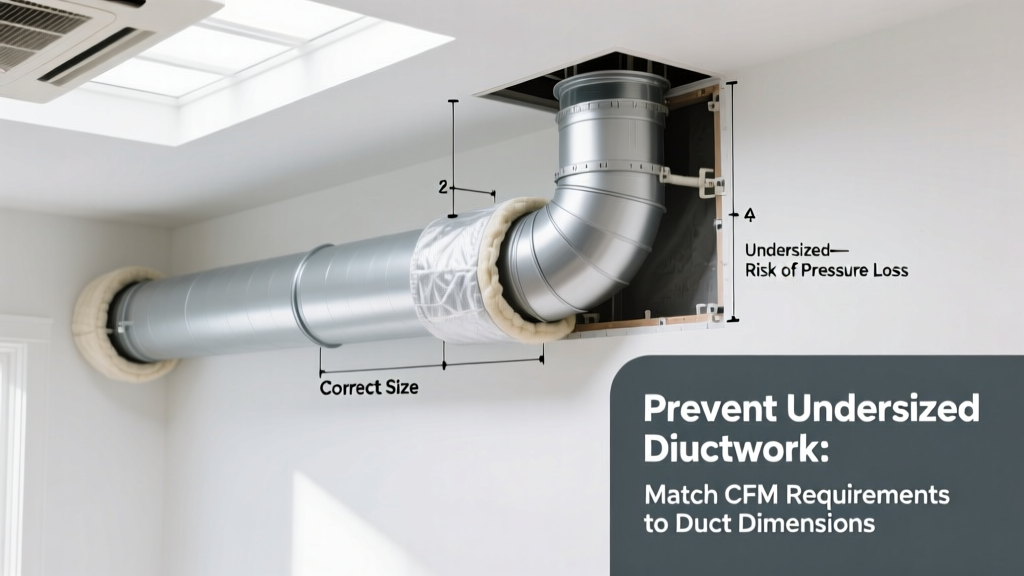
Undersized ductwork silently sabotages your HVAC system—cutting airflow by up to 40%, spiking energy use, and shortening equipment life. According to the U.S. Department of Energy’s 2022 Building Technologies Office report, nearly 30% of residential HVAC inefficiencies trace directly to improperly sized ducts—not the furnace or AC unit itself.
Why This Happens
Duct undersizing rarely occurs by accident—it’s usually the result of design shortcuts, unverified assumptions, or post-installation modifications. Contractors sometimes default to smaller ducts to save space or material costs, especially in tight attics or crawl spaces. Older homes retrofitted with modern high-capacity HVAC units often retain original ducts sized for far lower CFM requirements. And when homeowners add rooms or change layouts without updating duct sizing, static pressure climbs and airflow drops.
- Design based on square footage alone—not actual heat load calculations
- Use of generic duct charts instead of Manual D (ACCA) methodology
- Undersized return ducts (often overlooked, yet critical for balanced airflow)
- Excessive bends, kinks, or flex duct compression during installation
Maintenance Checklist
| Frequency | Task |
|---|---|
| Daily | Listen for unusual whistling or whooshing near vents or registers |
| Weekly | Check that all supply and return grilles are unobstructed and fully open |
| Monthly | Inspect visible duct runs for kinks, sagging, or disconnected sections |
| Yearly | Hire a certified HVAC technician to perform static pressure test and airflow verification (CFM per register) |
Warning Signs
If you notice two or more of these symptoms, duct undersizing is likely—and it’s accelerating wear on your blower motor and compressor:
- Some rooms stay consistently too hot or cold despite thermostat adjustments
- Registers blow weak or inconsistent air—even with clean filters
- Blower motor runs constantly or cycles rapidly
- Unusual noise from ducts: hissing, rattling, or vibrating metal panels
- Higher-than-expected summer cooling bills despite no thermostat changes
Recommended Products
While duct size itself can’t be changed without major renovation, these tools help detect, monitor, and mitigate undersizing effects before failure:
- Static pressure manometers (e.g., Testo 510i or Dwyer Magnehelic®)
- CFM flow hoods for register-level airflow measurement
- Smart thermostats with airflow diagnostics (e.g., Ecobee SmartThermostat with voice control & room sensors)
- Insulated rigid duct board (R-6 or higher) to offset poor sizing with better thermal performance
Can I fix undersized ducts myself?
No—duct resizing requires load calculations, engineering review, and often structural modifications. DIY attempts like adding booster fans or enlarging registers worsen imbalance and increase noise. As HVAC engineer Dr. Raj Patel notes in ASHRAE Journal (2021): “Forced airflow through undersized ducts raises static pressure beyond design limits—every 0.1” WC over spec increases blower energy use by 8% and cuts motor life by 25%.”
Does duct cleaning help with undersizing?
No. Cleaning removes debris but doesn’t increase cross-sectional area. In fact, aggressive cleaning can damage thin-gauge duct walls or loosen connections, worsening leakage and pressure loss. Focus instead on airflow verification—learn how to test for duct leakage first.
How do I know if my ducts were sized correctly?
A properly sized system meets three criteria: (1) total external static pressure ≤ 0.5” WC at full capacity, (2) airflow within ±10% of equipment-rated CFM per register, and (3) temperature drop across evaporator coil between 18–22°F. If any fail, revisit the original Manual D calculation—or request a copy from your contractor. If unavailable, schedule a Manual J load calculation before replacing equipment.
Will upgrading to a variable-speed blower fix undersized ducts?
It helps—but doesn’t solve the root issue. Variable-speed blowers maintain consistent airflow across varying resistance, reducing strain. However, they cannot overcome fundamental physics: insufficient duct area still creates excessive static pressure at high speeds. The U.S. EPA estimates that 14% of household water usage is from leaks—but for ducts, even 10% leakage compounds undersizing effects. So yes, pair it with a duct inspection—not as a substitute.
Are flexible ducts more prone to undersizing issues?
Yes—especially when improperly installed. Flex ducts must be fully extended and supported every 4 feet; a single 90° bend with 25% compression reduces effective area by 35%. According to ACCA’s Manual D, 4th Edition (2023), flex duct should never exceed 5 feet in length without transition to rigid duct—and never be used for main trunks.
"A duct system isn’t just tubing—it’s the circulatory system of your HVAC. Undersizing it is like asking your heart to pump blood through a garden hose." — Sarah Lin, Senior HVAC Designer, Building Science Corporation (2022)
Preventing duct undersizing starts long before installation—during design, load calculation, and specification. But once built, vigilance pays off: catching airflow issues early avoids $2,500+ in premature compressor replacements and keeps your home comfortable year-round. If your last HVAC upgrade skipped duct evaluation, download our free duct inspection checklist and start there.