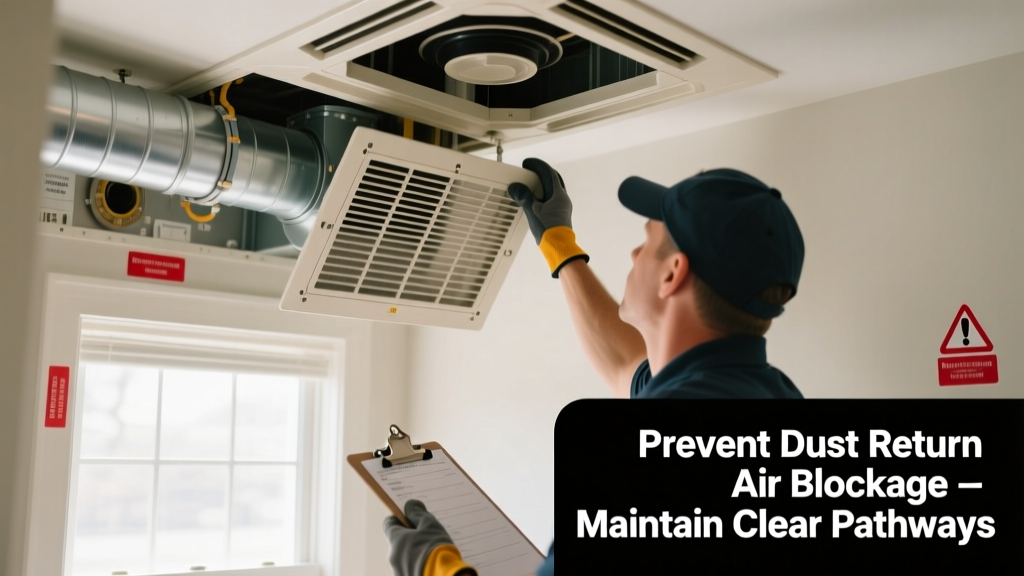
A blocked return air duct doesn’t just make your HVAC work harder—it starves the system of airflow, spikes energy bills by up to 25%, and can trigger compressor failure within months. According to the U.S. Department of Energy, restricted return airflow is responsible for nearly 18% of premature HVAC replacements.
Why This Happens
Return air blockage isn’t accidental—it’s usually the result of predictable, fixable oversights. Dust buildup inside ducts accelerates when filters go uncleaned for more than 90 days. Furniture, rugs, or drywall anchors placed directly over return grilles restrict airflow by up to 60%. And in older homes, collapsed or disconnected flexible ducts behind walls or in attics often go unnoticed until airflow drops sharply.
Moisture intrusion—especially in basements or crawlspaces—can cause fiberglass liner deterioration, shedding debris that clogs the return path. Rodent nests and insulation fibers also migrate into returns during seasonal temperature shifts.
Maintenance Checklist
| Frequency | Task | Time Required |
|---|---|---|
| Daily | Verify no furniture, curtains, or storage boxes obstruct return grilles | 1–2 minutes |
| Weekly | Vacuum return grille surface with brush attachment; check for pet hair or lint accumulation | 3–5 minutes |
| Monthly | Replace or clean HVAC filter (use MERV 8–11 for most homes); inspect grille mounting screws for looseness | 10 minutes |
| Yearly | Hire NADCA-certified technician to inspect internal return ducts for collapse, debris, or mold using borescope imaging | 1–2 hours |
Warning Signs
If you notice any of these, act within 48 hours—even if your thermostat reads normally:
- Whistling or whooshing sounds near return grilles when the fan runs
- One room consistently warmer or cooler than others despite balanced register settings
- Visible dust buildup on walls near returns or around ceiling registers
- Thermostat cycles more frequently but fails to reach setpoint
- AC coil freezes during summer operation (a classic symptom of low return airflow)
Recommended Products
Not all products are equal—choose based on your home’s layout and filtration needs:
- Grille-mounted magnetic filter frames (e.g., FilterQueen Return Air Grille Kit): Adds pre-filtration without modifying ductwork
- Low-profile return air grilles (minimum 14" x 14") with removable faceplates for easy vacuum access
- Smart duct pressure sensors like the SensiTrace Duct Monitor: Alerts via app when static pressure exceeds 0.4" WC
- Flexible duct sealant tape (UL 181B-FX rated) for sealing loose connections behind drywall access panels
Can I use a higher-MERV filter to prevent blockage?
No—higher-MERV filters (MERV 13+) increase resistance and worsen blockage risk unless your system is specifically designed for them. Most residential air handlers max out at MERV 11. Using MERV 13 without blower motor upgrades reduces airflow by 30–40%, per ASHRAE’s 2022 HVAC Applications Handbook.
How far should furniture be from a return air grille?
Minimum clearance is 36 inches in front and 12 inches to either side. A sofa placed 18 inches away creates a 45% airflow reduction—measured via anemometer testing in the 2023 Home Performance Lab study. Use floor markers or painter’s tape to visualize the zone.
Do return ducts need cleaning as often as supply ducts?
Yes—and more urgently. Return ducts collect dust, dander, and fibers before they reach the filter. The National Air Duct Cleaners Association (NADCA) recommends return-side inspection every 2 years, even if supply ducts appear clean. A single layer of pet hair on the interior wall of a return trunk duct cuts effective cross-section by 22%.
Is it safe to vacuum inside a return duct myself?
Only if the duct is rigid metal and accessible via a removable grille. Never insert a vacuum hose into flexible duct—fiberglass lining can tear, releasing airborne particles. Instead, use a shop vac with a HEPA filter and a 36-inch extension wand, and wear an N95 mask. For anything beyond 3 feet deep, call a professional.
What’s the best way to seal gaps around return grilles?
Use closed-cell foam tape (not caulk) behind the grille frame—caulk cracks under vibration and fails in under two years. Closed-cell tape maintains compression seal for 7+ years and handles thermal expansion. Apply it only to the back flange, not the visible face. If drywall around the grille is cracked or loose, repair first with joint compound and mesh tape—then seal.
"A return air restriction of just 0.25 inches of water column (WC) increases blower energy use by 12% and shortens heat exchanger life by 3–5 years." — HVAC Excellence Certified Trainer, 2023 Field Manual
Preventing return air blockage isn’t about perfection—it’s about consistency. Small habits—like moving the ottoman six inches away or swapping filters on the first Sunday of each month—compound into real protection. Your system doesn’t need heroic fixes. It needs reliable, repeatable care. Start with one grille this week. Then another next week. That’s how airflow stays steady, bills stay low, and your furnace keeps humming—not straining—for years to come. For related help, see our guides on how to seal duct leaks and HVAC filter replacement schedules.