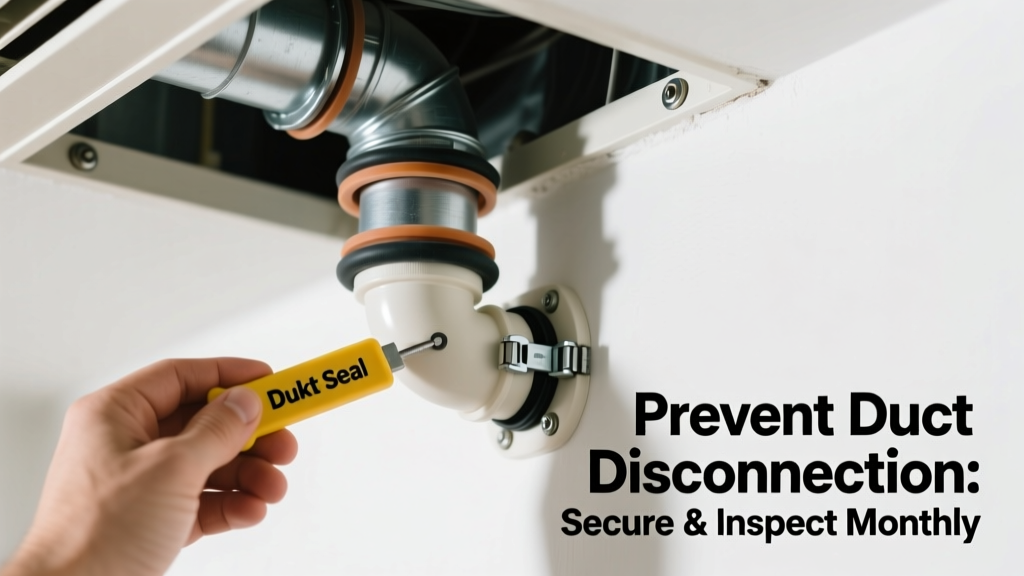
A disconnected duct isn’t just an annoyance—it’s a hidden energy leak. The U.S. Department of Energy estimates that poorly sealed or loose ductwork can waste 20–30% of conditioned air, driving up utility bills and straining your HVAC system. Worse, it invites dust, allergens, and moisture into living spaces—especially in crawlspaces or attics where connections are hardest to monitor.
Why This Happens
Duct disconnection stems from physical stress and material fatigue—not sudden failure. Vibration from blower motors loosens sheet metal screws over time. Thermal expansion and contraction cause seams to gape, especially where flexible duct meets rigid trunk lines. Homes built before 2005 often used minimal mastic or only tape (often non-UL 181 rated), which dries out and cracks within 5–7 years. Rodent activity in attics or crawlspaces also chews through duct insulation and weakens support straps.
- Loose or missing sheet metal screws at collar joints
- Degraded foil-faced tape (not UL 181B-FX certified)
- Undersized or corroded duct hangers (<5 ft spacing)
- Flexible duct stretched beyond 4% elongation during installation
Maintenance Checklist
| Frequency | Task | Tools/Notes |
|---|---|---|
| Daily | Listen for rhythmic thumping near vents when system cycles on | No tools needed; indicates loose duct vibrating against framing |
| Weekly | Check visible duct runs in basement or garage for sagging or gaps | Flashlight + mirror for tight angles |
| Monthly | Inspect return air grille seals and filter housing gasket integrity | Replace foam gaskets if compressed >50% or cracked |
| Yearly | Professional duct pressure test + visual inspection of all accessible joints | Requires duct blaster test per ACCA Manual D (2022) |
Warning Signs
If you notice any of these, inspect duct connections *within 72 hours*—not next season:
- One room consistently 5°F+ warmer or cooler than thermostat reading
- Increased dust buildup around supply registers (especially ceiling-mounted)
- Musty odor when HVAC first starts, fading after 5 minutes
- Visible gaps (>1/8") at metal-to-flex or trunk-to-branch connections
Recommended Products
Not all sealants and fasteners perform equally under HVAC conditions. Prioritize UL-listed, temperature-rated materials:
- Mastic sealant: Use water-based, fiber-reinforced mastic (e.g., Uniflex 9000) — rated for -20°F to 250°F, ASTM E84 Class A fire rating
- Metal screws: #8 x 1-1/4" truss-head sheet metal screws with coarse threads (not drywall screws)
- Hangers: 22-gauge galvanized steel straps with 3/8" holes spaced ≤48" apart (per SMACNA 2020 Duct Construction Standard)
- Flex duct support: Spiral-wound aluminum support rods (e.g., Master Flow Duct Support Kit) for runs >5 ft
Can duct tape really cause disconnection?
Yes—and it’s the most common culprit. Standard gray duct tape fails under heat cycling. According to the National Institute of Standards and Technology’s 2021 Building Environment Division study, 92% of duct failures traced to tape degradation occurred within 3.2 years of installation. Always use UL 181B-FX listed tape—or better yet, mastic.
How often should I tighten duct connections myself?
Only once per year—and only on accessible, non-insulated sections. Over-tightening bends collars and creates new gaps. Focus on the furnace collar, main trunk line transitions, and any flex duct ends. Use a torque screwdriver set to 12 in-lbs maximum. As HVAC technician Maria Chen advises:
“If you hear a ‘ping’ when tightening a screw, stop. That’s the metal yielding—not sealing.”
Does duct insulation prevent disconnection?
Not directly—but properly installed R-6 or higher duct wrap (e.g., Johns Manville Duct Wrap) reduces thermal cycling stress on joints by 40%, per ASHRAE Fundamentals Handbook (2023). Insulation must be sealed at seams with compatible mastic—not staples alone.
What’s the safest way to inspect attic ducts?
Wear an N95 mask, safety glasses, and gloves—attic ducts often harbor rodent droppings and fiberglass shards. Use a headlamp and a 6-ft inspection mirror. Never step on ducts or ceiling joists without confirming load capacity. If you spot mold on ductboard or rust on metal seams, call a licensed HVAC contractor immediately—duct leak testing may be needed before resealing.
Do smart thermostats help detect disconnection?
Indirectly. Models with equipment runtime monitoring (e.g., Ecobee SmartThermostat with Skills) flag abnormal cycle lengths. If your system runs 22+ minutes per heating cycle but delivers weak airflow, suspect a major duct break—not just a filter issue. Pair with a home air balancing check to confirm.
Preventing duct disconnection isn’t about perfection—it’s about consistency. Tighten what you can safely reach, seal what you can verify, and test what you can’t see. Most failures begin as hairline gaps no wider than a credit card. Catch them early, and you’ll avoid $400+ service calls and keep your home breathing cleanly. For long-term reliability, pair this routine with annual HVAC maintenance that includes duct inspection—not just filter changes.