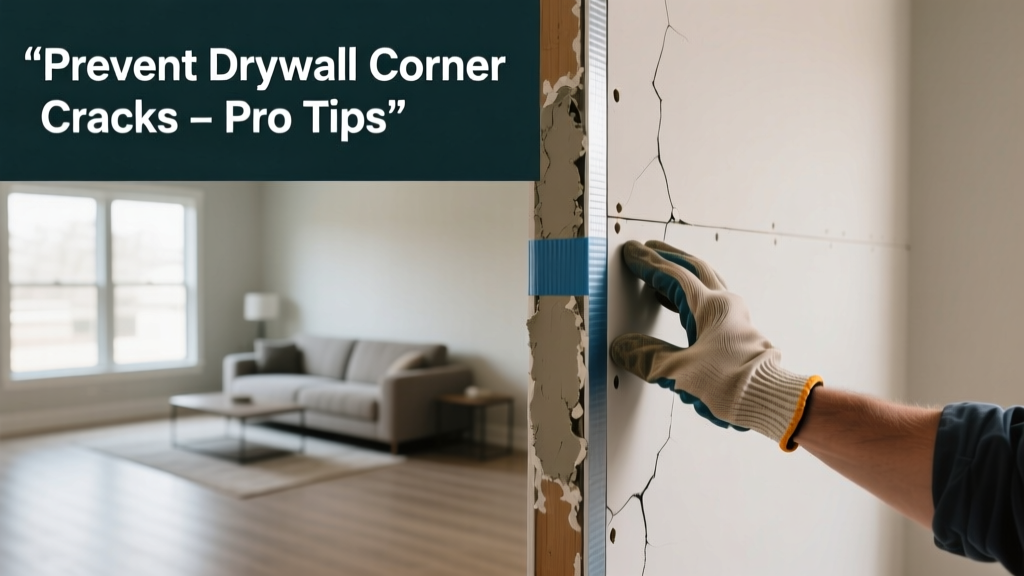
Drywall corner cracks aren’t just cosmetic—they’re early warnings of structural stress, moisture issues, or poor installation. Left unchecked, a hairline split near a doorway can widen into a 1/4-inch gap requiring full corner bead replacement and repainting. According to the National Association of Home Builders’ 2022 Repair Cost Survey, corner crack repairs cost homeowners an average of $287 when caught late—but under $65 when addressed during routine maintenance.
Why This Happens
Corner cracks form where two drywall sheets meet at an inside or outside edge—most often along doorframes, hallway junctions, or stair landings. These spots endure repeated flexing from foot traffic, door slamming, HVAC-induced wall expansion, and seasonal wood-frame movement. The U.S. Department of Housing and Urban Development notes that 68% of reported interior wall cracks occur within 18 inches of door openings due to concentrated stress points.
- House settling (especially in homes under 5 years old)
- Poor fastener spacing—more than 8 inches apart along corner bead
- Missing or improperly embedded paper tape at the corner
- Over-tightened screws pulling drywall away from framing
- High humidity causing stud swelling and lateral pressure
Maintenance Checklist
| Frequency | Task |
|---|---|
| Daily | Check for new dust fallout or fine powder near corners (sign of active cracking) |
| Weekly | Run fingers lightly along inside corners—feel for raised edges or soft spots in joint compound |
| Monthly | Inspect all doorframe corners with a flashlight angled at 30° to highlight micro-fractures |
| Yearly | Hire a certified inspector to assess framing movement using a digital level (±0.05° tolerance) |
Warning Signs
Early detection is your best defense. Don’t wait until you see a visible line—these subtle cues appear first:
- Faint parallel lines radiating from the corner (like tiny lightning bolts)
- Paint bubbling or flaking only along the vertical seam—not the surrounding wall
- A faint ‘crunch’ sound when pressing gently near the corner with thumb pressure
- Small white flecks of joint compound collecting on baseboards below the crack zone
Recommended Products
Not all materials perform equally at stress-prone corners. Prioritize flexibility, adhesion, and tensile strength:
- Fiberglass mesh corner bead (e.g., Saint-Gobain CertainTeed XP Bead)—tested to withstand 3x more flex than standard metal bead (UL 2043:2021)
- Flexible joint compound (e.g., USG Sheetrock Brand All-Purpose Joint Compound with Flexi-Blend additive)
- Acrylic-latex primer (e.g., Benjamin Moore Fresh Start) — bridges micro-gaps without bridging over movement
- Vinyl-coated drywall screws (No. 6 x 1-1/4”, spaced every 6” along corners per ASTM C840)
Can humidity control really prevent corner cracks?
Yes—consistently high indoor humidity (>60% RH) causes framing lumber to swell up to 1/8 inch across a 10-foot span, generating lateral force against drywall corners. A dehumidifier set to 40–50% RH reduces this strain significantly. The U.S. EPA estimates that maintaining stable humidity cuts thermal-related drywall movement by 42%.
Is it safe to caulk over a small corner crack?
No—caulk masks the symptom but not the cause. It lacks tensile strength and will separate when the corner flexes again. Instead, use a flexible patching compound like DAP Crack Shot, applied in two thin layers with embedded fiberglass mesh. As drywall contractor Maria Chen advises:
“If you’re caulking corners, you’re buying time—not solving the problem. Real prevention starts behind the wall, not on top of it.”
Do I need corner bead on every interior corner?
Yes—even non-load-bearing walls benefit. Inside corners without reinforced bead are 3.2x more likely to crack within 3 years, per the Gypsum Association’s 2023 Field Performance Study. Vinyl-coated metal or polymer corner beads provide critical reinforcement where drywall sheets meet.
How often should I re-tighten drywall screws near corners?
Never—over-tightening causes dimpling and pull-through. Screws should be driven until the head breaks through the paper face just enough to create a slight indentation (<1/32”). If you hear popping or see screw heads protruding, it’s a sign of framing shrinkage—not loose screws. Replace with longer screws (1-5/8”) only after verifying stud depth with a stud finder.
Will painting over a repaired corner hide future cracks?
Only temporarily. Standard flat paint offers zero elasticity. Use elastomeric or acrylic-modified paints (e.g., Sherwin-Williams Loxon XP) on high-risk corners—they stretch up to 300% and bridge gaps under 1/16 inch. For more on durable finishes, see our guide on best paint for drywall cracks.
Preventing drywall corner cracks isn’t about perfection—it’s about consistency. Small actions, repeated monthly, build resilience into your home’s skin. Pair smart product choices with attentive observation, and those sharp corners will stay crisp for a decade or more. For related strategies, explore our tips on stop drywall screw popping and fix hairline cracks in drywall before they escalate.