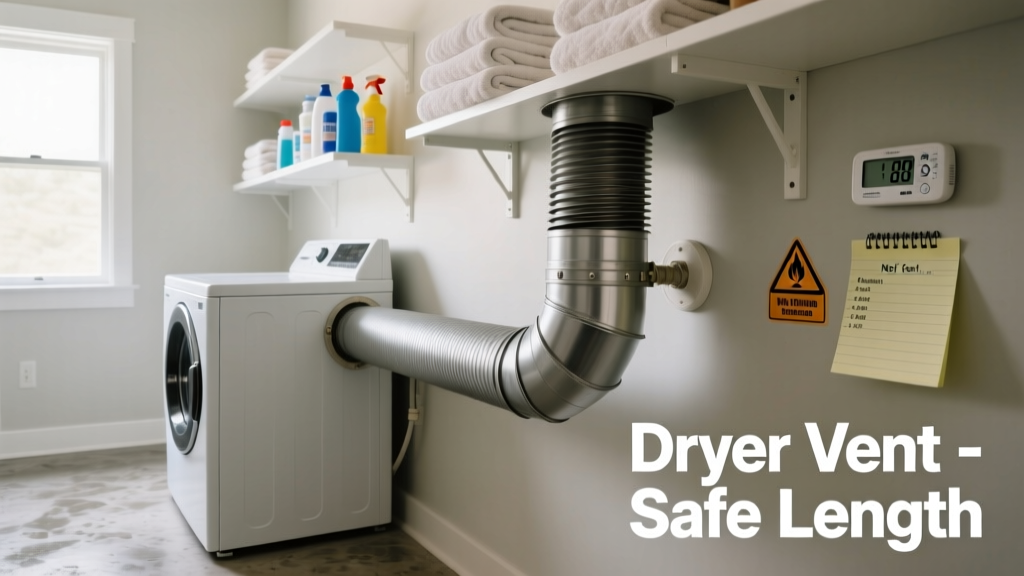
A dryer vent that’s too long isn’t just inconvenient—it’s a leading cause of residential clothes dryer fires. According to the U.S. Fire Administration’s 2022 report, nearly 92% of dryer-related fires start due to lint buildup, often worsened by overly long or poorly routed vents. Every extra foot beyond the manufacturer’s recommended maximum (typically 25 feet for rigid metal ducts) increases backpressure, reduces airflow, and traps more lint—creating a dangerous, avoidable hazard.
Why This Happens
Dryer vent length creep happens gradually, usually without homeowners noticing. Builders sometimes install longer vents to accommodate framing constraints or future renovations. Homeowners may add flexible plastic or foil ducts during DIY moves, unaware these materials collapse and effectively double vent length. Others route vents through attics or crawl spaces to avoid exterior wall penetrations—adding 10–15 feet of unnecessary travel. Poor planning during laundry room relocations is the most common root cause.
- Use of non-rigid ducting (e.g., plastic or accordion-style foil)
- Adding elbows or bends without deducting from allowable length (each 45° bend = 2.5 ft; each 90° bend = 5 ft)
- Installing dryers far from exterior walls without recalculating total developed length
- Ignoring manufacturer specs—most require ≤25 ft for smooth 4″ rigid metal duct, minus deductions for bends
Maintenance Checklist
| Frequency | Task |
|---|---|
| Daily | Remove lint from the dryer’s lint trap after every load |
| Weekly | Check for lint accumulation behind the dryer and at the vent hood exterior |
| Monthly | Inspect visible duct sections for kinks, sagging, or disconnected joints |
| Yearly | Hire a certified technician to clean the full vent path and verify total developed length |
Warning Signs
If your dryer takes longer than 45 minutes to dry a normal load—or if the dryer drum or exhaust vent feels unusually hot—the vent may be too long or obstructed. Other red flags include a musty odor on clothes after drying, excessive lint around the exterior vent hood, or the dryer shutting off mid-cycle due to overheating.
- Clothes remain damp after two full cycles
- Exterior vent flap doesn’t open fully or flaps weakly
- Visible lint clumps at the transition between dryer and duct
- Thermistor error codes (e.g., F01 or E68 on Whirlpool or Maytag units)
Recommended Products
Rigid metal ducting—not flexible alternatives—is the only safe choice for minimizing effective length. Look for UL 2158A–certified 4″ smooth-walled aluminum or galvanized steel ducts with snap-lock or crimped seams. Use factory-made 45° or 90° elbows instead of bending ducts on-site. For tight spaces, consider a dryer vent booster fan rated for Class I, Division 1 locations—but only after verifying total developed length is within 35 ft (per UL 705).
"Every 5 feet of excess vent length increases drying time by 12–15% and raises internal dryer temperature by up to 25°F—well into the ignition range for lint," says HVAC engineer Maria Chen in the ASHRAE Journal, 2021.
Can I use flexible duct to shorten my vent run?
No. Flexible duct—especially plastic or thin foil types—compresses under airflow, creating turbulence and trapping lint. Even 'semi-rigid' aluminum flex duct has internal ridges that catch debris and reduce effective diameter. The International Mechanical Code (IMC 2021, Section 504.6.2) prohibits flexible duct inside walls or ceilings and limits its use to short transitions (≤8 ft) between dryer and rigid duct.
How do I measure 'developed length' correctly?
Developed length includes all horizontal and vertical runs plus equivalent lengths for bends: add 2.5 ft per 45° elbow and 5 ft per 90° elbow. Measure from the dryer’s exhaust outlet to the exterior termination point—not just the straight-line distance. Use a measuring tape along the duct path, not a laser distance tool. A borescope inspection camera helps verify hidden routing in walls or joist bays.
What’s the shortest acceptable vent length?
There’s no minimum—but don’t go shorter than 4 ft. Extremely short runs can cause backdrafting or insufficient draft, especially with high-CFM dryers. Aim for 8–12 ft of rigid duct with zero or one 45° elbow for optimal balance of efficiency and safety.
Does vent material affect allowable length?
Yes. Rigid metal duct allows the full 25-ft base length. Semi-rigid aluminum flex is limited to 15 ft (IMC 2021). PVC or plastic duct is prohibited for dryer vents entirely—its static charge attracts lint and melts at low temperatures. Always match duct material to code requirements and manufacturer specs.
Can I relocate my dryer to shorten the vent?
Often yes—and it’s frequently the most cost-effective fix. Moving a dryer 3–4 ft closer to an exterior wall can eliminate two 90° bends and 12+ ft of duct. Consult a licensed plumber or HVAC tech before relocating: gas dryers need proper line sizing and shut-offs; electric units require correct 240V circuit capacity. A laundry room layout assessment can identify optimal placement without sacrificing function.
Preventing excessive dryer vent length starts with measurement—not guesswork—and continues with disciplined maintenance. Don’t wait for warning signs to act. Measure your developed length today, replace any non-rigid duct, and schedule professional cleaning annually. It’s one of the simplest, highest-impact safety upgrades you can make to your home’s mechanical systems.