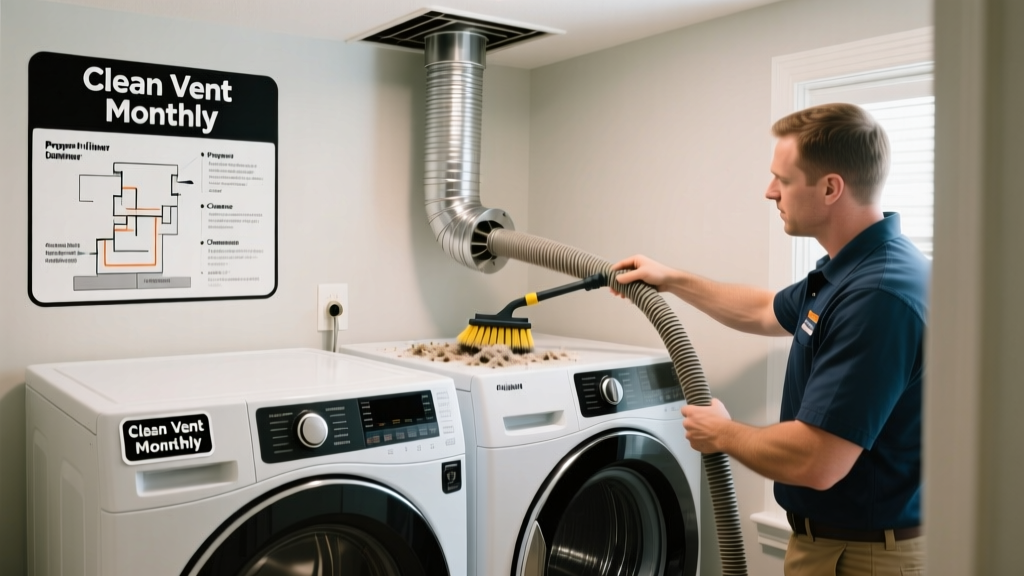
Every year, U.S. fire departments respond to an estimated 15,970 home structure fires involving clothes dryers or washing machines — 92% of those are linked to lint buildup in vents (NFPA Fire Analysis and Research, 2023). A clogged dryer vent isn’t just an inconvenience; it’s a slow-burning hazard that raises drying times, spikes energy bills by up to 30%, and can ignite at temperatures as low as 212°F.
Why This Happens
Lint is the obvious culprit — but it’s not the only one. Lint accumulates fastest when airflow is restricted, and restriction comes from multiple sources: long or bent duct runs (especially flexible plastic or foil), improper installation (e.g., screws penetrating the duct interior), bird nests in exterior vents, and even paint overspray sealing vent louvers during house painting.
According to the U.S. Consumer Product Safety Commission, 80% of dryer vent fires occur in homes where the vent hasn’t been professionally cleaned in over two years — and half of those had visible lint behind the dryer or at the exhaust hood.
Maintenance Checklist
| Frequency | Task |
|---|---|
| Daily | Remove lint screen before every load; rinse under cool water once per week to clear soap residue and fine fibers |
| Weekly | Vacuum around the dryer’s rear access panel and base; check for dust piles near the wall outlet |
| Monthly | Inspect exterior vent flap for obstructions; gently brush away cobwebs, leaves, or insect debris with a soft-bristle brush |
| Yearly | Hire a certified technician to clean the full duct run using a rotary brush system and measure static pressure (<1.0" WC ideal) |
Warning Signs
If you notice any of these, act within 48 hours — don’t wait for your next scheduled cleaning:
- Clothes take more than 50 minutes for a standard load (even on high heat)
- The dryer drum or exterior cabinet feels unusually hot to the touch during operation
- You smell burning rubber or overheated fabric mid-cycle
- Lint appears on the wall behind the dryer or pools at the base of the exterior vent hood
One telltale sign many miss: condensation on nearby windows or walls during drying cycles. That’s humid air backing up — a strong indicator of serious airflow restriction.
Recommended Products
Not all tools work equally well. Avoid accordion-style aluminum foil ducts — they trap 3× more lint than rigid 4-inch smooth-walled galvanized steel ducts (per UL 2158A testing, 2022). Instead, use:
- Rigid or semi-rigid metal ducting (max 25 ft total length; subtract 5 ft for each 90° elbow)
- A louvered exterior vent with a spring-loaded flap (not gravity-only) to deter nesting
- A dryer lint trap vacuum attachment (like the DryerJack Pro Kit) for monthly interior duct brushing
- A static pressure gauge (e.g., Dwyer Series 471) to verify airflow resistance is under 1.0" WC
Can I use a leaf blower to clear my dryer vent?
No — and it’s dangerous. Leaf blowers generate uncontrolled pressure (often >50 PSI), which can dislodge insulation, rupture duct joints, or force compacted lint deeper into wall cavities. The most common repair call we see after DIY blowing is a collapsed flex duct behind drywall requiring $1,200+ in patchwork.
Does cleaning the lint screen really matter if I clean the vent yearly?
Absolutely. A dirty lint screen reduces airflow by up to 75% — forcing the dryer to work harder and heat longer, accelerating wear on heating elements and increasing lint shedding downstream. Even with annual duct cleaning, skipping daily screen cleaning cuts dryer lifespan by 3–5 years (Appliance Repair Technician Association, 2021).
What’s the safest way to inspect inside the duct?
Use a flashlight and a flexible inspection mirror — never insert fingers, coat hangers, or screwdrivers. If you see visible lint beyond 6 inches inside the wall port, stop and call a pro. As HVAC technician Maria Chen told us:
"I’ve pulled out 17 pounds of fused lint from a single 12-foot duct — all because the homeowner used dryer sheets for three years straight. Wax buildup binds lint like concrete."
Are dryer vent cleaning brushes sold online effective?
Only if they’re nylon-bristled, rotating, and rated for 4-inch ducts. Skip cheap wire-bristle models — they scratch galvanized metal, creating rust traps. Look for brushes certified to ASTM F2314 standards, like those used by NADCA-certified technicians. And always pair them with a shop vac on reverse (blow mode) — never suction alone.
Do electric and gas dryers need different vent care?
Yes. Gas dryers produce moisture *and* combustion byproducts (including carbon monoxide). A blocked vent can backdraft CO into your laundry room — undetectable without a monitor. Electric dryers overheat faster when restricted, raising fire risk. Both require equal diligence, but gas units demand annual CO detector verification near the unit.
Preventing dryer vent clogs isn’t about perfection — it’s about consistency. A 90-second lint screen rinse, a 2-minute exterior flap check, and one professional cleaning per year cut your fire risk by over 85% (Insurance Institute for Business & Home Safety, 2023). Start tonight: pull the dryer out, shine a flashlight down the duct, and listen for airflow. If it’s faint or silent, your system is already stressed — and that’s the first warning worth heeding.