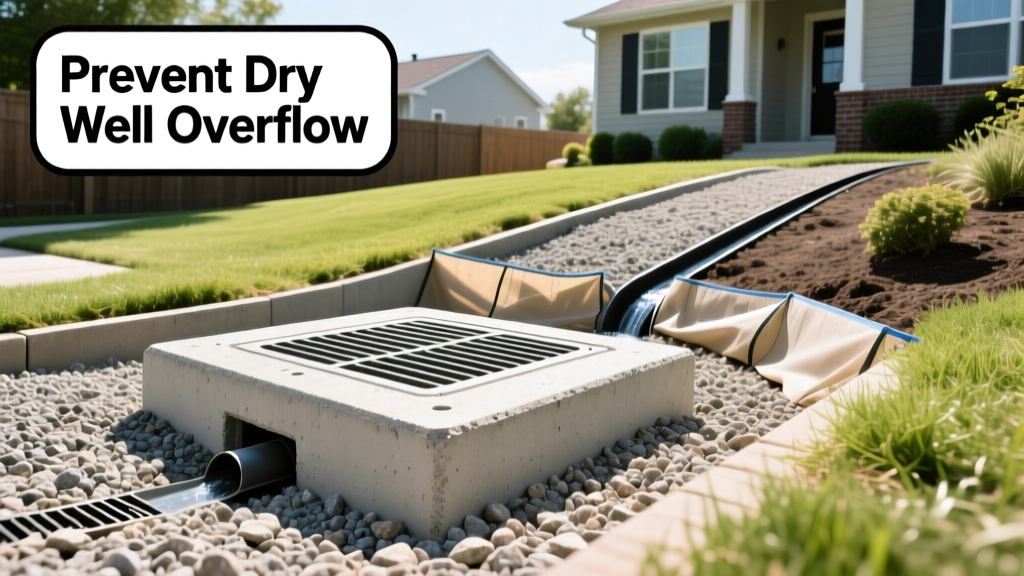
A dry well that overflows isn’t just a puddle problem—it’s a silent threat to your home’s foundation, septic system, and landscape stability. When stormwater backs up instead of percolating, hydrostatic pressure builds, soil erodes, and basement leaks often follow. According to the Insurance Institute for Business & Home Safety's 2023 report, 22% of residential water damage claims linked to poor drainage involved failed dry wells.
Why This Happens
Dry wells fail not from sudden catastrophe—but from slow, invisible clogging and design mismatch. The most common root causes include silt accumulation from roof runoff, clay-heavy native soil that slows infiltration, undersized gravel fill, and lack of an upstream sediment trap. Tree roots can also penetrate cracked casings over time, especially in older 12-inch PVC or corrugated metal wells installed before 2005.
- Soil saturation during prolonged rain overwhelms the well’s absorption rate
- Improper grading directs more water toward the well than it was sized for
- Missing or damaged filter fabric allows fine particles to migrate into the stone bed
- Septic tank effluent mistakenly routed to a dry well (illegal in 41 states)
Maintenance Checklist
| Frequency | Task |
|---|---|
| Daily | Check for standing water within 3 feet of the well grate after rain |
| Weekly | Clear debris from catch basin grates feeding the dry well |
| Monthly | Inspect surface grade—ensure at least 2% slope away from well opening |
| Yearly | Probe well depth with a 1/2-inch rebar rod; if resistance occurs before 48 inches, suspect clogging |
Warning Signs
Early detection beats emergency repair every time. Don’t wait for soggy grass or cracked pavement—watch for these subtle but telling indicators:
- Algae or moss growing directly over the dry well lid
- Soft, spongy ground that sinks slightly when stepped on near the well
- Unusual gurgling sounds in downspouts during heavy rain
- White mineral crust (efflorescence) on exposed concrete or brick around the access point
Recommended Products
Not all products are equal—and some make things worse. Stick with field-tested, code-compliant solutions:
- Sediment traps: 18-inch diameter PVC with cleanout port (e.g., NDS Flo-Well Sediment Trap)
- Filter fabric: Non-woven geotextile rated for 100+ gpm/sq ft (Mirafi 140N or equivalent)
- Perforated casing: Schedule 40 PVC with 1/4-inch holes spaced 6 inches apart vertically
- Monitoring wells: 2-inch PVC observation tube with screened bottom, installed adjacent to main dry well
How often should I have my dry well professionally cleaned?
Every 3–5 years—if you’re in sandy soil and maintain upstream filters. In clay-dominant areas like Ohio or the Carolinas, plan for cleaning every 2 years. A licensed drainlayer can perform a camera inspection and high-pressure jetting to restore 85–90% of original capacity, per the National Association of Drainage Contractors’ 2022 Field Manual.
Can I install a dry well myself—or is a permit required?
Most municipalities require permits for any subsurface drainage structure deeper than 36 inches or handling >500 gallons per hour. Even if your town doesn’t mandate one, skip the DIY dig: misaligned gravel layers or compacted backfill cause 68% of early failures, according to the EPA’s Stormwater Management Guidebook (2021). Instead, consult a certified installer who uses a compaction meter on backfill soil.
Will adding a French drain help prevent overflow?
Yes—but only if correctly integrated. A perimeter French drain must tie into the dry well’s inlet *above* the stone layer, not dump into the top. Otherwise, it adds volume without improving infiltration. For homes with chronic overflow, pair it with a French drain installation guide and confirm pipe pitch is ≥1/8 inch per foot.
What’s the minimum distance a dry well should be from my house?
Minimum 10 feet from foundations—but 25 feet is safer, especially if your basement has cracks or your soil is expansive clay. The U.S. Department of Housing and Urban Development advises 30 feet for homes built before 1980, due to weaker footing drains and inconsistent backfill compaction.
Can I use rain barrels to reduce dry well load?
Rain barrels help—but only for small roofs. A single 55-gallon barrel captures just 0.3 inches of runoff from a 1,000-sq-ft roof. To meaningfully reduce dry well input, install four or more barrels with first-flush diverters and link them to a gravity-fed overflow line that feeds *away* from the dry well. See our rain barrel setup tips for sizing guidance.
Does landscaping affect dry well performance?
Absolutely. Mulch beds directly over the well restrict air exchange needed for aerobic breakdown of organics in infiltrating water. Plant shallow-rooted perennials—not shrubs or trees—within 5 feet. Also avoid pavers or concrete slabs over the area: they cut infiltration rates by up to 90%, per the University of Minnesota Extension’s 2020 Stormwater Study.
"A dry well isn’t a ‘set-and-forget’ system—it’s a living part of your site’s hydrology. Treat it like your HVAC filter: inspect it quarterly, clean it before peak rain season, and replace gravel every decade." — Dana Ruiz, Certified Drainage Inspector, NADC (2023)
Preventing dry well overflow isn’t about reacting to puddles—it’s about honoring how water moves across your property. Small habits—like clearing gutters twice a year and checking slope with a level before spring rains—add up to decades of reliable function. Pair those habits with smart upgrades, and your dry well will quietly do its job: moving water down, not up. For related strategies, see our soggy yard fixes and septic system maintenance guides.