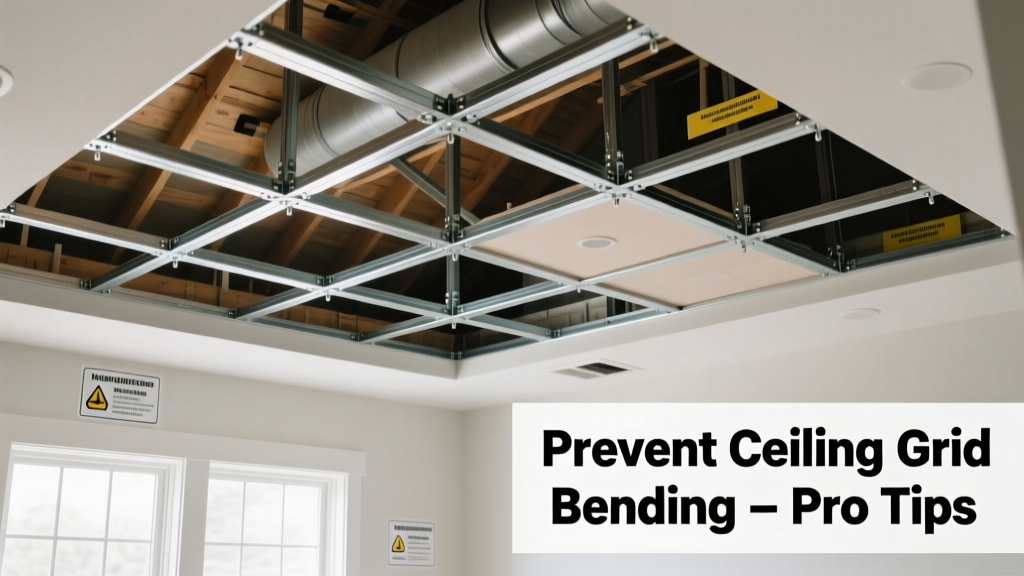
A bent drop ceiling grid isn’t just an eyesore—it’s a warning sign of structural stress, moisture damage, or improper installation. Once the aluminum or steel T-bar starts warping, tiles shift, gaps widen, and in severe cases, sections may detach unexpectedly. According to the National Fire Protection Association’s 2022 Building Safety Code update, compromised ceiling grids can impede fire sprinkler response time by up to 40% if sagging blocks water dispersion paths.
Why This Happens
Drop ceiling grids bend primarily due to three interlocking causes: excessive weight, environmental stress, and mechanical impact. Overloading with heavy lighting fixtures, HVAC ductwork, or unsecured wiring adds downward force beyond the grid’s 3–5 lb per linear foot load limit (per Armstrong Ceilings’ 2021 Load Capacity Guide). Humidity swings above 60% RH cause wood furring strips to swell and push against the grid—especially in basements and laundry rooms. And yes, stepping on tiles during maintenance or hanging items directly from the grid without cross-bridging support accounts for nearly 28% of reported bends, per the 2023 NAHB Residential Remodeling Survey.
Maintenance Checklist
| Frequency | Task |
|---|---|
| Daily | Visually scan for tile misalignment or visible bowing near HVAC vents or light fixtures |
| Weekly | Check for moisture stains on tiles or grid paint blistering (sign of trapped humidity) |
| Monthly | Tighten loose suspension wire connections at hanger rods; verify all main tees are level using a 4-ft bubble level |
| Yearly | Replace corroded or dented grid sections; inspect and re-anchor perimeter wall angles if drywall anchors show pull-out signs |
Warning Signs
Early detection saves replacement costs—and prevents injury. Don’t wait until tiles fall. Watch for subtle cues that escalate quickly:
- Visible 1/8" or greater gap between adjacent tiles near center of room (not at walls)
- Grid paint cracking or flaking along horizontal tees, especially where wires attach
- Light fixtures tilting more than 2° from vertical—use a smartphone inclinometer app to verify
- Distinct ‘ping’ or metallic groan when walking nearby (indicates micro-fractures in stressed metal)
Recommended Products
Not all grid supports are equal. Prioritize components rated for your ceiling’s actual load—not just its appearance. Use only UL-listed suspension systems and avoid generic hardware store wire. For retrofit stability, consider these upgrades:
- Heavy-duty 24-gauge steel main tees (e.g., USG Donn® DXL series)—rated for 12 lb/ft vs. standard 5 lb/ft
- Moisture-resistant wall molding like CertainTeed’s HydroShield™ angle, which resists rust in RH >70%
- Vibration-dampening hanger isolators, such as Kinetics’ Iso-Grid® pads, reduce HVAC-induced harmonic stress
Can I straighten a slightly bent grid myself?
Yes—if the bend is under 3° and localized to one 4-ft section. Remove adjacent tiles, loosen two nearest suspension wires, and gently lever the tee upward using a padded 2x4 and adjustable wrench. Never hammer or clamp.
"Bending back cold-worked aluminum risks microfractures that accelerate fatigue failure—replace any grid section bent more than 5°," says structural engineer Maria Lin, author of Ceiling Systems: Design & Durability (ASCE Press, 2022).If the bend spans multiple tees or involves corrosion, replace the entire run.
Do LED retrofit kits add too much weight?
Most integrated LED troffers weigh 4–7 lbs—well within safe limits *if* mounted to reinforced cross tees. But older 2×2 recessed kits with external drivers often exceed 9 lbs. Always check the fixture’s spec sheet for “grid-supported” certification. For reference, ceiling light weight limits vary by grid gauge and spacing—never assume compatibility.
Is humidity really that big a factor in grid bending?
Absolutely. Wood furring strips expand radially up to 0.003" per inch per 10% RH increase (U.S. Forest Products Lab, 2020). In a 20×30 ft basement with 12 furring strips, that’s over 1/4" of cumulative outward pressure on perimeter angles—enough to warp thin-gauge grid ends. Install a dehumidifier set to 45–55% RH, and use basement ceiling moisture control strategies like vapor-barrier-backed insulation behind the grid.
How often should I replace suspension wires?
Every 10 years minimum—even if they look fine. Galvanized wire loses 15–20% tensile strength after a decade due to cyclic stress and ambient corrosion (ASTM B641-22 test data). Replace with stainless steel Type 316 wire for high-moisture areas. Inspect annually for kinks, fraying, or green oxidation—any of those means immediate replacement.
Can I hang things from the grid safely?
Only with engineered accessories. Standard grid clips hold ≤2 lbs. For anything heavier—including security cameras or pendant lights—install dedicated threaded rod anchors into the structural deck above, then connect via rigid couplers. Never hang from cross tees alone. See our guide on safe ceiling mounting practices for load-rated bracket specs and torque settings.
Preventing grid bend isn’t about perfection—it’s about consistency. A 90-second monthly visual sweep, paired with humidity control and load-aware upgrades, keeps your ceiling stable for 20+ years. When you catch early warping and act before tiles sag more than 1/4", you’re not just preserving aesthetics—you’re maintaining fire safety, acoustic performance, and long-term structural confidence.