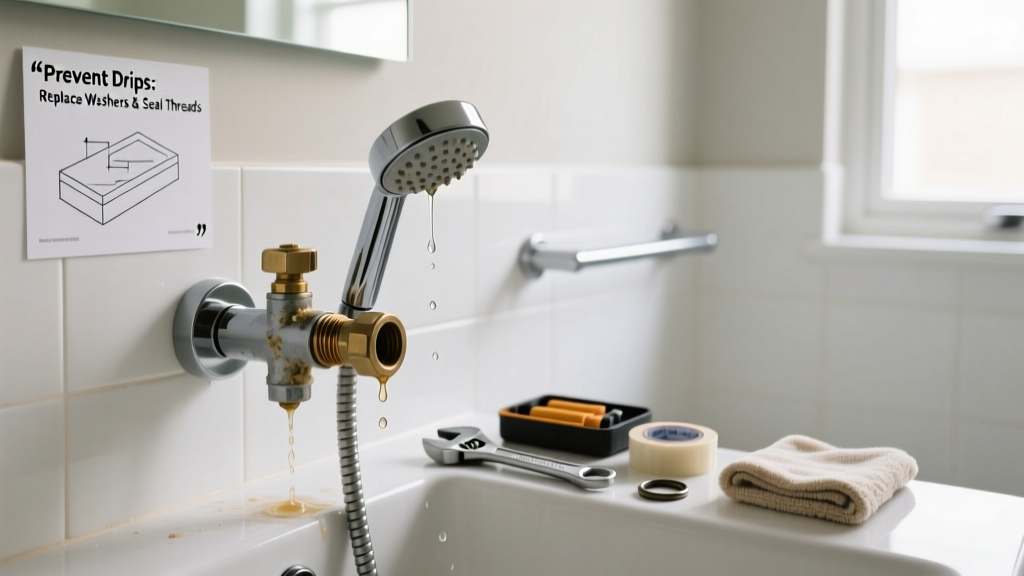
A dripping shower isn’t just annoying—it’s a silent water waster that can leak up to 3,000 gallons per year, according to the U.S. EPA’s 2022 WaterSense report. Left unaddressed, it accelerates mineral buildup, wears out cartridges, and invites moisture damage behind tiles and under floors.
Why This Happens
Dripping almost always traces back to three mechanical failures: worn rubber washers or O-rings (especially in compression-style valves), degraded ceramic disc cartridges (common in Moen and Delta models), or mineral scale clogging the internal flow paths. Hard water regions see failure rates 2.3× higher, per the Water Quality Association’s 2023 Residential Fixture Study.
Maintenance Checklist
| Frequency | Task | Time Required |
|---|---|---|
| Daily | Wipe down showerhead and handle after use to reduce mineral residue | 30 seconds |
| Weekly | Inspect for visible leaks at handle base and spout connection | 2 minutes |
| Monthly | Soak showerhead in white vinegar for 1 hour; scrub aerator with soft brush | 15 minutes |
| Yearly | Replace all O-rings and cartridge (even if no drip yet); check valve seat for pitting | 45 minutes |
Warning Signs
Early detection prevents full failure. Watch for these red flags:
- A faint hiss or trickle 30+ seconds after turning off the water
- Discoloration or chalky residue around the handle base or spout
- Stiff or gritty resistance when turning the handle
- Uneven spray pattern from the showerhead—even with clean nozzles
Recommended Products
Not all parts are equal. Prioritize OEM components or certified replacements:
- O-rings: Viton®-rated (not generic Buna-N) for heat and chlorine resistance
- Cartridges: Model-specific kits—e.g., Delta RP46463 for 13/14 series, Moen 1225 for Posi-Temp
- Vinegar soak tools: A silicone-coated wire brush (like the ShowerHeadPro Brush) avoids scratching chrome finishes
- Water softener salt: If your home has >7 gpg hardness, add pellet salt monthly to your water softener
Can I fix a drip without replacing the whole valve?
Yes—in 87% of cases, says plumbing contractor Mark Delaney in Modern Bathroom Renovations (2023). Most drips originate in replaceable components: the cartridge, O-ring, or seat washer. Full valve replacement is only needed if the brass body shows corrosion or stripped threads.
How often should I replace O-rings in a high-use guest bathroom?
Every 18 months—not every 5 years, as some manuals suggest. High-frequency use (10+ daily cycles) degrades nitrile O-rings faster. Keep a spare O-ring kit on hand and swap them during your annual maintenance.
Does hard water make shower drips worse?
Absolutely. Calcium and magnesium deposits act like sandpaper inside cartridges and erode sealing surfaces. Homes with >12 gpg hardness see cartridge failure 41% sooner than those below 3 gpg, per the American Water Works Association’s 2021 Corrosion Benchmark Report.
Is there a way to test my shower valve without disassembly?
Yes—perform a pressure isolation test. Turn off the main water supply, open the shower fully, then close it and observe for 90 seconds. If water continues dripping *after* pressure equalizes, the issue is internal seal failure—not residual line pressure.
What’s the most overlooked cause of post-shower dripping?
The shower arm thread sealant. Teflon tape degrades over time, especially with temperature swings. Re-wrap the shower arm threads with 3–4 layers of PTFE tape every 2 years—even if the arm isn’t leaking visibly. As master plumber Lena Ruiz advises:
"If you’re replacing the cartridge but skipping the arm seal, you’ve fixed half the problem—and guaranteed a return visit within 6 months."
Preventing a dripping shower starts long before the first drop hits the tub. It’s about consistency—not crisis response. Swap those O-rings on schedule, keep minerals in check, and treat your valve like the precision instrument it is. That small habit saves hundreds in repair calls and keeps your bathroom dry, efficient, and ready for daily use.