When your downspout stops draining, rainwater doesn’t just pool—it surges toward your foundation, saturates soil, and can seep into basements or erode landscaping. According to the Insurance Institute for Business & Home Safety's 2023 report, 68% of foundation water intrusion cases begin with improper gutter or downspout function.
Why This Happens
Downspouts fail to drain not because of sudden failure—but due to predictable, preventable buildup and misalignment. Leaves, pine needles, roof grit, and nesting debris accumulate over time. Ice dams in colder zones compress sediment into concrete-like plugs. Poor pitch (less than 1/4 inch per foot) prevents gravity-driven flow. And disconnected or corroded joints—especially at elbows or transitions to underground pipes—create silent leak points that mimic full blockages.
- Tree overhangs within 5 feet of roofline increase leaf load by 300%, per University of Minnesota Extension’s 2022 stormwater study
- Galvanized steel downspouts corrode fastest where moisture pools—typically at bottom 18 inches near grade
- Flexible corrugated drain pipes collapse under soil pressure if unsupported, reducing flow capacity by up to 70%
Maintenance Checklist
| Frequency | Task | Time Required |
|---|---|---|
| Daily | Visually scan for overflow during light rain | 2 minutes |
| Weekly | Clear debris from top of downspout opening (use gloved fingers or soft brush) | 5 minutes |
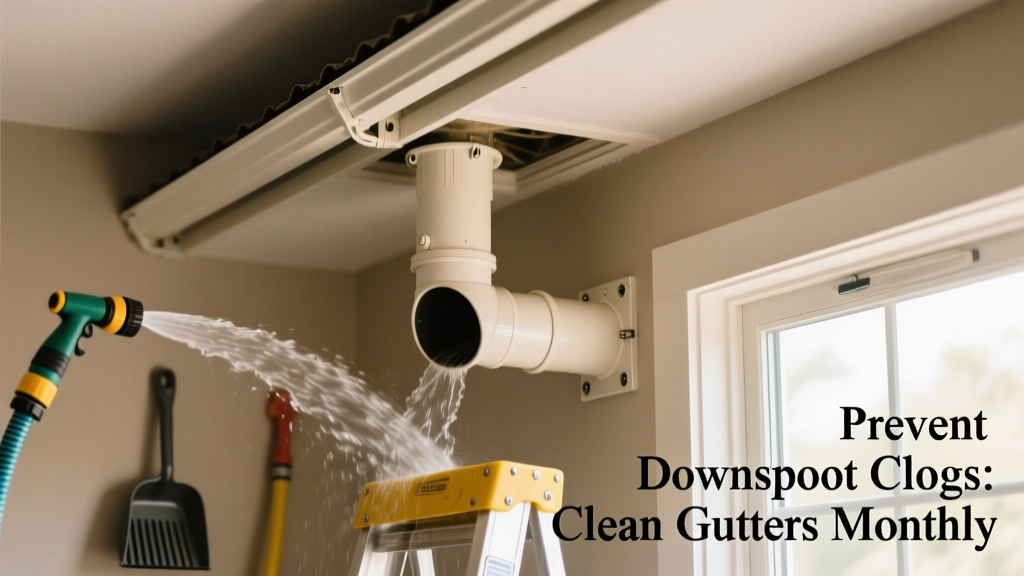
| Monthly | Flush with garden hose (start at top, check flow at bottom outlet) | 10 minutes |
| Yearly | Disassemble joints, inspect for corrosion, reseal with butyl tape, and verify slope with bubble level | 45 minutes per downspout |
Warning Signs
Don’t wait for flooding to act. Early indicators are subtle but consistent:
- Water dripping from seams or rivets—not just the outlet
- Staining or white mineral deposits on downspout exterior below elbow joints
- Soil erosion or muddy pooling directly beneath downspout exit
- Unusual gurgling or slow-draining sound during steady rain
- Visible sagging or bowing between fasteners
One sign alone may be incidental—but two or more together mean a functional failure is imminent.
Recommended Products
Not all products solve the same problem. Match tools to your risk profile:
- Gutter guards with micro-mesh (e.g., LeafFilter®): Best for homes under mature deciduous trees; reduces downspout debris load by 85% (Consumer Reports, 2023)
- Adjustable downspout extensions (e.g., RainPro Flex-Elbow): Direct water 5+ feet from foundation; critical if soil slopes toward house
- Butyl rubber sealant tape (e.g., Nashua 324): Re-seals joints without disassembly; lasts 7–10 years outdoors
- Downspout strainers (e.g., GutterStuff Pro): Fit inside vertical section to catch fine debris before it reaches bends
How often should I flush my downspouts?
Flush monthly during growing season (April–October), and immediately after any windstorm that drops significant debris. In winter, skip flushing if temperatures stay below freezing for >48 hours—use a fiberglass rod instead to probe for ice jams. Never use boiling water: thermal shock cracks PVC and loosens adhesive seals.
Can I fix a sagging downspout myself?
Yes—if sagging is under 1 inch and fasteners are intact. Tighten existing screws, add one new stainless-steel hanger every 6 feet, and confirm pitch with a 2-foot level. If sag exceeds 1.5 inches or you see rust-through holes, replace that 3-foot section.
"A downspout with visible bowing has lost 40% of its structural integrity—even if it still drains. Replace before spring thaw," says Ken Rupp, certified roofing inspector with the National Roofing Contractors Association (2024).
What’s the best way to extend downspouts away from the foundation?
Use rigid, non-perforated PVC or aluminum extensions angled at 1–2% slope (1/8″–1/4″ drop per foot). Bury only if using Schedule 40 pipe with cleanouts every 10 feet—and never extend beyond 10 feet without an inspection chamber. For DIYers, the downspout extension installation guide walks through grading, anchoring, and freeze-depth considerations.
Do gutter guards eliminate downspout maintenance?
No—they reduce frequency, not necessity. Even premium guards let fine granules and pollen pass. Those particles settle in elbows and accumulate over months. You’ll still need quarterly flushing and annual joint inspection. Think of guards as traffic control, not a bypass. For full-system protection, pair them with the gutter maintenance schedule.
Is it safe to use a pressure washer on downspouts?
Only on metal downspouts with no sealant or caulk present—and never above 1,200 PSI. High-pressure spray forces water behind seams, accelerating corrosion and loosening fasteners. Better to use a garden hose with adjustable nozzle set to “jet,” or try the no-tool unclogging method using gravity and warm vinegar-water solution for organic sludge.
Preventing downspout failure isn’t about perfection—it’s about consistency. A 10-minute monthly flush and a yearly joint check take less time than drying out a flooded crawl space. Your foundation, landscaping, and peace of mind all depend on water moving *away*, not pooling nearby.