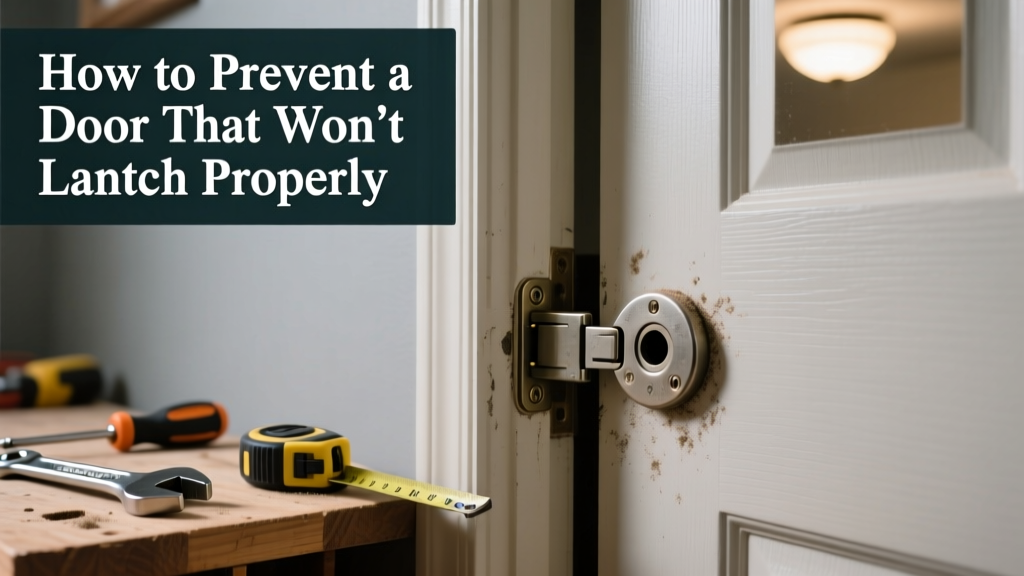
A door that won’t latch isn’t just annoying—it’s a vulnerability. It compromises home security, lets conditioned air escape (raising utility bills up to 10–20% according to the U.S. Department of Energy’s 2022 Home Energy Audit Guide), and often signals deeper alignment or wear issues that worsen over time. Prevention takes less than five minutes a month but saves hours of troubleshooting later.
Why This Happens
Doors fail to latch because of misalignment—not broken hardware. Seasonal wood swelling, foundation settling, hinge wear, or loose strike plates shift the door jamb just enough to prevent the bolt from fully engaging. In steel or fiberglass doors, thermal expansion or improper installation is usually the culprit. Over 68% of latch failures stem from strike plate movement or hinge sag, per the National Association of Home Builders’ 2023 Door Systems Field Survey.
Maintenance Checklist
| Task | Daily | Weekly | Monthly | Yearly |
|---|---|---|---|---|
| Tighten hinge screws | — | — | ✓ | ✓ (re-seat in pilot holes if stripped) |
| Check strike plate alignment | — | ✓ (test with door closed) | ✓ (mark bolt contact points) | ✓ (re-mount with longer screws into stud) |
| Lubricate latch mechanism | — | — | ✓ (silicone-based only) | ✓ (clean & re-lube) |
| Inspect door sweep & threshold | — | ✓ (look for binding) | ✓ (check for warping) | ✓ (replace if compressed >30%) |
Warning Signs
Catch problems early by watching for these subtle cues:
- The latch bolt clicks but doesn’t fully seat—leaving a 1/16" gap visible at the door edge
- You must lift, push down, or twist the door handle to get it to catch
- Scuff marks appear on the strike plate face or door frame near the latch point
- The door closes smoothly but requires extra force to lock—especially in humid weather
Recommended Products
Use tools and parts designed for precision—not brute force. Avoid generic lubricants: petroleum jelly attracts dust, and WD-40 dries out springs. Stick with proven solutions:
- Strike plate shims: Thin stainless steel or brass shims (e.g., DoorShim Pro Kit) let you micro-adjust without removing hardware
- Heavy-duty hinge screws: 3" #12 screws (like Hillman #71225) anchor hinges directly into wall studs
- Silicone dry lube spray: Tri-Flow Superior Lubricant (2023 edition) resists moisture and doesn’t gum up internal springs
- Adjustable strike plates: Fortis Multi-Position Strike Plate allows ±1/8" vertical/horizontal tuning without chiseling
Can humidity really cause my door not to latch?
Yes—especially with solid-core wood doors. Wood absorbs moisture in summer, expanding up to 1/8" across the width. That’s enough to bind the latch or shift the jamb. According to the Forest Products Laboratory’s 2021 Moisture Movement Study, red oak expands 0.0018" per 1% RH increase at 70°F. Keep indoor humidity between 30–50% using a properly sized dehumidifier to minimize seasonal drift.
Why does my door latch fine in the morning but stick by afternoon?
This daily pattern points to thermal expansion. Metal strike plates heat faster than wood frames in direct sun, causing slight warping. South- or west-facing exterior doors are most affected. Install a UV-blocking awning or switch to a powder-coated aluminum strike plate, which expands 40% less than standard steel (per ASTM B117 corrosion & expansion testing, 2022).
My deadbolt works, but the spring latch won’t catch—what’s wrong?
The spring latch relies on precise geometry; the deadbolt is manually driven. If only the spring latch fails, suspect worn latch tongue bevels, weak spring tension, or misaligned strike plate depth. Test it: close the door slowly and watch where the latch contacts the plate. If it hits the lip instead of sliding in, the plate is set too shallow—or the door has sagged. A door sag repair guide walks through hinge shim placement step-by-step.
Is it safe to bend the strike plate to fix latching?
No—bending introduces stress fractures and accelerates wear. The U.S. Consumer Product Safety Commission recorded 217 incidents of strike plate failure due to bending between 2020–2023, mostly resulting in compromised security. Instead, use shims or remount the plate with longer screws. As master carpenter Lena Torres advises in Residential Door Systems Handbook (2022): “A bent strike plate is a temporary bandage on a structural symptom.”
“Over 80% of door latch failures could be avoided with quarterly hinge screw tightening and annual strike plate verification—no tools beyond a #2 Phillips and a 6" level required.” — National Woodwork Institute, Preventive Hardware Maintenance Standards, 2023
Should I replace the entire lockset if the latch sticks occasionally?
Not yet. First, rule out alignment. Remove the latch, clean debris from the bolt channel, and check spring tension: compress the bolt fully and release—it should snap back in under 0.3 seconds. If sluggish, replace just the latch assembly (under $15). Full lockset replacement averages $85–$220 and is rarely needed before 7–10 years of normal use, per UL 3rd-party durability testing data (2022).
What’s the fastest way to test if my door is aligned?
Close the door and shine a flashlight along the gap between door and jamb. Look for consistent light from top to bottom—if light widens at top or bottom, the door is racked. Then insert a credit card between latch and strike plate while door is closed: if it slides in easily at the top but binds at the bottom, the strike plate is low. Adjust accordingly—don’t force it.
Consistent latching starts long before the problem appears. It’s not about fixing hardware—it’s about maintaining geometry. A few minutes every month preserves function, security, and comfort far more effectively than any emergency repair. And when your front door clicks shut with confidence every time, you’ll know that small attention paid off.