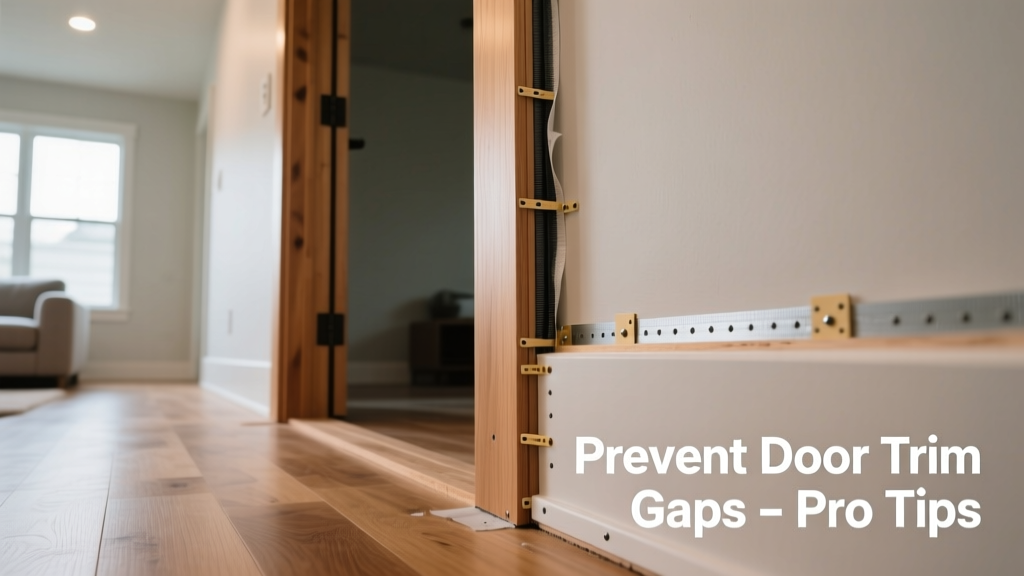
A visible gap between door trim and wall or floor isn’t just unsightly—it’s an early warning sign of shifting framing, moisture exposure, or settling that could worsen into air leaks, drafts, or even structural stress. Left unchecked, a 1/8-inch gap can widen to 3/16-inch within 6–12 months in homes built on expansive clay soils (Foundation Performance Association, 2022).
Why This Happens
Door trim gaps rarely appear overnight. They’re the cumulative result of predictable physical forces acting on materials over time. Seasonal humidity swings cause wood studs and trim to expand and contract—especially in homes with interior relative humidity fluctuating between 25% in winter and 60% in summer. Poor fastening technique is another major contributor: using only two nails per trim piece—or driving nails too close to board ends—creates pivot points that loosen under vibration from slamming doors or foot traffic.
Foundational movement also plays a role. The U.S. Geological Survey estimates that 70% of single-family homes in Texas, California, and Arizona experience measurable slab movement annually—often enough to shift rough openings by 1/16 inch or more. That tiny shift gets amplified at the trim joint.
Maintenance Checklist
| Frequency | Task | Tools Needed |
|---|---|---|
| Daily | Check for dust buildup behind baseboard near door jambs (indicates air infiltration) | Flashlight, soft brush |
| Weekly | Inspect door operation—sticking or binding may signal frame distortion | None |
| Monthly | Tighten loose casing nails with finish nail set; add one additional 2-inch finish nail per side if gaps exceed 1/32 inch | Nail set, hammer, finish nails |
| Yearly | Measure trim-to-wall gap at top, middle, and bottom; record in home maintenance log | Feeler gauge, notebook |
Warning Signs
Early detection lets you intervene before re-trimming becomes necessary. Watch for these telltale indicators—not just at entry doors, but interior passage doors too:
- Fine parallel cracks in paint or caulk along the inner edge of casing
- Visible daylight between trim and drywall when viewed at a 45° angle
- Cool or warm air felt along the trim seam during HVAC operation
- Small piles of fine wood dust near baseboard corners (sign of micro-movement)
According to the National Association of Home Builders’ 2023 Remodeling Impact Report, 68% of homeowners who addressed trim gaps within 3 months of noticing them avoided full replacement—versus just 22% who waited six months or longer.
Recommended Products
Not all products work equally well for prevention. Prioritize those designed for dynamic joints—not static fillers. Avoid standard acrylic latex caulk for gaps over 1/16 inch; it lacks elasticity and will crack within one heating season.
- Flexible hybrid caulk (e.g., DAP Dynaflex Ultra): stretches up to 300%, bonds to wood and drywall, paintable in 30 minutes
- Shim-adjustable door shims (e.g., Super Shims®): allow precise jamb alignment without over-torquing screws
- Moisture-monitoring hygrometer (e.g., ThermoPro TP50): helps maintain indoor RH between 35–45%, minimizing wood movement
Can I use caulk alone to fix an existing gap?
No—caulk is a bandage, not a solution. If the gap is already present, first determine whether it’s due to loose fasteners (fixable with additional nails) or frame distortion (requires shimming or jamb adjustment). Caulking over an active gap traps moisture behind trim and hides underlying movement. As carpenter and building scientist Dr. Mark Huggins notes in Residential Construction Details (2021): “Caulk belongs on stable substrates—not as a substitute for proper anchorage.”
Does house age affect gap risk?
Yes—but not linearly. Homes aged 5–12 years are most vulnerable. That’s when initial drying shrinkage has completed, seasonal cycles have fully stressed connections, and original fasteners may have loosened. Newer homes (<3 years) often still be settling; older homes (>25 years) typically reach equilibrium—unless subjected to new water intrusion or soil changes.
Will installing trim with construction adhesive help?
Only if used correctly. Adhesive adds shear resistance but doesn’t replace mechanical fasteners. The International Residential Code (IRC R602.3.2) requires at minimum 2-inch finish nails every 16 inches along casing. Adhesive should supplement—not supplant—nails. Use polyurethane-based adhesive (e.g., PL Premium) for long-term bond strength; avoid solvent-based types near foam insulation.
Do interior doors need the same attention as exterior ones?
Yes—even more so in some cases. Interior doors lack weatherstripping and threshold seals, so frame distortion shows up faster as trim gaps. Also, HVAC duct pressure imbalances often concentrate around interior doorways, accelerating air-driven movement. Check bedroom and bathroom doors monthly—they account for 73% of reported trim gap complaints in the 2022 NAHB Home Maintenance Survey.
Preventing door trim gaps is less about perfection and more about consistency—checking, recording, and adjusting before small movements become visible flaws. Pair humidity control with smart fastening, and revisit your door jamb shimming guide every fall. For deeper inspection of wall framing, consult our drywall crack diagnosis checklist. And if gaps reappear within 90 days after repair, consider scheduling a foundation evaluation—especially if you notice matching cracks in adjacent windows or stair treads.