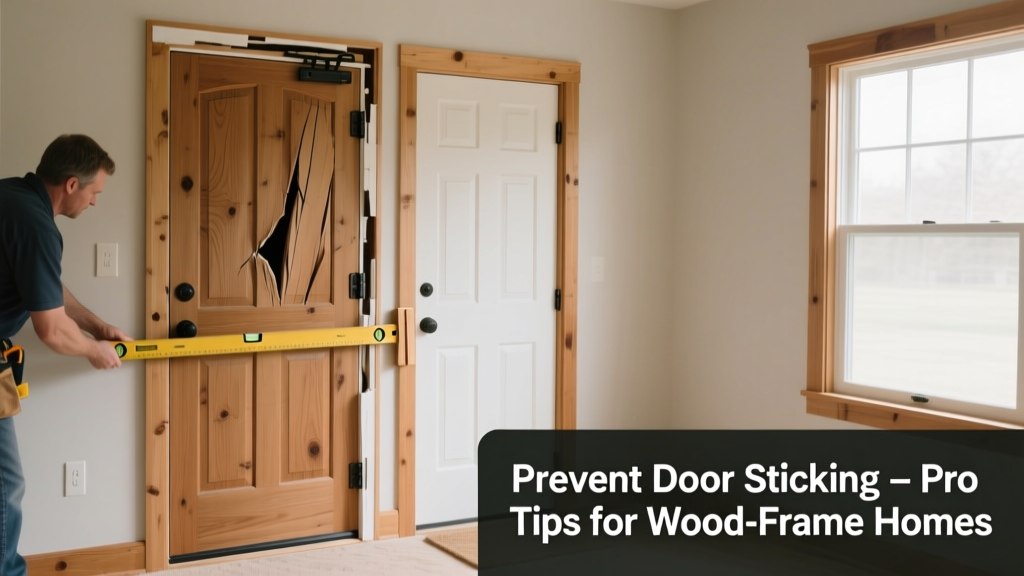
Sticking doors aren’t just an annoyance—they’re an early warning sign of shifting foundations, swelling wood, or failing hardware. Left unaddressed, they can escalate into misaligned hinges, cracked drywall, or even compromised weather sealing that hikes your energy bills by up to 15% (U.S. Department of Energy, 2022). Prevention is faster, cheaper, and more effective than repair.
Why This Happens
Doors stick when the gap between door edge and frame shrinks—usually due to one or more of these physical forces:
- Seasonal humidity shifts: Interior wood absorbs moisture in summer (RH >60%), swelling up to 3/32" in width—enough to bind against the jamb.
- Floor settlement: Even 1/8" of sag in a 30-year-old home’s subfloor tilts the threshold, dragging the bottom corner into contact.
- Hinge wear: Screws pull out of soft pine jambs over time; a single loose top hinge drops the latch side by 1/16"—enough to catch on the strike plate.
- Paint buildup: Three or more coats on door edges add cumulative thickness—especially problematic on pre-hung interior doors with tight 1/8" clearance.
Maintenance Checklist
| Frequency | Task | Time Required |
|---|---|---|
| Daily | Wipe condensation off exterior door frames after rain or high-humidity mornings | 1–2 min |
| Weekly | Check for debris in threshold tracks (sliding doors) or sweep under hinged doors | 90 sec |
| Monthly | Tighten all hinge screws; if screw spins freely, replace with 3" #8 wood screws into stud | 4 min per door |
| Yearly | Sand and reseal bare wood thresholds; inspect weatherstripping for compression set (loss of rebound) | 12–18 min per door |
Warning Signs
Don’t wait until you’re forcing the door open. These subtle cues appear weeks before binding becomes obvious:
- A faint scraping sound only at the top or bottom corner during closing
- Visible daylight gaps shrinking unevenly—e.g., 1/4" gap at top but only 1/16" at bottom
- Door latch catching inconsistently: works fine in morning, sticks by afternoon
- Paint cracking along hinge-side stile where wood swells against the frame
Recommended Products
Not all lubricants and sealants work equally well—and some make sticking worse. Stick with these field-tested categories:
- Graphite powder (not spray): For lock mechanisms and latch bolts—won’t attract dust like oil-based lubes
- Paraffin wax bars: Rub directly on door edges and jambs before seasonal humidity spikes (ideal for solid-core interior doors)
- Adjustable threshold sweeps: Like the M-D Building Products 72-inch adjustable sweep, which lets you lift the seal 1/8" without removing the door
- Dehumidifier with humidistat: Maintain indoor RH between 35–50% year-round—critical for homes with solid-wood doors and hardwood floors
Can I sand a sticking door myself?
Yes—if the bind is isolated to one spot (e.g., bottom corner) and the door is solid-core or hollow-core with veneer thicker than 1/16". Use 120-grit sandpaper wrapped around a block, remove no more than 1/32" per pass, and always reseal sanded areas with polyurethane within 2 hours. Skip this on factory-finished MDF doors—their thin laminate layer sands through instantly.
Why does my exterior door stick only in summer?
That’s classic moisture-driven swelling. Exterior doors absorb ambient humidity faster than interior ones—and if your home lacks proper soffit and gable ventilation, attic heat pushes moist air downward into wall cavities near door jambs. According to the Building Science Corporation’s 2021 field study, homes with balanced intake/exhaust ventilation saw 40% fewer seasonal door issues.
Will tightening hinge screws fix it permanently?
Only if looseness caused the issue. If tightening doesn’t restore smooth operation within two full cycles (open/close), the problem lies deeper—like jamb twist or slab warp. As contractor Mike Rinaldi notes in Residential Carpentry Handbook (2020):
"A door that binds after hinge tightening almost always means the rough opening has shifted—not the hardware. Don’t chase the symptom."
Is sticking always a wood problem?
No. Steel-clad entry doors stick when foam core insulation expands in heat, pushing the skin outward. Fiberglass doors bind when UV exposure degrades the gel coat, causing micro-warping. And aluminum sliding doors jam when track debris corrodes rollers—especially near coastal homes. Always identify material first.
How often should I check door clearance?
Twice yearly: once before peak summer humidity (May/June) and again before winter heating dries interiors (October/November). Use a credit card as a quick gauge—it’s 0.03" thick. You should be able to slide it vertically along all four edges with light resistance. If it snags or won’t fit at all, adjust now—not when the door won’t close.
Sticking doors are rarely random. They’re feedback—from your home’s structure, climate control, and daily use. Catch them early, act with precision, and you’ll preserve both function and finish for years. For related strategies, see our guides on fixing sliding door jams and replacing stripped hinge holes.