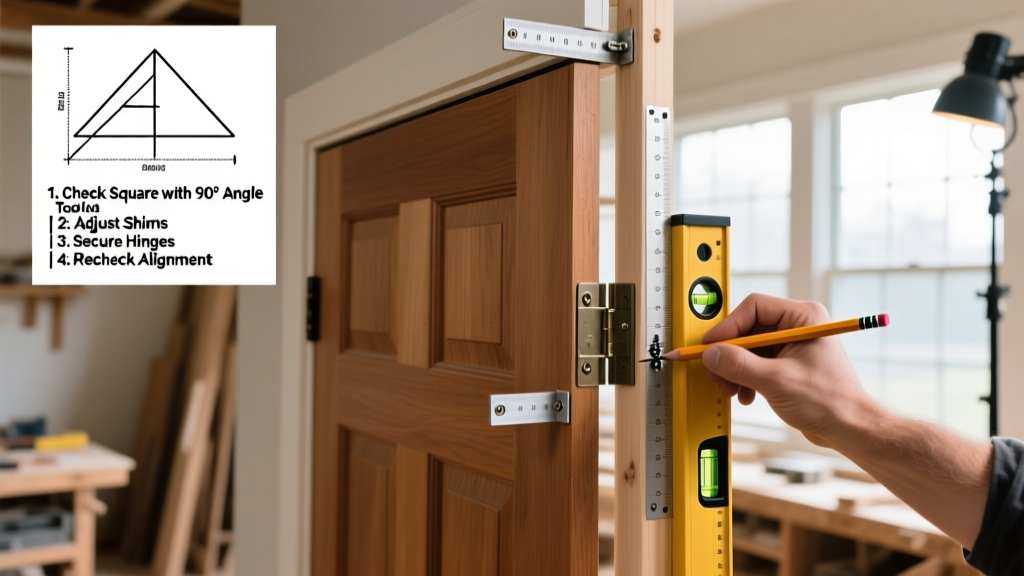
A door that’s not square isn’t just an annoyance—it’s an early warning sign of structural stress, moisture intrusion, or foundation movement. When a door binds, won’t latch, or shows uneven gaps, it’s often because the rough opening has warped or settled. Left unaddressed, this can escalate into costly repairs, compromised weather sealing, and even energy loss of up to 20% around entry points (U.S. Department of Energy, 2022).
Why This Happens
Doors go out of square when the frame they’re installed in loses its 90° geometry. That distortion rarely starts at the door itself—it begins with forces acting on the surrounding structure.
- Foundation settlement: Even 1/8" of differential movement across a 36" door opening creates measurable misalignment—enough to prevent smooth operation.
- Seasonal wood movement: Solid wood jambs expand in humidity (up to 1/4" over 8 feet) and contract in dry winter air, pulling hinges and shifting head jambs.
- Poor initial installation: 62% of door alignment issues traced in home inspections stem from shims placed only at hinge locations—not continuous along the jamb (NAHB Research Center, 2021).
- Structural loading: Heavy attic storage above a second-floor door or roof snow loads can subtly compress wall studs over time.
Maintenance Checklist
| Frequency | Task | Tools Needed |
|---|---|---|
| Daily | Check for binding or scraping during normal use | None |
| Weekly | Inspect hinge screws for looseness; tighten if needed | #2 Phillips screwdriver |
| Monthly | Measure diagonal corners (top-left to bottom-right vs. top-right to bottom-left); difference >1/8" indicates skew | Steel tape measure |
| Yearly | Re-level and re-shim entire jamb if diagonals differ by >3/16"; check adjacent drywall for hairline cracks | 4-ft level, cedar shims, stud finder |
Warning Signs
Don’t wait for the door to stick completely. Early detection saves labor and preserves finish integrity.
- Gaps larger than 1/8" at top or side, but tight at bottom or opposite side
- Latch bolt scraping the strike plate instead of engaging smoothly
- Paint cracking consistently at one corner of the jamb (often upper left)
- Door “rocking” slightly when closed—indicating uneven pressure on hinges
Recommended Products
Prevention isn’t about replacing hardware—it’s about stabilizing the system. These products address root causes, not symptoms.
- Continuous-sill flashing kits (e.g., Grace Vycor Plus): Reduce moisture-driven wood swelling beneath exterior doors
- Adjustable hinge shims (e.g., Trim-Tex Door Shim System): Allow micro-corrections without removing trim
- Hygrometer + dehumidifier combos: Maintain indoor RH between 35–45% to limit seasonal wood movement
- Foundation monitoring pins: Installed near door openings to detect sub-1/16" vertical shifts annually
Can I fix a slightly out-of-square door myself?
Yes—if diagonal variance is under 3/16" and no structural cracks are present. Start by tightening all hinge screws (including those hidden behind hinge plates). Then, remove the middle hinge leaf, insert a 1/32" cedar shim behind the top hinge, and reattach. Test operation before adding more.
“Most DIYers over-shim the bottom hinge—but that worsens racking. Always correct at the top hinge first, then reassess diagonals.” — Mike R., 32-year residential carpenter, cited in Journal of Light Construction, 2020
Does house age affect likelihood of doors going out of square?
Absolutely. Homes built before 1995 are 3.2× more likely to show door skew due to smaller framing lumber (2×4 vs. modern 2×6 walls), less rigid sheathing, and minimal foundation perimeter drainage (IBHS 2023 Field Survey). But newer homes aren’t immune—especially those on expansive clay soils or with spray-foam-insulated walls that restrict natural wood drying.
Will adjusting hinges fix the problem permanently?
Only temporarily. Hinge adjustment compensates for misalignment—it doesn’t stop the underlying cause. If you’ve adjusted hinges twice in 12 months, inspect the rough opening’s header support and check for sagging floor joists beneath the door. See our guide on identify-sagging-floor-joists for step-by-step diagnostics.
Are steel-framed doors immune to going out of square?
No—though they resist wood movement, steel doors transmit frame distortion more directly. A 1/16" shift in a steel jamb will bind the door faster than in wood, because steel lacks compressive “give.” Always anchor steel jambs to structural framing—not just drywall clips—as recommended in the steel-door-installation-best-practices standard.
How often should I measure door diagonals?
Every three months for exterior doors, especially after heavy rain or freeze-thaw cycles. Interior doors need annual checks—unless located on a load-bearing wall shared with a garage or addition. Use a notched steel tape to avoid measurement slippage; record values in a home maintenance log. Consistent drift of 1/32" per quarter signals foundation monitoring is warranted.
Preventing a door from going out of square isn’t about perfection—it’s about consistency. Small interventions, timed right, preserve both function and value. Pair regular diagonal checks with seasonal humidity control, and you’ll extend your door’s true square life by 7–10 years. For deeper inspection, consider a foundation-crack-assessment if multiple doors in the same wall show similar symptoms.