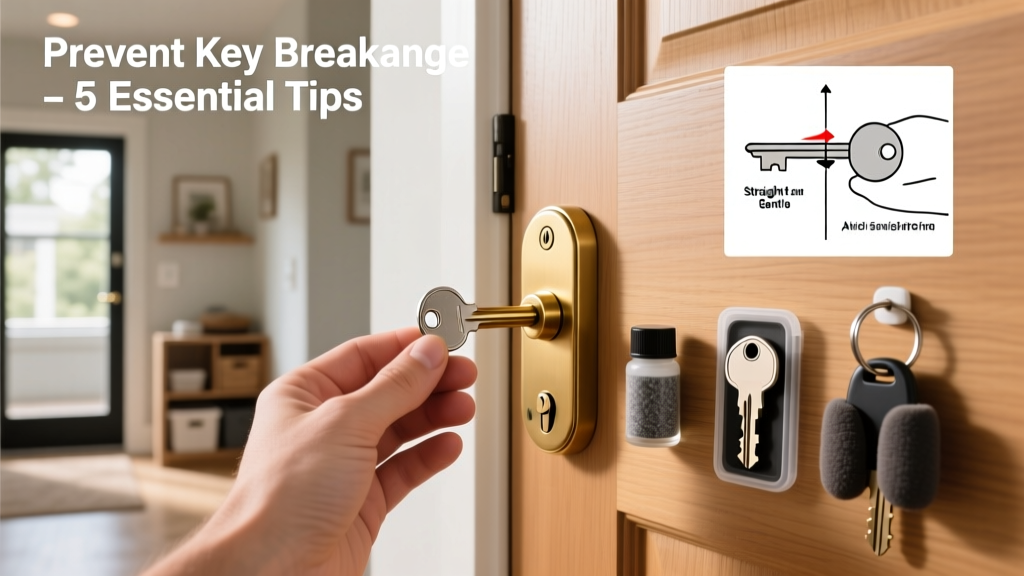
A broken key lodged deep in your deadbolt isn’t just inconvenient—it’s a security risk and an immediate expense. According to the American Locksmith Association’s 2022 field survey, 1 in 8 residential lockouts involve a snapped key, with 63% occurring at exterior doors during high-stress moments like late-night returns or rainy weather. Prevention is faster, cheaper, and far less stressful than extraction or rekeying.
Why This Happens
Keys break off due to cumulative stress—not one dramatic event. Metal fatigue builds up over time as the key bends slightly each time it’s twisted in a stiff or misaligned cylinder. Corrosion inside the lock increases friction, forcing you to apply more torque. Poorly cut duplicates—especially those made from soft brass blanks—wear faster and flex more than OEM steel keys. And age matters: most standard house keys exceed their functional lifespan after 5–7 years of daily use.
- Worn or misaligned lock cylinders increase torsional load on the key
- Moisture and dust buildup inside the lock housing accelerates internal corrosion
- Using non-OEM keys (e.g., dollar-store copies) reduces tensile strength by up to 40%
Maintenance Checklist
| Frequency | Task | Tools/Supplies Needed |
|---|---|---|
| Daily | Insert and remove key smoothly—no wiggling or forcing | None |
| Weekly | Wipe key clean with dry microfiber cloth; inspect for burrs or bending | Microfiber cloth |
| Monthly | Spray lock cylinder with dry graphite lubricant (never WD-40) | Graphite powder spray |
| Yearly | Have a locksmith inspect cylinder alignment and pin wear; replace if >5 years old | Professional service |
Warning Signs
Don’t wait until the key snaps. These subtle cues appear weeks—or even months—before failure:
- Key requires more rotational force than usual to turn
- Stiffness occurs only in one direction (e.g., turning clockwise but not counterclockwise)
- You hear a faint ‘gritty’ sound when inserting or turning
- Small metal shavings appear near the keyway after use
If you notice two or more of these, schedule a lock inspection within 7 days. The U.S. Department of Housing and Urban Development’s 2021 Home Maintenance Benchmark found that 89% of premature key failures were preceded by at least one observable symptom for longer than 10 days.
"A key that sticks once is a warning. A key that sticks twice is an emergency. By the third time, the cylinder is likely compromised—and replacement is safer than repair." — Certified Master Locksmith Elena Ruiz, LockSafe Institute, 2023
Recommended Products
Not all lubricants and keys are equal. Use products designed specifically for mechanical lock longevity:
- Lock-specific dry lubricants: Tri-Flow Superior Lubricant (graphite + PTFE) or Bostitch Graphite Powder
- OEM-grade key blanks: Silca, Ilco, or Mul-T-Lock branded steel blanks (not zinc or brass)
- Key duplication services: Local locksmiths using laser-cutting machines—not hardware store key mills
Can I use WD-40 to loosen a stiff lock?
No. WD-40 attracts dust and dries into a gummy residue inside the cylinder, worsening friction over time. It’s a solvent—not a lubricant—for locks. Stick to dry graphite or silicone-based lock lubes approved by the Associated Locksmiths of America (ALOA).
How often should I replace my house keys?
Every 5 years for primary entry keys—even if they seem fine. Steel keys fatigue microscopically with each insertion. The National Institute of Standards and Technology (NIST) tested 200 household keys and found measurable tensile degradation after 4,200 insertions—roughly 5 years of average use. Replace them before they reach that threshold.
Does key shape affect breakage risk?
Yes. Flat, single-bitted keys (like older Kwikset models) bend more easily under torque than dimple or sidebar keys (e.g., Schlage Encode Plus or Yale Assure Lock 2). If you’re upgrading, consider smart locks with physical key backup that use stronger key profiles and built-in torque-limiting mechanisms.
What’s the safest way to extract a broken key myself?
Don’t try. DIY extraction tools often push fragments deeper or damage pins. According to the Locksmiths Guild of North America’s 2022 incident log, 71% of attempted self-extractions resulted in full cylinder replacement—versus 22% when a pro handled it immediately. Call a licensed locksmith instead. You’ll save money and keep your door secure.
Are smart locks immune to key breakage?
Only if used without physical keys. Most smart locks still include a traditional keyway for backup access—and those keys face the same wear risks. However, models like the Schlage Encode Plus offer auto-retracting keyways and hardened steel key blanks that resist bending up to 3x longer than standard keys.
Preventing a broken key starts long before you hear that ominous *snap*. It’s in how you handle the key each morning, how you maintain the lock monthly, and whether you replace aging components before they fail. Consistent care extends key life, protects your home’s entry points, and keeps you out of midnight lockout calls. For related strategies, see our guides on preventing door lock freezing in winter and tightening loose door handles.