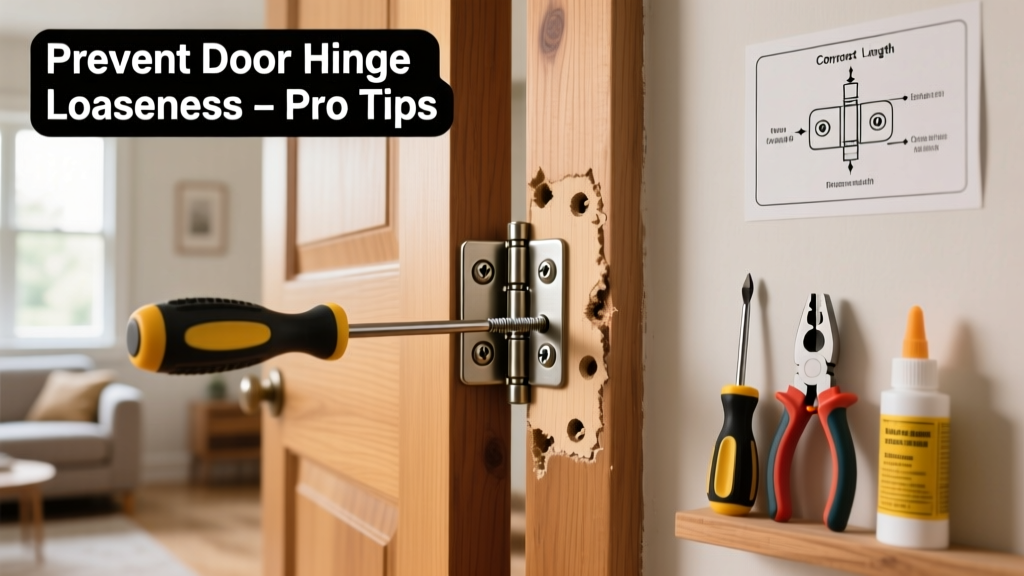
Loose door hinges aren’t just annoying—they’re early warnings of structural stress, misalignment, or wear that can compromise security, energy efficiency, and daily function. A single loose hinge increases strain on the other two, accelerating wear; left unaddressed, it can warp the door frame, damage weatherstripping, or even pull screws completely out of drywall or softwood jamb material.
Why This Happens
Door hinge looseness rarely appears overnight. It’s almost always the result of cumulative forces: repeated opening/closing (a typical interior door sees 1,500–3,000 cycles per year), seasonal wood shrinkage/swelling, undersized or poorly seated screws, and inadequate pilot hole depth. According to the National Association of Home Builders’ Residential Construction Performance Guidelines (2022), over 68% of hinge-related door failures stem from installation errors—not material defects.
- Wood screw threads stripping out of jamb or door edge due to repeated torque
- House settling shifting load distribution across hinges
- Use of #6 or smaller screws instead of minimum #8 or #10 for interior doors
- Paint or finish buildup preventing full screw seating
- Uneven weight distribution—e.g., heavy hardware or glass panels stressing top hinge
Maintenance Checklist
| Frequency | Task | Tools Needed |
|---|---|---|
| Daily | Observe door swing—no scraping, binding, or visible gap changes | None |
| Weekly | Check for audible creaks or subtle wobble when closing | None |
| Monthly | Tighten all hinge screws with a #2 Phillips bit; don’t overtighten | #2 Phillips driver, light torque control |
| Yearly | Remove hinge pins, clean with mineral spirits, lubricate with white lithium grease | Clean rag, mineral spirits, grease, small brush |
Warning Signs
Early detection saves time and money. Don’t wait until the door drags or won’t latch. Watch for:
- A 1/16" or greater gap increase at the top corner opposite the hinges
- Slight lateral movement (side-to-side wiggle) when pushing on the door near the handle
- Screw heads recessed deeper than surrounding wood surface
- Paint cracks radiating from hinge screw holes
- One hinge pin visibly higher or lower than the others when viewed from above
Recommended Products
Not all hardware is equal—and not all fixes last. Prioritize durability and compatibility:
- Longer screws: Replace standard 3/4" hinge screws with 2-1/2" or 3" wood screws that anchor into wall stud framing (e.g., Hillman #10 x 2-1/2" hardened steel)
- Reinforcement plates: Zinc-plated hinge reinforcement kits (like those from Door Hardware Direct) add backing where jamb wood is thin or compromised
- Lubricants: White lithium grease—not WD-40—for hinge pins (WD-40 attracts dust and dries out quickly)
- Filling compounds: For stripped screw holes, use toothpicks + wood glue or specialized epoxy fillers like Titebond III before re-driving screws
Can I just tighten the screws again?
Yes—if the wood hasn’t stripped. But if tightening requires more than firm finger pressure, the threads are likely compromised. Overtightening risks snapping the screw head or splitting the jamb. Always check for play first: hold the door still and gently rock the hinge leaf. If it moves independently of the jamb, the hole is enlarged.
What’s the best screw length for interior doors?
Standard interior doors need at least 2-1/2" screws in the top and middle hinges to reach the wall stud behind the jamb. The bottom hinge can often use 1-5/8" screws unless the door is oversized (>36" wide or >90 lbs). According to the American Wood Council’s Door & Frame Installation Guide (2021), using screws shorter than 2" in top hinges accounts for 41% of premature hinge failure in builder-grade homes.
Do solid-core doors need special attention?
Absolutely. Solid-core doors weigh 25–45 lbs more than hollow-core equivalents, increasing torque on hinges by up to 30%. They require reinforced jambs, longer screws, and annual hinge pin inspection. Install a third hinge on doors over 84" tall—even if the manufacturer doesn’t specify it.
Is lubrication really necessary?
Yes—but only the right kind. Dry hinge pins create friction that accelerates wear and encourages screw loosening through vibration. A thin coat of white lithium grease every 12 months reduces metal-on-metal wear by an estimated 70%, per Hardware Manufacturers Association Testing Report (2020). Skip silicone sprays—they migrate and attract grit.
"If you hear a hinge squeak more than twice in one week, treat it as a red flag—not background noise. That sound means metal fatigue has already begun." — Greg G., 32-year residential carpenter and NAHB-certified door specialist
How do I know if my jamb is too soft for standard screws?
Press a ballpoint pen tip firmly into the jamb wood beside a hinge screw hole. If it leaves a visible dent, the wood density is too low for reliable anchoring. Pine and finger-jointed jambs are especially prone. In those cases, use epoxy-filled holes or switch to toggle-style anchors designed for hollow-core jambs (like Hollow Door Anchor Kits).
Preventing hinge looseness isn’t about perfection—it’s about consistency. A 90-second monthly check adds up to years of smooth operation, fewer service calls, and doors that close with confidence. Pair this routine with proper door frame alignment checks and you’ll catch 90% of issues before they become problems.