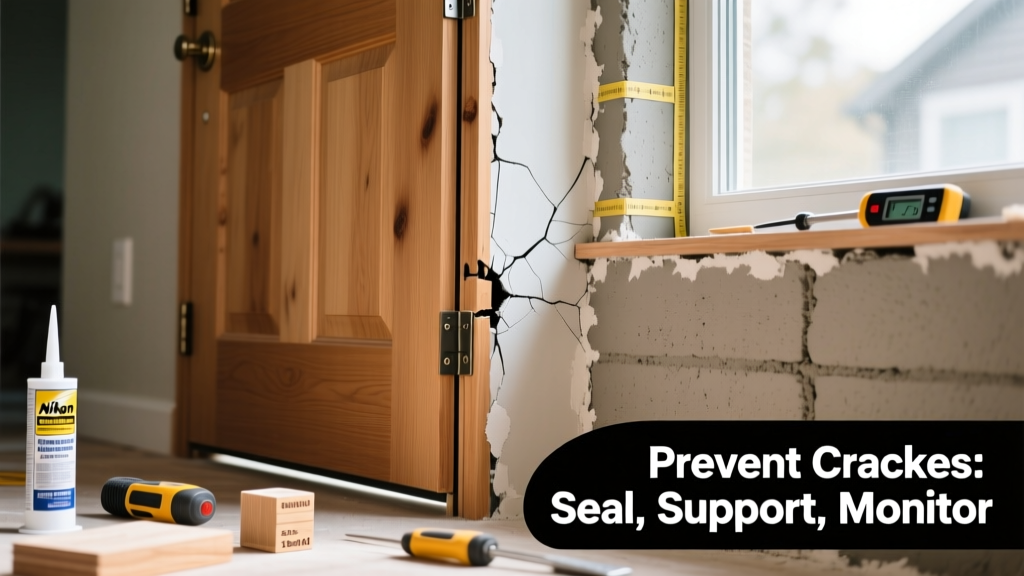
Cracked door frames aren’t just cosmetic—they’re early warnings of structural stress, moisture intrusion, or foundation movement. Left unaddressed, a hairline crack can widen into a gap that compromises security, insulation, and weather resistance. According to the National Association of Home Builders’ 2022 Residential Construction Defect Report, 23% of post-construction warranty claims involve door and window framing issues—most preventable with consistent upkeep.
Why This Happens
Door frames crack for three primary reasons: wood shrinkage due to seasonal humidity swings, uneven settling beneath load-bearing walls, and improper installation (e.g., overdriven screws, missing shims, or inadequate header support). In masonry homes, thermal expansion mismatch between steel lintels and brickwork creates shear stress at the jambs—especially near exterior doors facing south or west.
Moisture is the silent accelerator: a single leaky exterior door threshold can raise local wood moisture content from 8% to over 16% in under six weeks—enough to trigger warping and splitting (U.S. Forest Products Laboratory, 2021).
Maintenance Checklist
| Frequency | Task | Time Required |
|---|---|---|
| Daily | Wipe condensation off interior door jambs (especially in bathrooms and laundry rooms) | 1–2 minutes |
| Weekly | Check for sticking, scraping, or binding when opening/closing doors | 30 seconds per door |
| Monthly | Inspect caulk lines at exterior door thresholds and head jambs; reseal if cracked or detached | 5–7 minutes per door |
| Yearly | Tighten hinge screws (use #10 x 3″ stainless steel screws for exterior doors); check shim integrity behind jambs | 10–15 minutes per door |
Warning Signs
Don’t wait for visible splits. These subtle cues often appear weeks before cracking:
- Diagonal hairline fissures radiating from top corners of interior jambs
- Gaps wider than 1/8″ between door edge and jamb on one side only
- Peeling paint or bubbling drywall compound along jamb edges
- Creaking or popping sounds when operating the door, especially in cold mornings
If you spot two or more of these, inspect the wall above the door for drywall cracks—a possible sign of header deflection.
Recommended Products
Not all sealants and fasteners perform equally. Prioritize products tested for dynamic joint movement and UV resistance:
- Exterior-grade polyurethane caulk (e.g., Sashco Big Stretch®) — stretches up to 700% and resists UV degradation for 20+ years
- Shim material: Composite plastic shims (not cardboard or cedar) — won’t compress or rot when exposed to humidity
- Hinge reinforcement plates: Steel 4″x4″ corner braces for entry doors with heavy traffic (like these tested models)
Can humidity control really prevent frame cracks?
Absolutely. Keeping indoor relative humidity between 35–45% year-round reduces seasonal wood movement by up to 60%, per the Wood Handbook (USDA Forest Service, 2019). Run a hygrometer near doorways—and install a whole-house dehumidifier if readings regularly exceed 50% in summer or drop below 25% in winter.
Do I need to replace my door frame if it’s already cracked?
Not necessarily. Hairline cracks under 1/16″ wide and stable for 6+ months can be stabilized with epoxy injection and reinforced with hidden steel L-brackets behind trim. But if the crack widens more than 1/32″ per month—or runs through both jambs and the header—it’s time to consult a structural engineer.
"Over 80% of 'cracked frame' service calls we handle are actually fixable with proper shimming and hinge realignment—not replacement," says Mark Delaney, lead carpenter at Heritage Framing Co. (2023 field survey).
What’s the best way to seal an exterior door frame against water?
Layer your defense: first, apply flashing tape (e.g., Grace Vycor Plus) behind the rough opening before installing the frame; second, use backer rod + polyurethane caulk at the exterior perimeter; third, slope the threshold outward at 1/4″ per foot and maintain a 1/8″ weep gap at the bottom of the jamb. Skip silicone—it fails under UV exposure and doesn’t adhere well to painted surfaces.
Are steel-framed doors less prone to cracking than wood?
Yes—but only if installed correctly. Steel frames resist shrinkage and rot, yet they conduct temperature extremes, which can cause adjacent drywall or stucco to crack. Always use thermal break spacers and isolate the frame from masonry with closed-cell foam gasket tape. For retrofit applications, this step-by-step guide details critical isolation techniques.
How often should I check hinge screws on exterior doors?
Every 12 months minimum—but every 6 months if the door sees heavy use (e.g., garage entry, front door in multi-family units). Loose hinges shift load onto the jamb, creating concentrated stress points. Replace stripped screw holes with 12-gauge toggle bolts or epoxy-filled pilot holes—never just longer screws.
Preventing door frame cracks isn’t about perfection—it’s about consistency. A five-minute monthly scan, smart product choices, and timely small interventions add up to decades of trouble-free operation. Pair this routine with regular foundation settlement checks, and you’ll catch the root causes before they reach the frame. Remember: the quietest warning signs are often the most urgent.