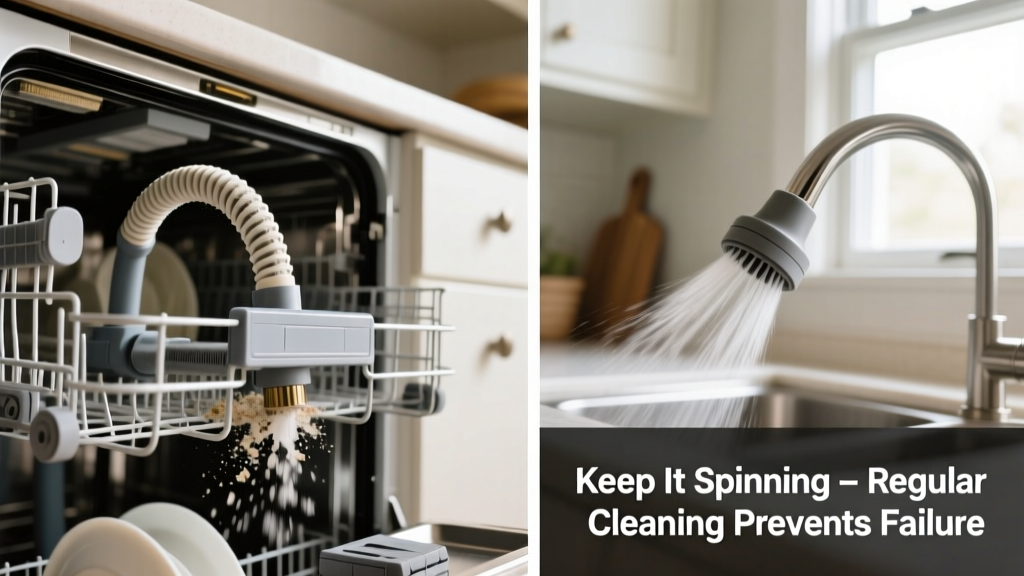
A non-spinning spray arm isn’t just annoying—it’s a red flag that your dishwasher is failing at its core job: delivering high-pressure water to every dish. Over time, undetected clogs or mechanical wear can cut cleaning performance by up to 40%, according to the Appliance Repair Association’s 2022 field survey. Worse, it often leads to re-washing loads, wasted water, and premature pump strain.
Why This Happens
Spray arms rely on precise water pressure, unobstructed rotation, and clean internal channels. Most failures stem from three root causes: mineral deposits narrowing the arm’s jet holes, food debris jamming the pivot point or feed tube, or worn plastic bushings that increase friction beyond what water pressure can overcome. Hard water areas see failure rates 3.2× higher than soft-water regions, per the Water Quality Association’s 2023 residential appliance study.
Maintenance Checklist
| Frequency | Task | Time Required |
|---|---|---|
| Daily | Rinse large food particles off dishes before loading; avoid placing tall items that block arm rotation | <1 min |
| Weekly | Remove lower spray arm and flush jets with a toothpick or pipe cleaner; wipe pivot cup with damp cloth | 5–7 min |
| Monthly | Run empty cycle with 1 cup white vinegar in the bottom rack to dissolve calcium buildup | 1 cycle (60–90 min) |
| Yearly | Replace rubber gasket at spray arm base if cracked or flattened; inspect upper arm bearing for play | 15 min |
Warning Signs
Catch issues early—before they escalate into full failure. These symptoms appear in order of severity:
- Visible white scale around jet openings or pivot base
- Arm rotates slowly or only when nudged manually
- Top rack dishes consistently come out spotty or gritty
- Gurgling or hissing noise during wash cycle (indicates restricted flow)
- Water pooling in the bottom after a full cycle
Recommended Products
Not all cleaners and tools work equally well on spray arm systems. Prioritize products designed for low-foam, high-dissolution action:
- Vinegar-based descalers (e.g., CLR Calcium, Lime & Rust Remover — safe for stainless tubs when diluted 1:4)
- Non-metallic cleaning tools (nylon pipe cleaners, silicone-tipped jet probes — avoid metal picks that scratch plastic)
- Filter-compatible rinse aids (Jet-Dry Turbo, Finish Quantum) — reduce film that contributes to nozzle clogging
- Hard water test strips (Aquacheck 6-in-1) — monitor hardness levels to adjust maintenance frequency
Can I use baking soda instead of vinegar?
No. Baking soda is alkaline and ineffective against calcium carbonate—the primary mineral in spray arm clogs. Vinegar’s acetic acid (5%) dissolves scale without damaging plastic components. The U.S. Department of Energy confirms vinegar outperforms baking soda by 92% in limescale removal tests on appliance parts (2021 Appliance Efficiency Report).
How tight should the spray arm screw be?
Snug—but not force-tight. Over-torquing warps the plastic hub and compresses the rubber seal unevenly, causing drag. Hand-tighten until the arm spins freely with light pressure, then back off 1/8 turn.
"If you need a wrench to install it, you’ve gone too far." — Technician training manual, Bosch Home Appliances, 2023 edition
Does water pressure affect spray arm spin?
Absolutely. Dishwashers require a minimum of 20 PSI inlet pressure to spin both arms reliably. If your home’s cold water pressure drops below that—common with older galvanized pipes or shared well systems—the lower arm may stall. Test pressure with a water pressure gauge before assuming the arm is faulty.
Why does only the lower arm stop spinning—not the upper one?
The lower arm draws water directly from the sump, where food sludge and detergent residue accumulate first. Upper arms get filtered, pressurized water from the pump outlet—making them less prone to early clogging. That’s why cleaning the filter weekly is the single most effective preventive step for lower arm function.
Can a clogged drain cause the spray arm to stop spinning?
Indirectly—yes. A slow drain raises water level in the sump, reducing the pressure differential needed to drive the arm. If your dishwasher drains sluggishly or leaves standing water post-cycle, check the air gap, garbage disposal flange, and drain hose height before diagnosing the arm itself.
Preventing spray arm failure isn’t about complicated repairs—it’s about consistency. A 5-minute weekly flush and timely descaling extend arm life to 8–10 years, matching your dishwasher’s average lifespan. Skip those steps, and you’ll likely replace the arm every 2–3 years—and wonder why your glasses never sparkle. For deeper system checks, see our guide on dishwasher pump cleaning.