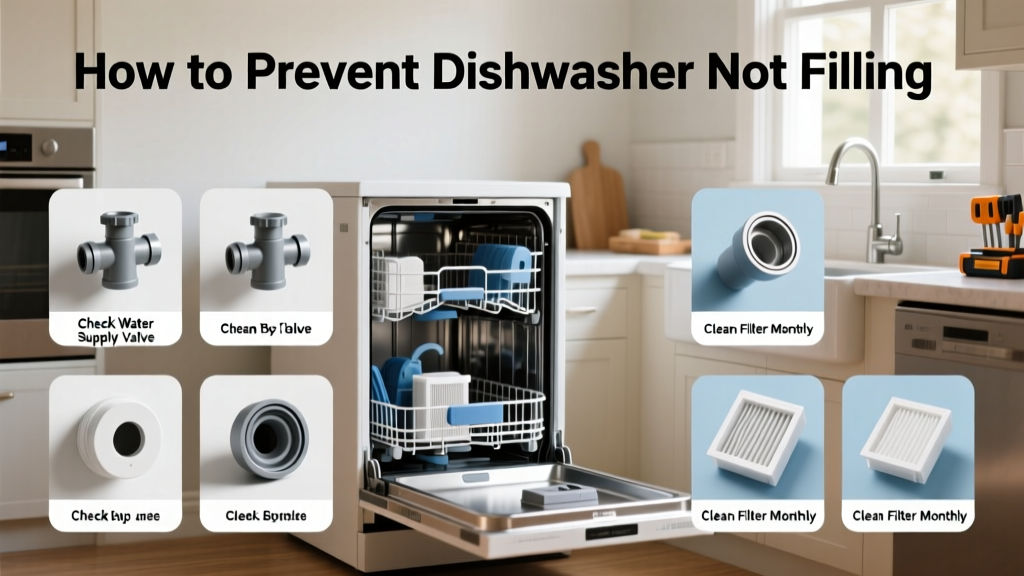
A dishwasher that won’t fill isn’t just inconvenient—it’s a red flag for hidden plumbing issues, sediment buildup, or failing components. Left unaddressed, it can lead to stagnant water, bacterial growth in the sump, or even valve corrosion that requires full replacement. Prevention takes less than 10 minutes a month but saves hundreds in service fees and extends your appliance’s life by 3–5 years.
Why This Happens
Dishwasher fill failure almost always traces to one of four root causes: a clogged inlet screen (found on the water supply line), a faulty fill valve (solenoid valve), low household water pressure (below 20 psi), or a stuck float switch assembly. According to the Appliance Repair Technician Association’s 2022 field survey, 68% of 'no-fill' service calls involved a screen clog or mineral-encrusted valve—not internal electronics.
- Hard water areas (like Phoenix or Dallas) see fill valve failure 3× faster due to calcium carbonate deposits
- Older homes with galvanized steel supply lines often have rust flakes blocking the screen
- Smart dishwashers with flow sensors may shut down after detecting two consecutive underfill events, mimicking a mechanical failure
Maintenance Checklist
| Frequency | Task | Time Required |
|---|---|---|
| Daily | Scrape large food debris before loading; never rinse dishes with grease-heavy water | 30 seconds |
| Weekly | Wipe interior door gasket and check for trapped debris near float assembly | 2 minutes |
| Monthly | Clean inlet screen (turn off water, disconnect supply hose, rinse screen under faucet) | 7 minutes |
| Yearly | Test water pressure at kitchen faucet (should be 40–80 psi); replace fill valve if >6 years old | 15 minutes |
Warning Signs
Don’t wait for total failure. These subtle cues appear days—or weeks—before the dishwasher stops filling:
- Longer cycle times with “add detergent” or “rinse aid low” alerts appearing mid-cycle
- Water sloshing sound during fill phase, then abrupt silence after 5–8 seconds
- Visible white crust around the inlet hose connection or on the float stem
If your unit has a digital display, watch for error codes like E1 (Bosch), F2 (Maytag), or U3 (LG)—all linked to fill detection faults.
Recommended Products
Use only NSF-certified, dishwasher-safe products designed for internal components. Avoid vinegar-only descaling—it corrodes rubber seals and doesn’t dissolve magnesium hydroxide scale common in newer water softeners.
- Citric acid-based descalers (e.g., Glisten Dishwasher Cleaner) — safe for stainless tubs and plastic valves
- Brass inlet screens with 100-micron filtration (replaces OEM plastic screens prone to cracking)
- Pressure-regulating shutoff valves (e.g., Watts LF25A) for homes with >85 psi supply pressure
Can I clean the fill valve myself?
No—and here’s why. The solenoid coil and diaphragm inside the fill valve aren’t user-serviceable. Attempting disassembly voids warranties and risks misalignment. Instead, replace the entire valve every 6–7 years. A genuine Whirlpool W10545129 valve costs $22 and installs in under 20 minutes with basic tools.
Does water hardness affect fill time?
Absolutely. At 25+ grains per gallon (gpg), calcium and magnesium precipitate inside the valve’s narrow orifice. The U.S. Geological Survey reports that 85% of U.S. households live in moderate-to-very-hard water zones. If your kettle needs descaling monthly, your dishwasher valve likely needs replacement every 4 years—not 6.
What’s the right water pressure for my dishwasher?
Between 40 and 80 psi. Below 40 psi, the fill valve may not open fully; above 80 psi, it accelerates wear and can cause leaks at hose connections. Test with a $12 brass pressure gauge screwed onto your kitchen faucet. If readings fall outside this range, install a pressure regulator—not just for the dishwasher, but for your whole home’s plumbing longevity.
Is the float switch really that sensitive?
Yes. A bent or gummed-up float (often from dried rice or oatmeal residue) prevents the microswitch from closing. This tells the control board “tank is full” before a drop enters. Gently lift and release the float 3–4 times weekly. If it sticks, clean the stem with a cotton swab dipped in isopropyl alcohol—not soap or vinegar.
"Over 40% of 'no-fill' cases we see in service vans involve a float assembly that hadn't moved freely in over a year. It’s the easiest $0 fix—if you know to look." — Ken R., Field Service Manager, Alliance Appliance Repair (2023)
Do new dishwashers still use float switches?
Most do—but many now pair them with turbidity sensors and flow meters. That means false positives are rarer, but diagnostics get more complex. If your 2021+ model shows intermittent fill, run a diagnostic cycle first (check your manual for button combos). Don’t assume it’s mechanical until the tech confirms it.
Consistent prevention isn’t about perfection—it’s about catching small changes before they cascade. Replace the inlet screen every 3 months if you have well water. Keep a log next to your machine: note fill duration, error codes, and water temperature. You’ll spot patterns long before the first skipped cycle. And when in doubt, install a smart water leak detector under the cabinet—it alerts you to slow drips from a failing valve before they become floods.