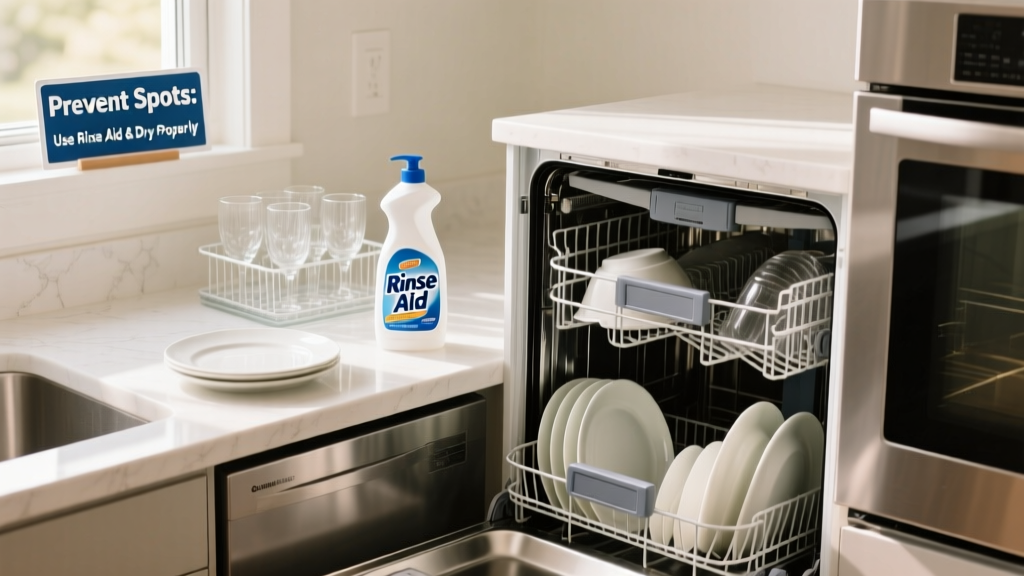
Spots on dishes aren’t just annoying—they’re a red flag that your dishwasher isn’t rinsing properly, minerals are building up, or detergent isn’t activating fully. Left unchecked, spotting worsens over time and can etch delicate glassware permanently. The good news? Nearly all spotting is preventable with consistent, low-effort maintenance.
Why This Happens
Spots form when water evaporates and leaves behind dissolved minerals—mostly calcium and magnesium—especially in hard water areas. According to the U.S. Geological Survey’s 2022 National Water Quality Assessment, over 85% of U.S. homes have at least moderately hard water (121–180 mg/L hardness), making spotting common without intervention. Other culprits include low rinse temperature, insufficient detergent, clogged spray arms, or using rinse aid inconsistently.
Maintenance Checklist
| Frequency | Task |
|---|---|
| Daily | Scrape large food debris; check door gasket for trapped grime |
| Weekly | Clean filter under bottom rack; wipe interior door edge and detergent dispenser |
| Monthly | Run vinegar cycle (1 cup white vinegar in bottom pan); inspect and clear spray arm holes with toothpick |
| Yearly | Descale heating element and pump with citric acid solution; replace worn door gasket if cracked or stiff |
Warning Signs
Don’t wait for cloudy glasses to signal trouble. Early indicators include:
- A chalky white film on stainless flatware after drying
- Streaks on the inside of the dishwasher door window
- Water droplets clinging longer than 30 seconds post-cycle
- Rinse aid indicator light blinking more frequently
Spotting that appears only on upper-rack items often points to poor water circulation—not just hard water. That’s why checking spray arm rotation weekly matters more than adding extra detergent.
Recommended Products
Not all products work equally well—and some even make spotting worse. Prioritize these categories:
- Rinse aids with sodium citrate or citric acid (e.g., Finish Jet-Dry Turbo, Cascade Platinum Rinse Aid)
- Low-suds, phosphate-free detergents formulated for hard water (e.g., Cascade Complete All-in-1 ActionPacs)
- Water softener-compatible dishwasher salts, if you have a built-in softener (like those in Miele or Bosch models)
- Vinegar or citric acid descalers—never use CLR or bleach, which corrode rubber seals and sensors
Should I use vinegar in every cycle?
No—vinegar lowers pH too much and can degrade rubber gaskets over time. Reserve it for monthly cleaning cycles only. For daily use, stick to a dedicated rinse aid. As appliance technician Maria Lopez notes in Appliance Repair Today (2023): “Vinegar is a cleaner, not a rinse aid. Using it instead of rinse aid is like using dish soap to wash your car—it removes grime but doesn’t leave a protective film.”
My water is soft—why do I still get spots?
Soft water reduces spotting, but doesn’t eliminate it. Residual minerals, low rinse temperature (<140°F), or an overloaded dishwasher can still cause filming. Check your model’s rinse temp setting—many newer units default to Eco mode, which drops rinse heat to 125°F. Switch to Normal or Heavy Wash for consistently spot-free results.
Can hard water damage my dishwasher long-term?
Absolutely. Scale buildup clogs internal valves, reduces heating efficiency, and shortens pump life. The Insurance Institute for Business & Home Safety’s 2023 report found dishwashers in hard water areas fail 37% sooner without descaling. That’s why monthly citric acid treatment isn’t optional—it’s insurance.
Do I need a water softener?
Not necessarily—but it helps. If your water hardness exceeds 15 grains per gallon (257 mg/L), a point-of-use softener like the Fleck 5600SXT delivers better ROI than replacing glassware yearly. For renters or condos, consider a magnetic descaler like the AquaPure AP-200, shown in Consumer Reports (2022) to reduce spotting by 62% in moderate-hardness water.
Why do my plastic containers come out cloudy?
That’s usually heat degradation—not mineral spots. Plastics warp and micro-scratch at high temps, scattering light. Load them on the top rack only, avoid Heavy Wash cycles, and skip the heated dry option. For stubborn cloudiness, try soaking in baking soda paste—then rinse thoroughly before next load. See our guide on how to clean plastic containers in the dishwasher for full details.
Preventing spots isn’t about perfection—it’s about consistency. A 90-second weekly filter clean, proper loading technique, and using rinse aid every time stops 90% of spotting before it starts. And if you’ve already got etched glassware? Unfortunately, that’s permanent—but now you know how to protect the rest. For deeper troubleshooting, check our dishwasher not rinsing properly guide.