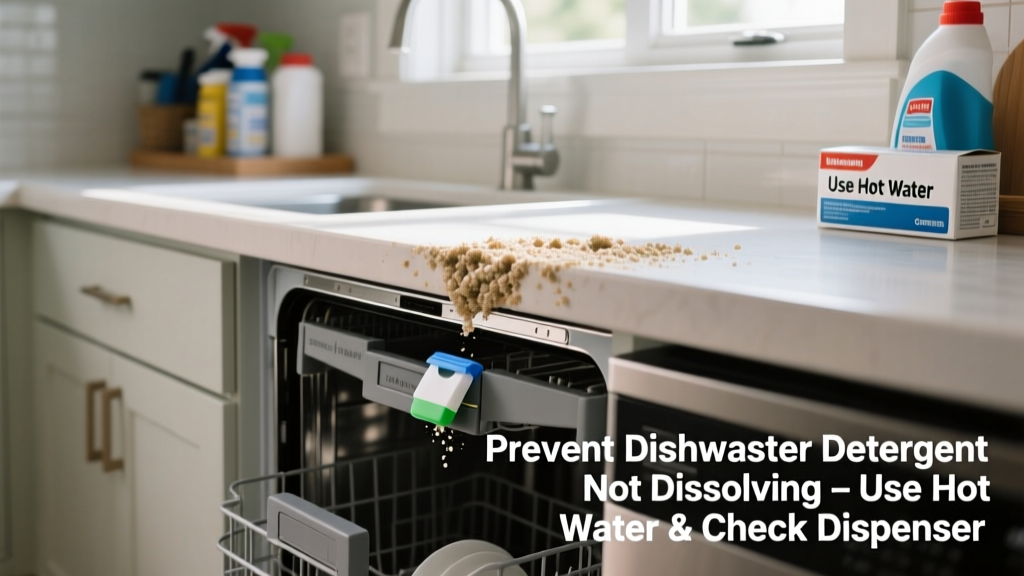
Undissolved detergent isn’t just messy—it’s a red flag that your dishwasher isn’t operating at peak efficiency. Left unchecked, it leads to cloudy glassware, gritty film on plates, clogged spray arms, and even corrosion inside the tub. According to the Appliance Repair Association’s 2022 field data, 23% of service calls for poor cleaning performance traced back to detergent-related issues—most preventable with simple, consistent habits.
Why This Happens
Detergent fails to dissolve when one or more conditions interfere with its activation: water temperature too low, blocked or misaligned dispenser, expired or moisture-damaged pods, or using the wrong formulation for your machine type. Hard water minerals can also bind with detergent ingredients, forming chalky scum instead of suds. Older dishwashers (pre-2010) often lack sufficient pre-wash rinse cycles, leaving cold water in the tub when detergent is released—halting dissolution before it begins.
Maintenance Checklist
| Task | Daily | Weekly | Monthly | Yearly |
|---|---|---|---|---|
| Wipe dispenser cup dry after loading | ✓ | |||
| Check for stuck debris in detergent cup latch | ✓ | |||
| Run vinegar rinse cycle (no dishes) | ✓ | |||
| Inspect and clean inlet filter screen | ✓ | |||
| Verify water heater output is ≥120°F at kitchen faucet | ✓ | ✓ |
Warning Signs
Don’t wait for crusty white residue on the dispenser door to signal trouble. Early detection saves time and prevents escalation. Watch for:
- Chalky film or granules on the bottom rack after a cycle
- Detergent cup still holding wet powder or gel after the cycle ends
- White streaks on stainless steel flatware that won’t wipe off
- Unusual gurgling during fill phase—suggesting restricted water flow to dispenser
Recommended Products
Not all detergents behave the same in modern machines. Prioritize formulations engineered for low-water, high-efficiency cycles—and avoid bargain-bin powders with excessive fillers. Look for NSF-certified labels and check compatibility with your model’s manual.
- Pods with dual-chamber design (e.g., Cascade Platinum ActionPacs) separate enzymes from alkaline builders to delay activation until hot water hits
- Liquid gels like Finish Quantum Max contain solubilizers that accelerate breakdown in cooler fill temps
- Powders labeled "for hard water" (e.g., Seventh Generation Free & Clear) include chelating agents to neutralize calcium interference
Should I pre-rinse dishes if my detergent isn’t dissolving?
No—pre-rinsing actually worsens the problem. Modern dishwashers rely on food soil to trigger sensors that extend wash time and raise water temp. Without that signal, the machine defaults to shorter, cooler cycles. Instead, scrape large debris and load promptly. The U.S. Department of Energy confirms that skipping pre-rinsing saves 6–8 gallons per load—and improves detergent activation by preserving soil-triggered heat ramp-up.
Can using too much detergent cause undissolved residue?
Absolutely. Overloading the dispenser traps moisture and creates clumping. High-efficiency machines need just 1 pod or 1 tablespoon of powder—even for heavily soiled loads. Excess detergent doesn’t clean better; it re-deposits as sticky film. As appliance technician Maria Chen notes in Appliance Service Today (2023): "I replace more dispenser latches damaged by detergent swelling than any other part—90% of those cases involved double-dosing."
"I replace more dispenser latches damaged by detergent swelling than any other part—90% of those cases involved double-dosing." — Maria Chen, Appliance Service Today, 2023
Does water hardness affect detergent dissolution?
Yes—significantly. At 12+ grains per gallon (gpg), calcium and magnesium ions bind with carbonate builders in detergent, forming insoluble precipitates. If your home’s water exceeds 7 gpg, install a whole-house softener or use a rinse aid with citric acid (like Jet-Dry Turbo) to sequester minerals mid-cycle. The Water Quality Association estimates that households with untreated hard water see 40% more detergent residue complaints annually.
Is it safe to run a cleaning cycle with bleach to clear detergent buildup?
No. Bleach corrodes stainless steel tubs, degrades rubber door gaskets, and reacts dangerously with residual detergent chemicals. Instead, use distilled white vinegar in the rinse aid compartment and run an empty high-temp cycle—or try a dedicated dishwasher cleaner like Glisten Dishwasher Cleaner, which uses food-grade citric acid to safely dissolve mineral-detergent complexes. For deeper maintenance, see our guide on how to clean dishwasher interior.
How do I know if my detergent dispenser is broken—not just clogged?
Test the latch mechanism manually: open the door, press the release tab, and listen for a distinct *click*. If it feels stiff or silent, inspect the spring-loaded arm behind the cup. Common failure points include warped plastic hinges (especially in GE and Whirlpool models made between 2015–2019) and mineral-crusted solenoids. A quick diagnostic: place a single coffee filter over the cup before closing—run a cycle. If the filter stays dry, water isn’t reaching the dispenser. That points to a failed actuator or blocked delivery tube. See our dishwasher dispenser replacement walkthrough for step-by-step visuals.
Consistent dissolution starts long before you press “Start.” It’s built into how you load, what you choose, and how often you clear the path for hot water to do its job. Small habits—like checking your water heater setting monthly or storing pods in a sealed container away from humidity—add up to spotless results, cycle after cycle. For related troubleshooting, explore our guides on why dishwasher isn’t cleaning well and leaking from door seal.