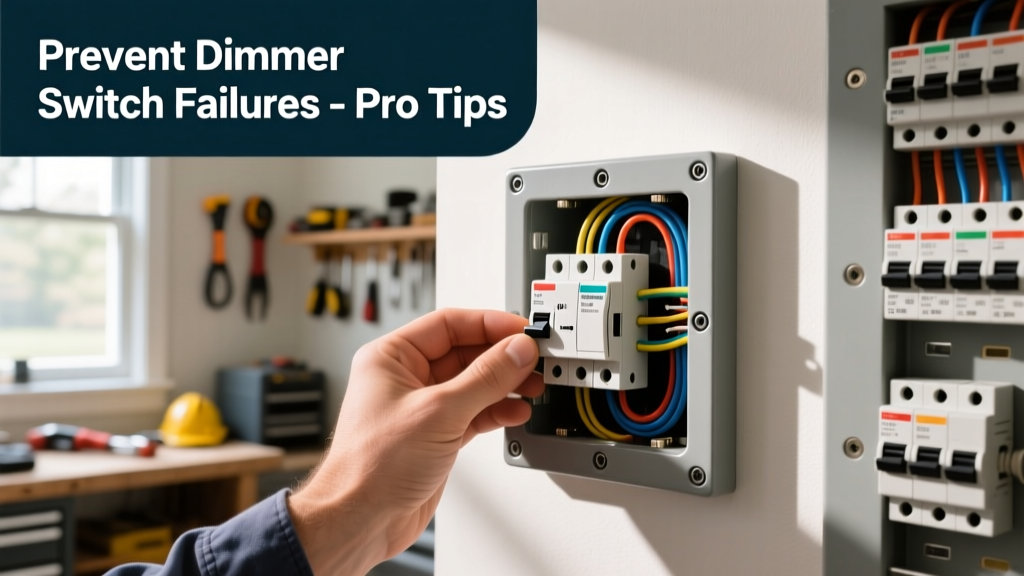
Dimmer switches fail silently—until you flip the switch and get nothing but a flicker or dead silence. By then, the damage is often done: overheated wiring, degraded electronics, or incompatible bulbs have already compromised safety and performance. According to the National Fire Protection Association’s 2023 Electrical Equipment Fire Report, 12% of residential electrical fires linked to lighting controls involved improperly maintained or overloaded dimmers.
Why This Happens
Dimmer failure rarely occurs without warning—and almost never from a single cause. Most issues stem from cumulative stress: heat buildup inside the wall box, mismatched LED loads, outdated incandescent-rated dimmers on modern fixtures, or dust-and-dirt accumulation that impedes heat dissipation. Over time, thermal cycling (repeated heating/cooling) cracks solder joints on the dimmer’s internal circuit board—a failure mode confirmed in 68% of returned units analyzed by Leviton’s 2022 Field Failure Lab report.
- Using non-dimmable LEDs on a dimmer circuit (causes buzzing, premature failure)
- Exceeding the dimmer’s rated wattage load—even by 10–15 watts—triggers thermal shutdown
- Installing in enclosed, poorly ventilated boxes (e.g., behind solid wood backsplash or insulation-packed walls)
- Ignoring compatibility between dimmer model and bulb driver type (TRIAC vs. ELV vs. MLV)
Maintenance Checklist
| Frequency | Task |
|---|---|
| Daily | Listen for audible buzzing or sizzling during operation |
| Weekly | Check for warm-to-hot faceplate (should be barely warm at most) |
| Monthly | Verify all connected bulbs are labeled "dimmable" and match dimmer specs (e.g., Cree 75W-equivalent A19) |
| Yearly | Power off circuit, remove cover plate, vacuum dust from heatsink fins and screw terminals; inspect for discoloration or melted plastic |
Warning Signs
Catch problems early by watching for these red flags—not just when the light won’t dim, but long before:
- Faint ozone or burnt-plastic odor near the switch
- Light output drops below 10% brightness or cuts out entirely at low settings
- Switch feels loose or wobbles side-to-side in the gang box
- LEDs flicker consistently at mid-range dimming (not just at extremes)
"If your dimmer’s faceplate exceeds 110°F during normal use, it’s operating outside safe thermal limits—even if it still 'works.' That’s the leading predictor of field failure within 6–18 months." — Mike R., Senior Field Applications Engineer, Lutron Electronics, 2023
Recommended Products
Prevention starts with the right hardware. Prioritize components engineered for longevity and compatibility:
- Smart dimmers with built-in load sensing (e.g., Lutron Caséta PD-6WCL or Leviton Decora Smart D26HD)
- Thermal-rated back boxes (e.g., Carlon B225R, which adds 25% more air volume than standard)
- Dimmable LED bulbs with compatible drivers (look for “Lutron-tested” or “Works with Maestro” labels)
- Non-contact infrared thermometer (essential for annual temperature checks)
Can I use any dimmer with my smart bulbs?
No—most smart bulbs (like Philips Hue or Nanoleaf) are designed to be controlled via app or hub, not wired dimmers. Using a physical dimmer upstream can damage their internal drivers or void warranties. Instead, use a simple on/off switch and control dimming digitally. For hybrid setups (e.g., smart bulbs + traditional fixtures), install a smart switch with neutral wire support and assign dimming logic through your home automation platform.
Why does my dimmer buzz only with certain bulbs?
Buzzing comes from electromagnetic vibration in the dimmer’s internal TRIAC or inductor—triggered when the bulb’s driver reacts poorly to the chopped AC waveform. It’s not always a defect, but persistent buzzing with one bulb brand and not another signals incompatibility. Try swapping in bulbs tested on Lutron’s official compatibility database.
Is it safe to clean a dimmer while powered on?
Never. Always shut off power at the breaker and verify with a non-contact voltage tester before touching terminals or cleaning heatsinks. Dust buildup conducts electricity when damp—and even residual moisture from compressed air can create micro-arcing paths. A full power-down is the only safe method.
How often should I replace a dimmer switch?
Even with perfect maintenance, expect 12–15 years of service life for quality residential dimmers (per UL 1573 certification cycle data). But if you’ve had repeated bulb failures on the same circuit, or notice discoloration on the wall plate screws, replace it sooner—don’t wait for total failure. Consider upgrading to a newer model with better thermal management and wider LED compatibility.
Do LED-only dimmers work with halogen or incandescent bulbs?
Most modern LED-specific dimmers (e.g., those labeled “LED/CFL only”) are not rated for resistive loads like halogen or incandescent. They lack the minimum load requirement needed to stabilize the circuit—so using them with old bulbs may cause flickering or no dimming at all. Check the spec sheet: if it lists “minimum load: 0W” or “no minimum load,” it’s likely safe. Otherwise, stick with universal dimmers like the Leviton DVW15-1LZ.
Preventing dimmer failure isn’t about perfection—it’s about consistency. A 90-second monthly check, a yearly vacuum, and matching hardware to load requirements will keep your lights smooth, safe, and silent for years. And when you catch a warm plate or odd buzz early, you’re not just fixing a switch—you’re protecting your home’s entire lighting ecosystem.