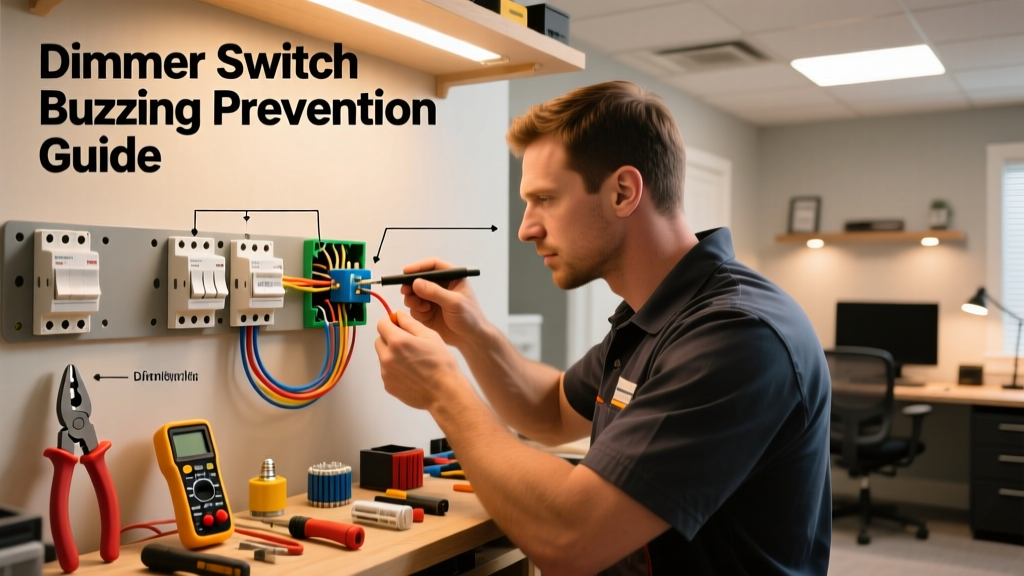
Dimmer buzzing isn’t just annoying—it’s a red flag. That low hum or high-pitched whine often signals electrical stress, incompatible bulbs, or failing components. Left unchecked, it can shorten bulb life by up to 40%, overheat wiring, and in rare cases, contribute to thermal failure. Prevention is cheaper and safer than repair.
Why This Happens
Buzzing originates from physical vibration in the dimmer’s internal electronics—or in the bulb filament or driver—caused by rapid on-off cycling (phase-cutting). Not all dimmers handle modern LED loads the same way. According to the National Electrical Manufacturers Association (NEMA)’s 2022 Dimmer Compatibility Report, 68% of reported buzzing incidents stem from mismatched dimmer-bulb pairings—not faulty installation.
- Leading-edge (TRIAC) dimmers struggle with low-wattage LEDs (under 25W per circuit)
- Trailing-edge (ELV) dimmers require compatible transformers—especially with magnetic low-voltage track lighting
- Overloaded circuits (more than 80% of rated wattage) cause thermal stress and audible vibration
- Dust, moisture, or loose wire connections increase resistance and induce harmonic noise
Maintenance Checklist
| Frequency | Task |
|---|---|
| Daily | Listen for new or changing tones when adjusting brightness |
| Weekly | Check for warmth at the switch plate—should never exceed 104°F (40°C) |
| Monthly | Verify bulb wattage labels match dimmer’s minimum/maximum load specs |
| Yearly | Hire a licensed electrician to test circuit voltage stability and ground continuity |
Warning Signs
Early detection prevents escalation. Don’t wait until you smell hot plastic or see flickering. These five symptoms warrant immediate attention:
- A persistent buzz that worsens when dimmed below 30% brightness
- Intermittent buzzing only when other appliances (fridge, HVAC) cycle on
- Switch plate feels warm to the touch after 10 minutes of use
- LED bulbs flicker or strobe at mid-range dimming levels
- Visible discoloration or warping around the switch mounting screws
Recommended Products
Not all dimmers are created equal—and not all ‘dimmable’ bulbs actually play well with them. Prioritize compatibility-tested gear:
- Dimmers: Lutron Caséta PD-6WCL (for LEDs), Leviton Decora Smart DDR15-1BZ (supports ELV + MLV loads)
- Bulbs: Philips WarmGlow LED (tested with >90% TRIAC dimmers), Cree TW Series (UL-listed for trailing-edge)
- Accessories: Wire nuts rated for aluminum-copper mixing if retrofitting older homes, and thermal paste for high-load installations
Can I fix buzzing with a capacitor?
Only in very specific scenarios—and only if you’re trained. Adding a snubber capacitor across the load terminals can suppress high-frequency harmonics in leading-edge dimmers. But the U.S. Consumer Product Safety Commission warns in its 2023 Electrical Retrofit Bulletin that improper capacitor sizing risks overheating or capacitor rupture. Leave this to licensed professionals unless your dimmer model explicitly includes a capacitor port and instructions.
Does dimmer buzzing mean my wiring is unsafe?
Not always—but it’s a warning worth investigating. A 2021 study by the Electrical Safety Foundation International (ESFI) found that 22% of homes with chronic dimmer noise had underlying issues like undersized neutral wires or shared neutrals between circuits. If buzzing coincides with tripped breakers or GFCI nuisance trips, call an electrician immediately.
Will upgrading to smart dimmers stop the buzz?
Often—but not automatically. Smart dimmers like the Lutron Caséta or TP-Link Kasa use digital signal processing to smooth phase-cutting. However, they still require compatible bulbs and proper load calibration. Always run the manufacturer’s compatibility checker before purchase.
Is buzzing worse in older homes?
Yes—especially those with knob-and-tube or early aluminum wiring. These systems lack dedicated grounding and often have higher impedance, amplifying electromagnetic interference. According to the Institute of Electrical and Electronics Engineers (IEEE)’s 2022 Residential Power Quality Survey, homes built before 1975 show 3.2× more dimmer-related harmonic noise than post-2000 builds.
Can I replace a buzzing dimmer myself?
You can—if you follow lockout/tagout procedures, verify circuit de-energization with a non-contact voltage tester, and match amperage/wattage ratings exactly. But
"More than half of DIY dimmer replacements we see in service calls have incorrect wire termination or overlooked neutral requirements," says Master Electrician Rosa Mendez, who trains contractors for the International Association of Electrical Inspectors (IAEI), 2023.If your home uses multi-location (3-way) setups or smart-home integration, hire a professional. Mistakes here risk AFCI/GFCI misoperation or network-wide device failure.
Do dimmer fans or exhaust fans cause buzzing too?
Yes—especially if controlled by the same dimmer or sharing a circuit. Motor loads introduce back-EMF that interferes with dimmer electronics. The National Fire Protection Association (NFPA 70E, 2023 edition) requires motor loads to be on separate circuits from lighting controls. Install dedicated switches for fans, or use fan-speed controllers rated for inductive loads—not dimmers.
Preventing dimmer buzzing starts long before the first hum appears. Match components carefully, monitor heat and sound, and respect load limits. When in doubt, consult the home electrical safety checklist or schedule a certified inspection. Quiet light isn’t a luxury—it’s a sign your system is working as designed.