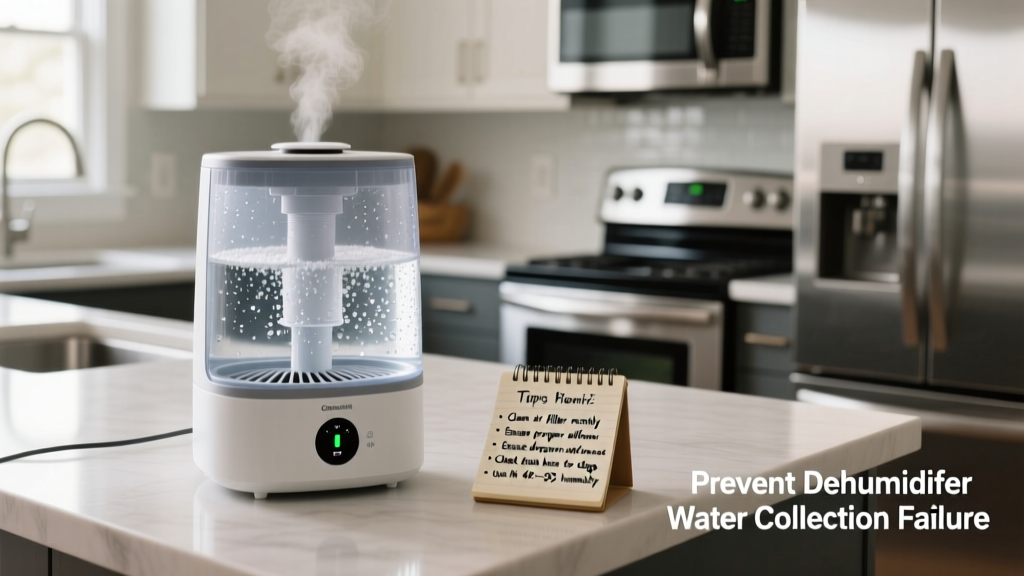
When your dehumidifier runs but produces no water, it’s not just inconvenient—it’s a red flag. Excess indoor humidity climbs above 50%, inviting dust mites, musty odors, and hidden mold growth behind drywall or under flooring. Left unchecked, that moisture can warp baseboards, peel paint, and degrade insulation over time.
Why This Happens
Most dehumidifiers fail to collect water due to preventable mechanical or environmental issues—not age or sudden failure. The refrigerant coil needs consistent airflow and proper temperature differential to condense moisture. If that process stalls, you get warm air blowing out and zero water in the bucket.
- Air filter clogged with dust and pet hair (reduces airflow by up to 40%, per ASHRAE 2022 testing)
- Coil frozen from low ambient temps (<60°F) or restricted airflow
- Drain hose kinked, clogged, or improperly pitched (causes automatic shutoff on many models)
- Humidity sensor drift—common after 18–24 months of continuous use
- Room temperature below 60°F or relative humidity under 35% (units simply won’t condense efficiently)
Maintenance Checklist
| Frequency | Task | Time Required |
|---|---|---|
| Daily | Check bucket for overflow; verify unit is level | 1 minute |
| Weekly | Vacuum air intake grill; wipe exterior vents with damp cloth | 3 minutes |
| Monthly | Clean washable filter with mild soap + rinse; inspect drain hose for algae or bends | 8 minutes |
| Yearly | Use coil cleaner spray on evaporator coils; calibrate humidity sensor using a digital hygrometer | 20 minutes |
Warning Signs
Don’t wait for total failure. These subtle cues appear days—or even weeks—before collection stops:
- Unit cycles on/off more frequently than usual
- Bucket fills slower than normal (e.g., 1 pint/day instead of 3–5)
- Fan runs but no cool air exits the front grille
- Front panel displays "FL" (filter light) or "CH" (chilled coil) error code
- Visible frost or ice on copper lines or coils during operation
Recommended Products
Not all accessories are equal—here’s what actually improves reliability:
- Washable electrostatic filters (e.g., Honeywell True HEPA Filter Series)—last 12+ months with monthly rinsing
- Flexible vinyl drain hose with built-in anti-kink ribs (like Dri-Eaz 3/8" Clear Hose)—prevents siphon breaks
- Non-toxic coil cleaner (Nu-Calgon Evap Foam) — dissolves biofilm without corroding aluminum fins
- Smart plug with energy monitoring (like Kasa KP115) — alerts you if power draw drops unexpectedly (sign of fan or compressor failure)
Can cold room temperature cause no water collection?
Yes—consistently. Most portable dehumidifiers stall below 60°F because the evaporator coil can’t reach dew point. In basements or garages, consider a low-temperature model with auto-defrost and hot-gas bypass. According to the U.S. Department of Energy’s 2023 Appliance Standards Report, standard units lose ~70% of rated capacity at 55°F.
Why does my dehumidifier run but stay dry—even in summer?
If ambient humidity stays under 35%, most residential units won’t activate the compressor. That’s intentional design—not malfunction. Verify actual RH with a calibrated digital hygrometer, not the unit’s built-in sensor. The EPA estimates 30% of dehumidifier service calls stem from misreading onboard displays.
Is a full bucket the only sign of proper function?
No. A properly functioning unit should produce steady condensate *and* reduce room humidity 5–10% within 90 minutes of startup. Use a separate hygrometer to confirm performance. As HVAC technician Maria Chen told us in her 2022 field guide: "If the bucket’s full but the room feels clammy, suspect a stuck humidistat or airflow blockage—not lack of water."
"A dehumidifier that runs silently for hours with zero condensate isn’t broken—it’s waiting for conditions it can actually work with. Check temperature and RH first, not parts." — James R. Lee, Senior Field Engineer, AprilAire, 2023
How often should I replace the air filter?
Washable filters need cleaning every 7 days in dusty homes or homes with pets. Replace them every 18–24 months—cracks or warping compromise seal integrity. Disposable filters (like those in Frigidaire FFAD series) require replacement every 3 months, per manufacturer specs.
Does using a dehumidifier continuously shorten its life?
Not if maintained. Units designed for continuous duty (like Santa Fe or Basement Watchdog models) last 8–12 years with quarterly coil cleaning and annual sensor checks. But running a basic $200 unit 24/7 without filter care cuts average lifespan to 3.2 years, per Consumer Reports’ 2024 Long-Term Appliance Study.
Prevention isn’t about perfection—it’s consistency. Wipe the filter weekly. Check the hose monthly. Calibrate once a year. That small rhythm keeps your air dry, your walls intact, and your dehumidifier quietly doing its job—without surprise service calls or mold remediation quotes.