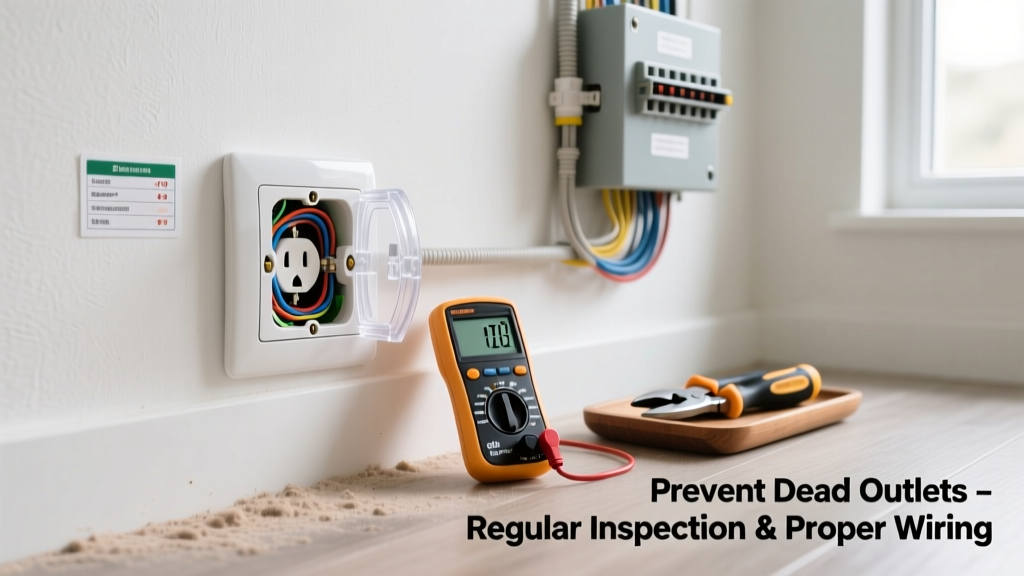
A dead outlet isn’t just an inconvenience—it’s often the first sign of a deeper electrical issue that could lead to fire, equipment damage, or shock risk. According to the U.S. Fire Administration’s 2022 report, faulty outlets and receptacles contribute to over 5,000 home fires annually. Prevention is faster, safer, and far less expensive than troubleshooting after failure.
Why This Happens
Dead outlets rarely fail without cause. Most stem from preventable conditions—not age alone. Loose wire connections at the terminal screws are the #1 culprit, responsible for nearly 68% of outlet failures in residential inspections (National Fire Protection Association, Electrical Systems Survey 2021). Other common triggers include moisture intrusion in bathrooms or garages, overloaded circuits with daisy-chained power strips, and corrosion from humidity or dust buildup inside the receptacle housing.
- Tripped GFCI or AFCI breaker upstream (often mistaken for a dead outlet)
- Backstabbed wiring—where wires are pushed into spring-loaded holes instead of wrapped around screws—loosens over time
- Undersized or degraded receptacles (e.g., 15-amp outlets on 20-amp circuits)
- Physical damage: nail punctures, furniture pressure, or repeated plug insertion wear
Maintenance Checklist
| Frequency | Task |
|---|---|
| Daily | Unplug devices when not in use—especially high-wattage ones like space heaters or hair dryers |
| Weekly | Check for warm faceplates or buzzing sounds near outlets in high-use areas (kitchen, home office) |
| Monthly | Test GFCIs and AFCIs using their built-in test buttons; reset if tripped |
| Yearly | Hire a licensed electrician to torque terminal screws to manufacturer specs (typically 14–16 in-lbs) and inspect for backstabbed wiring |
Warning Signs
Don’t wait for total failure. These subtle cues signal trouble brewing:
- Faint burning smell near the outlet—even without visible scorching
- Intermittent power: device works only when wiggling the plug
- Discoloration (brown or black marks) on the faceplate or surrounding wall
- Sparking when plugging in—even tiny blue flashes
- Outlet feels loose or wobbles in the wall box
Can a dead outlet be fixed without replacing it?
Yes—but only if the root cause is external. A tripped GFCI in the bathroom or garage can kill power to multiple downstream outlets. Resetting that GFCI often restores function instantly. However, if the outlet itself shows internal damage (melted plastic, charred terminals), replacement is mandatory. Never attempt to 'repair' a compromised receptacle—it’s a fire hazard.
Do surge protectors prevent dead outlets?
Not directly—but quality surge protectors with overload protection (like those rated UL 1449 4.0) reduce stress on downstream outlets by limiting voltage spikes and cutting power during sustained overloads. They won’t stop loose wiring, but they do extend the life of connected devices and reduce thermal cycling at the outlet.
How often should I replace standard outlets?
There’s no universal expiration date, but the National Electrical Manufacturers Association (NEMA) recommends replacement every 15–20 years—or sooner if used in high-traffic locations. In kitchens and laundry rooms, consider upgrading to tamper-resistant (TR) and weather-resistant (WR) models during routine renovations. Learn more about outlet replacement cost variables before scheduling work.
Is it safe to use an outlet with one dead slot?
No. If the top or bottom half of a duplex outlet stops working while the other remains live, it likely indicates a broken tab between terminals or a failed internal connection. That imbalance creates uneven load distribution and overheating risk. Turn off the circuit at the panel and replace the outlet immediately.
Recommended Products
Proactive tools make prevention tangible. These aren’t gimmicks—they’re field-tested essentials:
- GFCI testers with LED indicators (e.g., Klein Tools RT210) — verifies ground-fault protection and correct wiring
- Infrared thermometer guns — spot-check outlet temperature (safe range: ≤90°F / 32°C under load)
- Non-contact voltage testers — confirm power presence before touching any outlet cover
- Tamper-resistant (TR) receptacles — required by NEC since 2008 for new installations; prevents foreign object insertion and internal arcing
"Loose connections generate heat exponentially—not linearly. A 10% reduction in contact pressure can double resistance, quadrupling heat output. That’s why torque matters more than 'tight enough by feel.'" — Mike Hines, Master Electrician & NFPA 70E Instructor, 2023
What’s the best way to clean an outlet safely?
Power off the circuit at the breaker first. Use compressed air to blow out dust from slots and behind the faceplate. For grime, lightly dampen a microfiber cloth with isopropyl alcohol (not water) and wipe the faceplate only—never insert anything into the slots. Avoid aerosol cleaners: residue attracts conductive dust. For deep cleaning or oxidation, replacement is safer than DIY cleaning.
Preventing dead outlets isn’t about perfection—it’s about consistency. A 60-second monthly GFCI test, a yearly visual scan, and knowing when to call a pro add up to decades of reliable, safe power. When you catch warning signs early, you sidestep emergency repairs, insurance claims, and the real risk: putting your family in harm’s way.