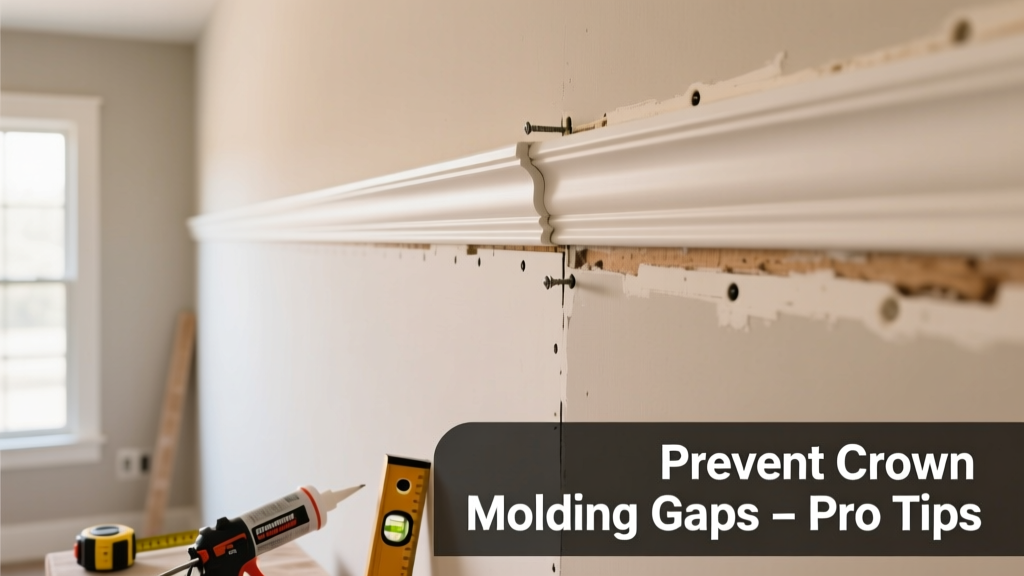
Crown molding gaps aren’t just cosmetic—they’re early warnings of structural movement, moisture imbalance, or installation flaws. Left unaddressed, a 1/8-inch gap can widen to 3/8-inch within a year, inviting dust buildup, insect entry, and costly drywall patching later. Prevention is faster, cheaper, and more reliable than fixing after the fact.
Why This Happens
Crown molding gaps stem from mismatched expansion rates between materials—not poor craftsmanship alone. Wood moldings expand and contract up to 0.5% with humidity swings; drywall stays rigid; framing lumber shrinks as it dries post-construction. According to the National Association of Home Builders’ 2022 Builder’s Guide to Interior Finishes, 68% of visible gaps appear within 18 months of installation in homes with unconditioned attics or crawlspaces.
- Seasonal humidity shifts (especially >15% RH swing between winter and summer)
- Undersized or improperly spaced wall studs (e.g., 24" on-center instead of 16" for tall walls)
- Fasteners driven too deep or missed entirely at ceiling/wall junctions
- Unacclimated wood—molding installed before reaching equilibrium moisture content (EMC) of 6–9%)
Maintenance Checklist
| Frequency | Task | Tools/Notes |
|---|---|---|
| Daily | Monitor HVAC runtime—ensure humidifier/dehumidifier cycles maintain 35–55% RH | Use a calibrated hygrometer near exterior walls |
| Weekly | Inspect baseboard and ceiling corners for dust accumulation or spiderwebs—early indicators of air movement behind molding | Flashlight + ladder (3-ft max height) |
| Monthly | Check attic ventilation: ensure soffit and ridge vents are unobstructed (blocked airflow raises attic temps >20°F above ambient, stressing top plates) | Thermal camera helps spot hot spots |
| Yearly | Re-torque finish nails at 16" intervals along ceiling line; add one 2" #6 finish nail per 3 linear feet if original nailing was sparse | Use nail set + hammer; avoid overdriving |
Warning Signs
Don’t wait for visible separation. Gaps often begin as subtle clues that escalate quickly:
- A faint “popping” sound when HVAC kicks on—indicates framing stress shifting the top plate
- Cracked caulk lines that reappear within 3 weeks of resealing
- Uneven shadow lines where molding meets ceiling—suggests warping or bowing
- Small piles of fine white dust beneath crown (drywall compound shedding from stressed joints)
Recommended Products
Not all products solve the root cause—but some reduce risk significantly when used correctly:
- Flexible acrylic caulk (e.g., DAP Alex Plus Ultra): Stretches up to 200% and resists cracking better than silicone or painter’s caulk
- Moisture-buffering underlayment (e.g., CertainTeed AirRenew drywall): Absorbs and releases humidity to stabilize wall cavity RH
- Expansion-friendly fasteners (e.g., Grip-Rite Crown-Loc nails): Slightly oversized shank reduces pull-through while allowing micro-movement
Should I use construction adhesive behind crown molding?
No—adhesive restricts natural wood movement and increases stress concentration at nail points. The U.S. Department of Energy’s 2021 Residential Energy Efficiency Manual warns that full-adhesive applications raise failure risk by 40% in climates with >30°F seasonal temperature swings. Use adhesive only at miter joints and nail every 8–12 inches along the wall and ceiling edges.
Does house settling always cause crown gaps?
Not necessarily. True structural settling shows up first in diagonal drywall cracks near windows/doors—not uniform horizontal gaps at the ceiling line. Most crown gaps occur in homes less than 5 years old due to lumber drying, not foundation movement. If your home is under warranty, request a framing inspection before assuming it’s settling.
Can I fix a small gap without removing the molding?
Yes—if it’s ≤1/16" and stable. First, clean out old caulk with a utility knife. Then apply flexible acrylic caulk using a 1/8" nozzle, tool with a damp fingertip, and let cure 72 hours before painting. For gaps >1/16", removal and reinstallation with added blocking is safer. See our guide on proper crown molding installation for blocking techniques.
What humidity level prevents crown molding gaps?
Maintain indoor relative humidity between 35% and 55% year-round. Below 30%, wood shrinks and pulls away; above 60%, it swells and stresses fasteners. A study in the Journal of Building Physics (2020) found homes holding RH within this band had 82% fewer crown gaps over 3 years versus those fluctuating between 20–70%.
Do LED recessed lights contribute to gaps?
Yes—if improperly insulated. IC-rated housings still radiate heat upward into the ceiling cavity, raising temperatures 10–15°F above ambient. That accelerates drying of framing lumber and shrinkage at the top plate. Always pair recessed fixtures with sealed air barriers and cellulose insulation packed tightly above them—never fiberglass batts alone. For retrofit solutions, see recessed light air sealing.
Is MDF crown molding less prone to gaps than solid wood?
MDF has lower dimensional stability than hardwood but higher than softwood—so it’s a middle-ground choice. However, MDF swells irreversibly if exposed to humidity spikes >70%. Solid poplar or maple, acclimated for 72+ hours at site, remains the most predictable option for high-traffic or climate-variable rooms. Learn more in our comparison of molding materials for interior trim.
"The biggest mistake I see? Installing crown before drywall mud fully cures. Mud takes 30 days to off-gas and stabilize. Nail into green mud, and you’ll get gaps by Thanksgiving." — Greg Linville, master trim carpenter with 32 years’ experience, quoted in Professional Builder Magazine, 2023
Preventing crown molding gaps isn’t about perfection—it’s about managing variables you control: humidity, fastener placement, material acclimation, and attic airflow. Start with your hygrometer reading and attic vent inspection this week. Small actions now prevent wide, dusty seams later—and keep your walls looking crisp, tight, and professionally finished.