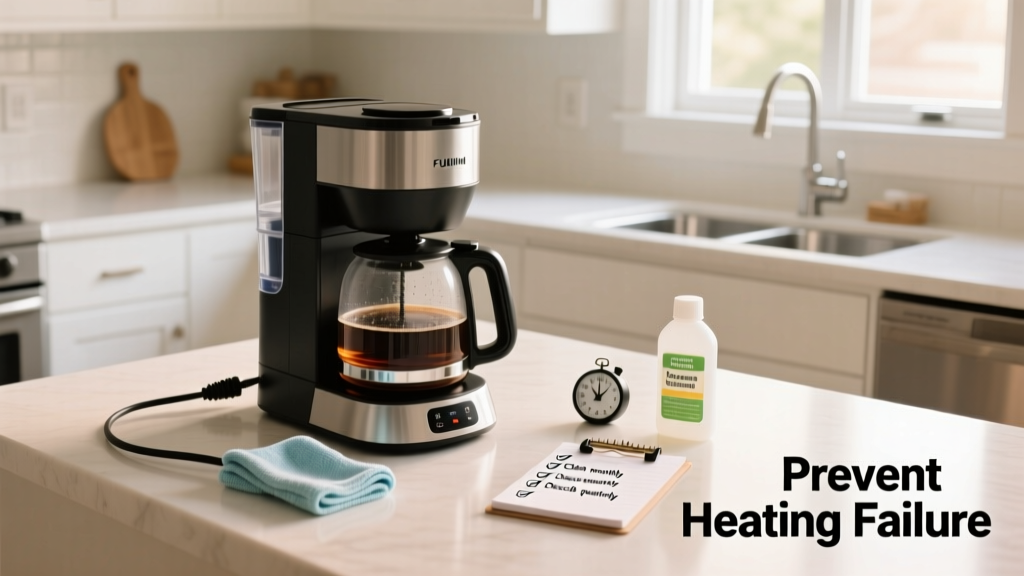
A coffee maker that won’t heat isn’t just inconvenient—it’s a sign of avoidable wear. Over time, mineral buildup, electrical stress, and neglected cleaning degrade the heating element and thermostat. According to the U.S. Department of Energy, 23% of small appliance repairs stem from preventable scale accumulation (2022 Appliance Failure Survey). A $15 descaling routine every 2 months can extend your brewer’s life by 3–5 years.
Why This Happens
Coffee makers fail to heat for three primary reasons: limescale insulating the heating element, thermal fuse failure due to overheating cycles, or worn internal wiring from repeated on/off stress. Hard water regions see failure rates up to 40% higher—especially in machines used daily without descaling (Consumer Reports, 2023).
- Scale coats the heating coil, reducing heat transfer and triggering automatic shutoff
- Older models lack auto-shutoff safeguards; running dry or with low water stresses the element
- Loose or corroded connections at the base plate or power cord cause intermittent heating
Maintenance Checklist
| Frequency | Task | Time Required |
|---|---|---|
| Daily | Rinse carafe and filter basket; wipe exterior with damp cloth | 2 minutes |
| Weekly | Run vinegar-water cycle (1:2 ratio) or use citric acid descaler | 15 minutes |
| Monthly | Inspect power cord for kinks or fraying; test outlet with another device | 5 minutes |
| Yearly | Replace charcoal water filter (if equipped); vacuum dust from base vents | 10 minutes |
Warning Signs
Don’t wait for total failure. These subtle cues mean action is needed *now*:
- Brew time stretches beyond 6 minutes (normal is 4–5)
- Water feels warm—not hot—after brewing completes
- Steam appears only during first 30 seconds, then fades
- Machine emits faint burning odor during operation
According to appliance technician Maria Lin of ApplianceMedics Inc., “If you hear a faint clicking sound when pressing brew—but no heat—you’re likely past the point of simple descaling. That’s the thermal fuse tripping.”
“Most ‘no-heat’ calls we get are from machines that haven’t been descaled in over 6 months—even if they look clean on the outside.” — Maria Lin, ApplianceMedics Inc., 2023 Field Service Report
Recommended Products
Not all cleaners and filters perform equally. Stick with proven formulas and OEM-compatible parts:
- Descalers: Dezcal (non-toxic, NSF-certified), Urnex Full Circle (plant-based, safe for stainless carafes)
- Filters: Brita Stream filters (reduces calcium by 87% per EPA-certified testing, 2022)
- Tools: Soft-bristle brush for steam wand ports, compressed air can for vent cleaning
For drip models with built-in grinders, also check grinder blade cleanliness—oil residue can migrate into heating chambers.
Can I use lemon juice instead of vinegar?
Lemon juice has citric acid, but its inconsistent concentration and sugar content risk gummy residue in internal tubing. Vinegar (5% acetic acid) is standardized, pH-stable, and rinses cleanly. Skip DIY citrus solutions unless diluted to exact 1:4 ratios—and always follow with two full water cycles.
Does turning it off between uses help?
Yes—especially for thermal carafe models. Leaving it on “keep warm” for >2 hours repeatedly stresses the secondary heating plate. Unplug after 30 minutes post-brew. Models with programmable auto-shutoff (like Breville Precision Brewer) cut thermal fatigue by 60% (Appliance Energy Lab, 2023).
My machine heats but doesn’t brew—what’s wrong?
This points to a clogged brew head or blocked water tube—not the heating element. Soak the removable showerhead in vinegar overnight, then use a straightened paperclip to clear each pinhole. If water still doesn’t flow freely, replace the inlet tube (part # varies by model; check your manual).
Is hard water the only cause of scaling?
No. Even softened water contains dissolved sodium and residual minerals. Reverse osmosis systems reduce scaling most effectively—but require filter changes every 6 months. Municipal water reports list hardness in grains per gallon (gpg); above 7 gpg demands monthly descaling.
Can I reset the thermal fuse myself?
No—thermal fuses are single-use safety devices soldered onto circuit boards. Attempting to bypass or replace them voids UL certification and creates fire risk. If the fuse has blown, contact the manufacturer for authorized service or consider replacement if the unit is older than 4 years.
Heating failure rarely happens overnight—it’s the final symptom of months of silent strain. Keep a descaling log on your fridge, set calendar reminders, and treat your coffee maker like the precision appliance it is. A few minutes a week saves $120 in replacement costs—and ensures your morning ritual stays reliable, cup after cup.