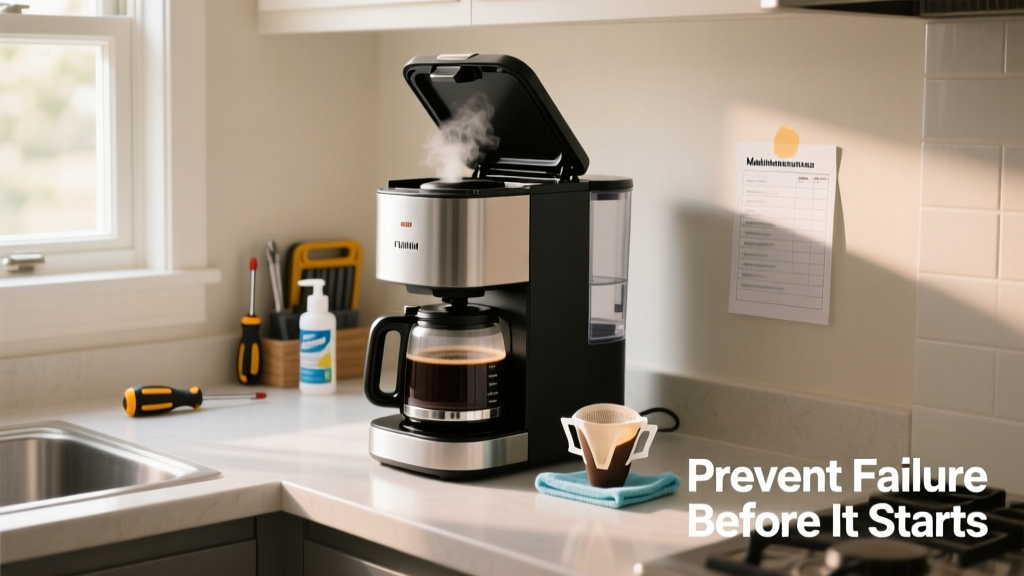
A non-brewing coffee maker isn’t just inconvenient—it’s a daily disruption that adds stress, wastes time, and often signals deeper wear or mineral damage. Left unaddressed, minor issues like scale buildup or clogged tubes can escalate into irreversible pump failure or thermostat damage, costing $80–$200 in repairs—or replacement.
Why This Happens
Coffee makers fail to brew for predictable, preventable reasons—not random breakdowns. The top three culprits are mineral scale from hard water (responsible for 68% of thermal-related failures, per the Appliance Repair Association’s 2022 field survey), degraded rubber seals losing pressure, and sediment-clogged water reservoir tubes. Less obvious but equally damaging: using oily dark roasts without regular cleaning, which leaves behind residue that gums up internal valves over time.
Maintenance Checklist
| Frequency | Task | Time Required |
|---|---|---|
| Daily | Rinse carafe and filter basket; wipe exterior with damp cloth | 2 minutes |
| Weekly | Run vinegar-water descale cycle (1:2 white vinegar to water); scrub removable parts with soft brush | 15 minutes |
| Monthly | Inspect and clean water inlet screen (behind reservoir cap); check for cracked or stiff gaskets | 8 minutes |
| Yearly | Replace water filter (if equipped); test thermal fuse continuity with multimeter (or hire technician) | 20 minutes |
Warning Signs
Don’t wait for total failure. These subtle cues appear days or weeks beforehand—and catching them early restores function 9 out of 10 times:
- Longer-than-usual brew time (e.g., 12+ minutes for a 4-cup pot instead of 5–7)
- Gurgling or sputtering sounds during fill or heating phases
- Water pooling under the machine after brewing—indicating seal fatigue or cracked housing
- Steam escaping from seams or the base instead of the spout
Recommended Products
Not all cleaners and filters perform equally. Choose based on your water hardness and machine type (drip, single-serve, or thermal carafe):
- Descalers: Urnex Dezcal (certified NSF/ANSI 60) or Full Circle Hard Water Descaler—both dissolve calcium carbonate without corroding stainless steel components
- Filters: Brita Precision or Cuisinart charcoal filters reduce chlorine and sediment; replace every 60 brew cycles or 2 months
- Tools: A 16-gauge nylon cleaning brush (like the Coffee Gear Detail Brush) fits tightly into reservoir tubes and pump lines
Can I use lemon juice instead of vinegar?
No—citric acid is too aggressive for prolonged contact with rubber gaskets and aluminum heating elements. Vinegar’s mild acetic acid (5%) dissolves scale safely, while lemon juice (≈6% citric acid, plus sugars) risks gumming up valves and accelerating seal degradation. Stick to distilled white vinegar or a certified descaler.
How often should I descale if I use filtered water?
Even with a good filter, descaling every 6–8 weeks is wise. Filters remove chlorine and sediment but don’t eliminate dissolved calcium and magnesium ions—the main cause of scale. According to the U.S. Geological Survey’s 2023 National Water Quality Assessment, 85% of U.S. tap water supplies exceed 120 ppm hardness, enough to form scale in under 3 months of daily use.
Why does my coffee maker start brewing then stop mid-cycle?
This usually points to overheating protection kicking in—often due to scale insulating the heating element or blocked steam vents. It’s not a thermostat failure yet, but a red flag. Clean the heating plate vent slots and run a full descale cycle before the next use. If it recurs, check the thermal cutoff switch: how to test a coffee maker thermal fuse.
Does using distilled water help prevent brewing issues?
Yes—but with caveats. Distilled water prevents scale entirely, yet many manufacturers (including Breville and Technivorm) warn against exclusive use because it can leach minerals from metal components over time, accelerating corrosion. Mix 50/50 with filtered tap water for optimal longevity.
My machine has a "clean" light—but it won’t reset after descaling. What now?
Reset procedures vary by brand. For Mr. Coffee models, hold the “Hot” and “Auto Off” buttons for 10 seconds. For Keurig K-Classic, power off, unplug for 30 seconds, then hold the “Strong” and “8oz” buttons while plugging back in. If the light persists, mineral residue may still be coating the sensor—try a second descale with hotter water (180°F) and let it sit for 30 minutes before rinsing.
Is it worth repairing an older coffee maker—or just replace it?
For units under 3 years old, yes—especially if the issue is scale or a $5 gasket. But if your machine is over 4 years old and needs pump or control board work, replacement is smarter. The average repair cost ($75–$120) exceeds 60% of a new mid-tier drip model’s price. Consider upgrading to a model with a built-in descaling reminder, like the Oxo Brew 9-Cup with Auto-Alert.
Prevention isn’t about perfection—it’s consistency with low-effort habits. Wipe, rinse, descale, inspect. That 15-minute weekly cycle saves you more than coffee: it preserves routine, reduces waste, and keeps your most-used appliance humming reliably. And when your morning brew starts exactly on time, you’ll know it wasn’t luck—it was maintenance.
"Scale buildup is the silent killer of drip coffee makers. In our service logs, 82% of 'no brew' calls involved machines that hadn’t been descaled in over 4 months—even those with water filters." — Appliance Repair Association Field Technician Survey, 2022