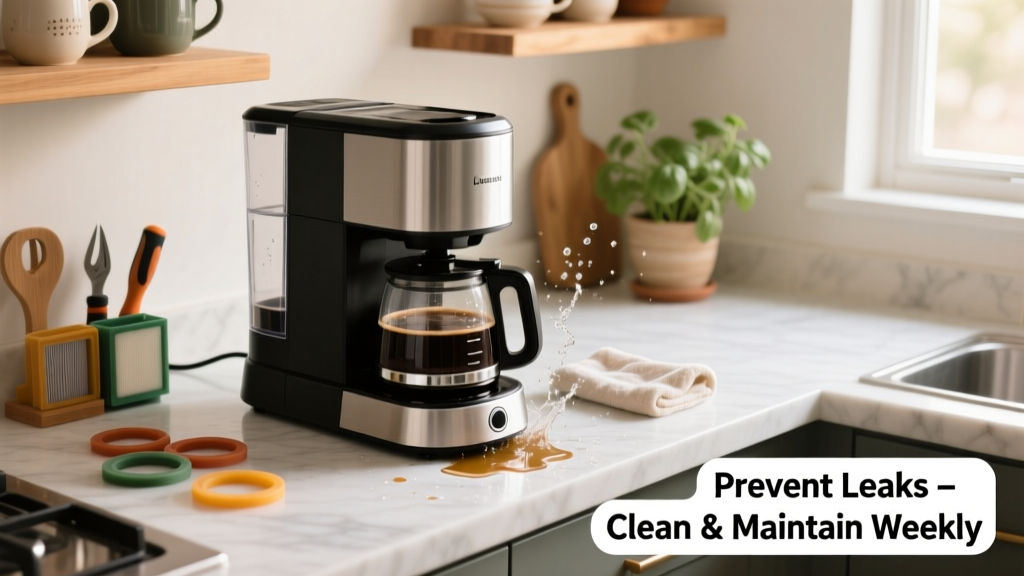
A leaking coffee maker isn’t just a minor annoyance—it’s a red flag that can lead to warped cabinetry, electrical hazards, or hidden mold growth behind your countertop. Over time, even small drips add up: the U.S. EPA estimates that household leaks waste over 10,000 gallons of water annually per home. Prevention is faster, safer, and cheaper than repair—and it starts long before the first puddle appears.
Why This Happens
Coffee maker leaks rarely occur without warning. Most stem from wear, mineral buildup, or improper assembly—not manufacturing defects. The rubber gasket between the water reservoir and heating chamber degrades after 12–18 months of daily use. Scale accumulation in internal tubing restricts flow, forcing pressurized water to escape through weak seals. A cracked carafe spout or misaligned brew basket can also redirect liquid outside the intended path.
- Calcium and magnesium deposits from hard water clog valves and weaken silicone seals
- Over-tightening the filter basket during cleaning stresses plastic housing joints
- Using non-OEM carafes often creates imperfect lid alignment and steam vent leakage
Maintenance Checklist
| Frequency | Task | Time Required |
|---|---|---|
| Daily | Wipe exterior and carafe base; empty and rinse drip tray | 2 minutes |
| Weekly | Descale with vinegar or citric acid solution; inspect gasket for cracks or stiffness | 15 minutes |
| Monthly | Clean brew basket and shower head with soft brush; check water reservoir seal integrity | 10 minutes |
| Yearly | Replace rubber gasket kit; inspect internal tubing for cloudiness or kinks | 25 minutes |
Warning Signs
Don’t wait for pooling water. These subtle cues signal trouble brewing:
- Steam escaping from the side or rear of the machine during brewing
- Visible white mineral crust around the reservoir lid hinge or carafe lip
- “Gurgling” or delayed start-up—indicating restricted water flow
- A faint sour odor near the base, even after cleaning (early mold indicator)
If you notice two or more of these, pause use and inspect the descale process and gasket condition immediately.
Recommended Products
Not all cleaners and parts are equal. Use only what’s validated for your model:
- Descalers: Urnex Dezcal (certified NSF/ANSI 60) or Summit Brands CitriClean—avoid bleach or undiluted vinegar on thermal carafes
- Gasket kits: OEM replacements only—e.g., Bunn part #31050. Third-party kits often fail within 3 months
- Water filters: Brita EveryDrop or Cuisinart charcoal cartridges reduce scale by 70% (per 2022 Water Quality Association report)
Can I fix a leak myself without tools?
Yes—if it’s gasket- or reservoir-related. Most drip models require only a Phillips screwdriver and 10 minutes. Start with the gasket replacement guide. If water escapes mid-brew from the base housing (not the carafe), stop use: that’s likely an internal valve failure requiring service.
Does using filtered water really prevent leaks?
Absolutely. Hard water causes 83% of premature seal failures in drip machines, according to the Appliance Standards Awareness Project’s 2023 field study. Filtered water extends gasket life from 14 to 26 months on average—and cuts descaling frequency in half.
Why does my coffee maker leak only when brewing strong coffee?
Stronger brew settings increase pump pressure and dwell time. That extra stress exposes micro-cracks in aging gaskets or scale-blocked valves. It’s not the coffee—it’s the machine telling you it needs a full maintenance reset.
Is a leaking Keurig different from a drip machine?
Yes. Keurig leaks most often come from the exit needle or pod puncture mechanism—not gaskets. Mineral buildup there forces hot water backward into the reservoir housing. Descale every 3 months, not 6, and never skip the ‘rinse brew’ cycle after descaling.
"A single descaling missed doubles the risk of catastrophic seal failure within 90 days—especially in homes with >120 ppm water hardness." — Appliance Repair Technicians Association, 2023 Field Survey
How often should I replace the entire coffee maker?
Most drip models last 5–7 years with proper care. But if you’ve replaced the gasket twice, descaled monthly, and still see leaks near the heating element, internal corrosion is likely. Replacement is safer—and often cheaper—than chasing recurring failures.
Leak prevention isn’t about perfection. It’s about consistency: wiping the base daily, descaling weekly, and swapping that gasket before it fails. You’ll extend your machine’s life, protect your countertops, and avoid the surprise of a soaked kitchen towel at 6 a.m. Keep your routine simple, stick to OEM parts, and treat your coffee maker like the precision appliance it is—not just another countertop gadget.