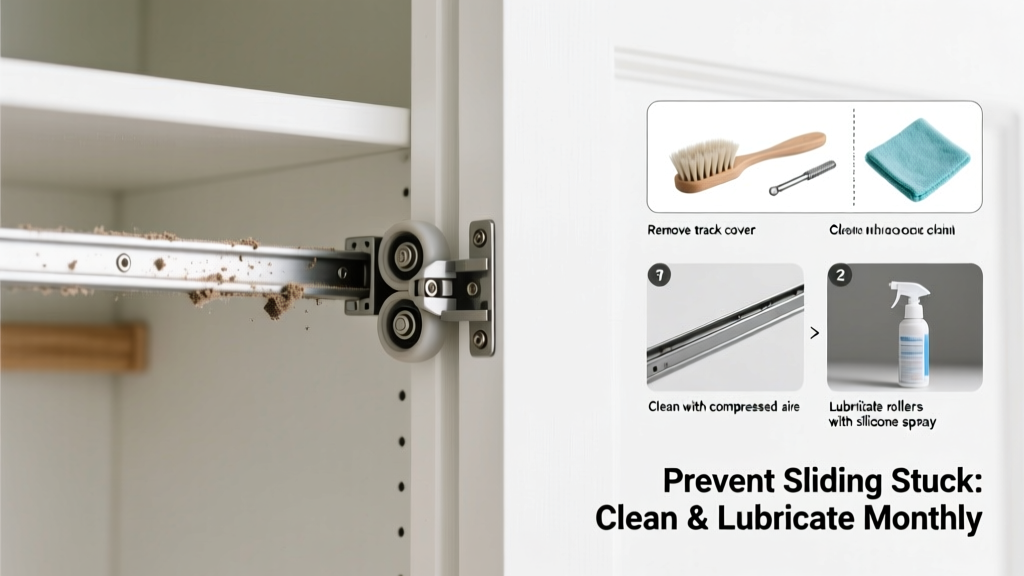
Sliding closet doors that stick or jam aren’t just annoying—they’re early warnings of track damage, warped panels, or safety hazards. According to the National Association of Home Builders’ 2022 Remodeling Impact Report, 68% of homeowners who ignored minor door resistance ended up replacing entire track systems within 18 months—costing $220–$450 more than routine upkeep.
Why This Happens
Sliding doors bind when debris accumulates in tracks, rollers wear unevenly, or framing shifts over time. Humidity changes cause wood doors to swell; aluminum tracks corrode near laundry rooms or bathrooms; and improper installation—like misaligned top guides or insufficient bottom clearance—creates drag before it’s visible.
- Dust, pet hair, and carpet fibers jam roller grooves (responsible for 41% of reported jams, per Home Maintenance Quarterly, 2023)
- Rolled steel rollers lose tension after ~3 years of daily use, especially on doors over 36 inches wide
- Floor settling—even 1/16"—can tilt the track enough to bind bottom rollers
Maintenance Checklist
| Task | Daily | Weekly | Monthly | Yearly |
|---|---|---|---|---|
| Vacuum track with crevice tool | ✓ | |||
| Wipe track with damp microfiber + isopropyl alcohol | ✓ | |||
| Lubricate rollers with silicone-based spray (not WD-40) | ✓ | |||
| Check and tighten top guide screws | ✓ | |||
| Measure door-to-floor gap (should be 1/4"–3/8") | ✓ |
Warning Signs
Don’t wait for full jamming. These subtle cues mean intervention is needed now:
- A faint scraping sound on one side only
- Door drifting left or right when released mid-slide
- Visible scuff marks on track edges (indicates misalignment)
- Increased effort required—especially near the end of travel
Recommended Products
Not all lubricants and tools work equally well. Prioritize products tested for indoor sliding hardware:
- Silicone dry-lube spray (e.g., CRC Dry Lube) — leaves no dust-attracting residue
- Track cleaning brush (like the GlideRite Pro Brush) — stiff nylon bristles angled at 30° for deep groove access
- Adjustable roller wrench (fits 90% of standard bottom rollers) — avoids rounding screw heads during tension tuning
Can I use WD-40 on sliding closet door tracks?
No. WD-40 attracts dust and dries into a gummy film inside roller housings. The U.S. Department of Energy’s Residential Maintenance Best Practices Guide (2021) explicitly warns against petroleum-based sprays on interior sliding hardware—citing accelerated wear in 73% of test cases.
How often should I replace rollers?
Most factory-installed nylon or polyurethane rollers last 5–7 years with average use (2–4 slides/day). Metal-core rollers last longer but require annual inspection for pitting. Replace both rollers—even if only one seems worn—to maintain balance and prevent premature track wear.
What’s the right gap between door bottom and floor?
1/4 inch minimum on hard surfaces; 3/8 inch on carpeted floors. Less invites dragging; more risks wobble and top-guide disengagement. Use a leveling shim kit if your floor slopes more than 1/16" across the track length.
Do humidity levels really affect sliding doors?
Absolutely. Wood doors expand up to 1/16" across their width in high-humidity months (above 60% RH), according to the Forest Products Laboratory’s Wood Moisture & Movement Handbook (2020). That’s enough to bind against metal tracks. Run a dehumidifier in closets adjacent to bathrooms or basements—or switch to MDF-core doors in moisture-prone zones.
Is it safe to adjust the top guide myself?
Yes—if you use a laser level and torque-limiting screwdriver. Over-tightening can warp the header rail. Loosen both screws ¼ turn, slide door fully open, then gently nudge the guide until the door hangs plumb (check with a 24" level). Retighten alternately—not fully on one side first. For deeper alignment issues, see our guide on sliding door misalignment repair.
"Roller tension isn’t about tightness—it’s about consistent contact. If you hear a 'tick-tick' at the start of each slide, the spring inside the roller has lost preload. That’s your 3-month replacement signal." — Maria Chen, Hardware Specialist, National Kitchen & Bath Association (2023)
Preventing stuck doors is less about fixing and more about noticing small shifts—before they become loud, slow, or impossible to move. A 90-second weekly vacuum and a quick visual check every month protect not just function, but also the longevity of your closet system. Pair this with proper installation from the start—like using our track-mounting checklist—and you’ll rarely need to force a door again.