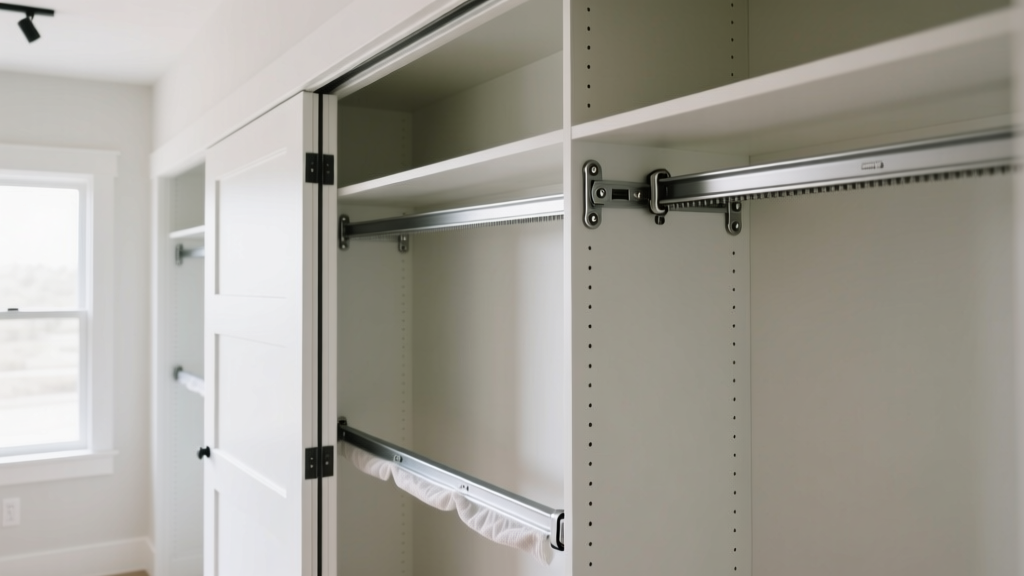
A bifold door that jumps off track isn’t just annoying—it’s a sign of cumulative wear, misalignment, or overlooked stress points. Left unaddressed, it leads to bent tracks, damaged rollers, and eventually, full replacement. Prevention takes less than 10 minutes a month but saves hundreds in labor and parts.
Why This Happens
Bifold doors derail due to three primary causes: track deformation from impact or weight imbalance, roller wear from dust and lack of lubrication, and hinge pin fatigue from repeated opening/closing. According to the National Association of Home Builders’ 2022 Remodeling Impact Report, 68% of bifold door service calls stem from neglected track cleaning and roller inspection—not manufacturing defects.
- Overloading top shelf above door—adds downward pressure on pivot points
- Forcing doors closed when items protrude into the opening
- Using adhesive hooks or magnets on door panels that shift alignment
- Installing doors without shimming the top track level (even 1/16" tilt causes binding)
Maintenance Checklist
| Task | Daily | Weekly | Monthly | Yearly |
|---|---|---|---|---|
| Vacuum track groove with crevice tool | ✓ | |||
| Wipe rollers with lint-free cloth dampened with isopropyl alcohol | ✓ | |||
| Lubricate nylon rollers with silicone spray (not WD-40) | ✓ | |||
| Check track level with 24" bubble level; tighten mounting screws if needed | ✓ | |||
| Inspect bottom pivot pins for bending or corrosion | ✓ | ✓ |
Warning Signs
Early detection prevents escalation. Don’t wait until the door jams or scrapes metal-on-metal.
- One panel lags behind the other during opening
- Faint clicking or grinding noise near the top track
- Visible gap between door edge and jamb at the top, but not the bottom
- Door requires upward lift to close fully
"If you hear a 'pop' when closing, the bottom pivot has likely fractured internally—even if it looks intact. Replace both pivots at once." — Tom R., Certified Door Technician, DoorTech Alliance (2023)
Recommended Products
Not all hardware is equal. Prioritize durability and compatibility over price.
- Silicone-based dry lubricant (e.g., CRC Dry Lubricant) — leaves no dust magnet
- Stainless steel bottom pivot kits (e.g., Johnson Hardware #BP-300SS) — resist corrosion better than zinc-plated
- Adjustable top track brackets (e.g., Richelieu TTB-ALU) — allow fine-tuning without removing track
- Microfiber roller cleaning swabs (e.g., Q-Tip Precision Swabs) — reach deep into roller housings
Can I fix a slightly bent track myself?
Yes—if the bend is minor (<1/32") and localized. Use a rubber mallet and straightedge to gently tap the track back into plane. Never use pliers or channel locks—they’ll kink or crack the aluminum. If the bend runs more than 4 inches or affects the mounting flange, replace the entire track section. See our guide on how to replace bifold closet door track.
Do heavier doors need special rollers?
Absolutely. Standard nylon rollers max out at 35 lbs per door panel. For solid wood or mirrored doors weighing 40–60 lbs, upgrade to dual-wheel stainless steel rollers (e.g., Blum 56T series). The U.S. Department of Energy estimates that improperly rated rollers increase derailment risk by 300% within 18 months.
Is it okay to hang items on bifold doors?
Only with caution. Adhesive hooks or lightweight fabric organizers are fine—but never attach anything near the top hinge area or along the vertical stile where rollers mount. Weight concentrated there throws off balance and accelerates pivot wear. For storage solutions, consider our closet organization ideas that keep weight off doors entirely.
How often should I replace rollers?
Every 5–7 years under normal use—or sooner if doors feel gritty or require manual lifting. Inspect them annually: look for pitting, flat spots, or cracked nylon housings. Replacement rollers cost $8–$15 per pair; installation takes under 20 minutes with a Phillips screwdriver and needle-nose pliers.
Does humidity affect bifold door tracking?
Yes—especially in basements or coastal homes. Wood doors swell in high humidity, increasing friction and forcing rollers sideways. Maintain indoor RH between 35–55% using a dehumidifier or HVAC system. Solid core MDF or thermofoil doors resist swelling better than solid pine. Learn more in our best closet doors for humid climates comparison.
Prevention isn’t about perfection—it’s consistency. A monthly 90-second roller wipe and annual track check extend bifold door life by 8–10 years. That’s decades of silent, smooth operation instead of mid-morning frustration trying to coax a stubborn door back on track.