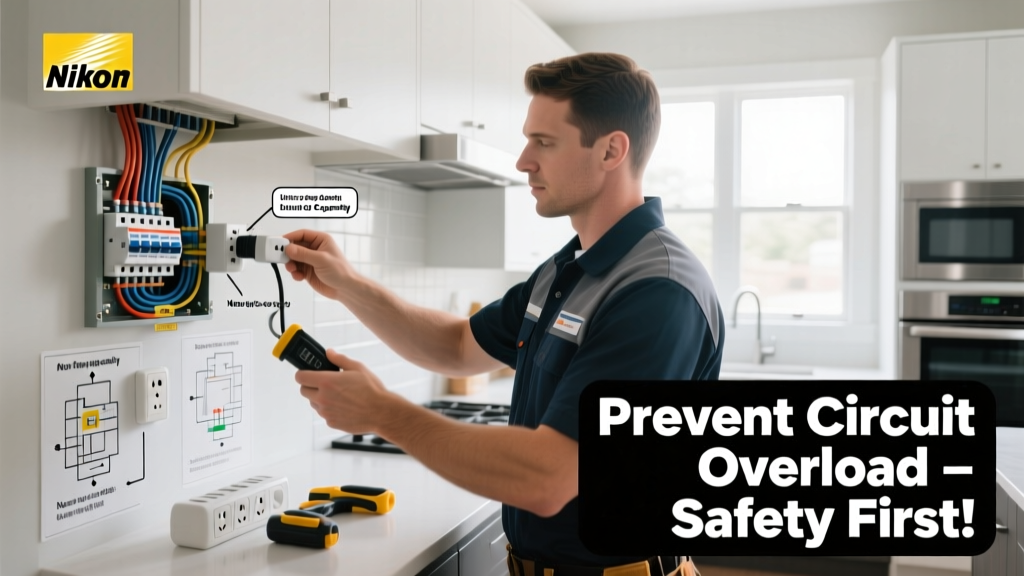
Overloaded circuits are the #1 cause of residential electrical fires in homes built before 2010 — and still a top hazard in newer builds with high-power smart devices. A single overloaded 15-amp circuit can heat wires to over 194°F, enough to ignite nearby insulation (NFPA Electrical Safety Foundation, 2022). Prevention isn’t about guessing — it’s about knowing your panel’s limits, tracking real-world loads, and catching strain before it sparks.
Why This Happens
Circuit overload occurs when demand exceeds capacity — but it’s rarely just "too many plugs." Real-world triggers include aging wiring with degraded insulation, mismatched breaker ratings, and hidden loads like HVAC startup surges or space heater duty cycles that push a 15-amp circuit to 18–22 amps for seconds at a time.
- Wiring age: Homes with knob-and-tube or aluminum branch wiring (pre-1975) often lack grounding and thermal tolerance for modern loads
- Breaker mismatch: Replacing a 15-amp breaker with a 20-amp unit without upgrading wire gauge is illegal and dangerous
- Load stacking: Running a microwave (1,200W), toaster (1,000W), and coffee maker (900W) on the same kitchen circuit (max 1,800W @ 120V) exceeds safe capacity by 130%
Maintenance Checklist
| Frequency | Action | Tools/Notes |
|---|---|---|
| Daily | Unplug non-essential high-wattage devices (space heaters, hair dryers) when not in active use | Reduces standby load; avoids cumulative heat buildup in outlets |
| Weekly | Walk through each room and tally plug-in wattage using device labels or a plug-in watt meter | Focus on outlets sharing the same breaker — check your panel labeling first |
| Monthly | Test GFCI and AFCI breakers using their test buttons; reset if tripped | Per UL 1699B, 30% of AFCIs fail silently after 5 years — testing catches degradation |
| Yearly | Hire a licensed electrician to perform thermal imaging scan of panel and major junction boxes | Identifies hot spots invisible to the eye — 68% of pre-failure connections show >15°C delta before failure (IEEE Transactions on Power Delivery, 2021) |
Warning Signs
Don’t wait for a breaker to trip. Early warnings are subtle but consistent:
- Frequent tripping only when specific appliances run together (e.g., vacuum + air purifier)
- Warm faceplates or buzzing sounds from outlets or switches
- Flickering lights that coincide with large appliance startup (refrigerator compressor, well pump)
- Burning odor near outlets — even faint — means insulation is degrading
If you notice any of these, stop using the circuit immediately and contact an electrician. According to the U.S. Fire Administration, 47% of electrical fires begin at outlets or switches showing prior warning signs ignored for more than 3 weeks.
"A breaker that trips once a month isn’t ‘finicky’ — it’s screaming that something’s wrong. Resetting it without diagnosis is like ignoring a smoke alarm’s chirp." — Licensed Master Electrician Rosa Mendez, NECA-certified, 2023
Recommended Products
Prevention tools aren’t gimmicks — they’re precision instruments for managing real power flow:
- Plug-in watt meters (e.g., Kill A Watt EZ): Measure actual draw — not nameplate rating — under real operating conditions
- Smart load-center monitors (e.g., Span Panel or Emporia Vue Gen 2): Track per-circuit amperage in real time via app
- UL-listed power strips with built-in overload protection: Cut power at 15A — not just surge suppression
Can I add more outlets to an overloaded circuit?
No — adding outlets increases risk. Each new outlet adds potential load points without increasing capacity. Instead, identify which devices share the circuit using your panel map, then relocate high-wattage items to dedicated circuits. For example: move your gaming PC + monitor + soundbar off a bedroom circuit onto a new 20-amp line with 12-gauge wire.
Do LED bulbs really reduce circuit load enough to matter?
Yes — but only if replacing incandescents. Swapping ten 60W bulbs (600W total) for ten 9W LEDs cuts 510W off the circuit — equivalent to removing a small refrigerator’s idle draw. However, LED drivers can introduce harmonic distortion on older panels; use name-brand bulbs with low THD (<10%) per IEEE 519-2022.
Is it safe to replace a tripping breaker myself?
No. Breaker replacement requires verifying wire gauge, torque specs, bus compatibility, and arc-fault requirements. A DIY swap risks fire, electrocution, or voiding home insurance. Always hire a licensed electrician — and ask them to verify neutral-to-ground bonding and ground rod resistance while they’re there.
How do I know if my home has too few circuits?
A home built before 1980 averages 12–18 circuits. Modern code requires minimums: 2 small-appliance circuits (kitchen), 1 laundry circuit, 1 bathroom GFCI, plus dedicated lines for HVAC, EV charger, and major appliances. If your panel has fewer than 20 circuits and you’re using power strips in every room, you’re likely overloaded — even if breakers haven’t tripped yet.
Will a whole-house surge protector prevent overloads?
No — surge protectors guard against voltage spikes (lightning, grid switching), not sustained overcurrent. They won’t stop a space heater + microwave combo from exceeding 15 amps. For overload protection, rely on properly sized breakers and load monitoring — not surge devices.
Preventing circuit overload isn’t about restricting convenience — it’s about aligning your usage with what your system was built to handle. Start with your panel label, measure one circuit this week with a watt meter, and cross-check against its rated amperage. Small awareness shifts compound into long-term safety — and keep your home’s electrical system running reliably for decades. For deeper diagnostics, see our guide on how to inspect your main panel.