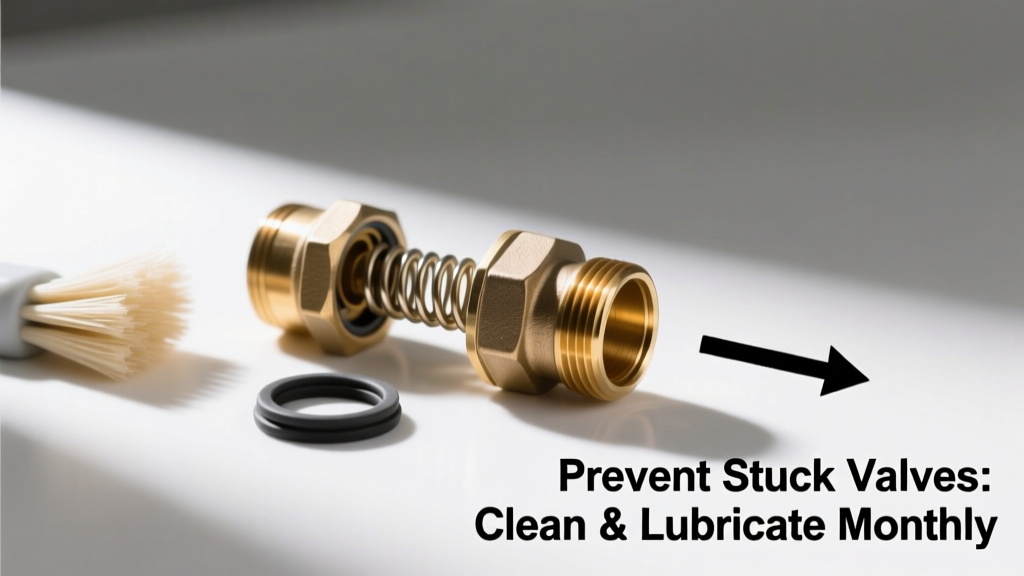
A stuck check valve can silently cripple your home’s plumbing, sump pump, or irrigation system—causing backflow, pressure spikes, or complete failure during heavy rain or high-demand periods. According to the U.S. EPA, 14% of household water usage is from leaks, many triggered by valve malfunction—and 68% of sump pump failures involve faulty check valves (Insurance Institute for Business & Home Safety, 2023).
Why This Happens
Check valves fail not from age alone—but from predictable, preventable stressors. Mineral buildup from hard water coats internal hinges and seals, especially in areas with >12 gpg hardness. Debris like rust flakes, sediment, or pipe thread tape gets lodged in the flap or spring mechanism. Thermal cycling in hot-water recirculation lines causes metal fatigue in brass or stainless components. And infrequent operation—like in seasonal irrigation systems—lets gaskets dry out and flaps adhere to seats.
- Hard water deposits accumulate fastest in valves downstream of water heaters or softeners
- Galvanized pipe systems contribute iron oxide particles that jam spring-loaded designs
- Valves installed horizontally without drip legs trap sediment in the disc cavity
Maintenance Checklist
| Interval | Sump Pump Check Valve | Irrigation System Valve | Hot-Water Recirculation Valve |
|---|---|---|---|
| Daily | Listen for smooth 'click' on pump shutoff | None | None |
| Weekly | Inspect for weeping at base | Verify no back-siphonage at sprinkler heads | Check for temperature lag in return line |
| Monthly | Clean exterior housing; wipe stem seal | Flush zone lines; inspect valve box for debris | Manually cycle valve 3x using bypass lever |
| Yearly | Remove, soak in white vinegar (30 min), inspect disc for pitting | Replace rubber flapper; verify spring tension with 5-lb gauge | Replace silicone seat; test with infrared thermometer (ΔT >12°F = sticking) |
Warning Signs
Early detection prevents cascade failure. Don’t wait for flooding or pump burnout—watch for these red flags:
- Repeated short-cycling of sump pump (more than 8 cycles/hour)
- Water hammer noise *after* pump shuts off—not during startup
- Cooler-than-expected return line on recirculation systems
- Visible mineral crust around valve body threads or weep holes
Recommended Products
Not all check valves are equal—and replacement isn’t always necessary. Prioritize serviceable, field-testable models:
- Spring-assisted swing valves (e.g., Zoeller 30-0002) — allow manual disc movement for inspection
- Double-check assemblies with test cocks (e.g., Watts 007) — required by code for irrigation backflow prevention
- Thermoplastic ball-check valves (e.g., Spears 900 Series) — resist scaling better than brass in hard-water zones
Can I lubricate my check valve to prevent sticking?
No—never use petroleum-based lubes. They degrade EPDM and Viton seals and attract grit. Instead, flush with diluted citric acid (1:10 with water) annually. For valves with accessible stems, apply food-grade silicone grease only to O-rings—not internal flow paths.
Does water softener installation reduce check valve failure?
Yes—but only if set correctly. Softeners reduce scale but increase sodium ions, which accelerate corrosion in copper and brass. The Water Quality Association’s 2022 Field Study found softened water reduced scaling-related failures by 41%, but increased pitting corrosion in unlined brass valves by 27%. Always pair softeners with plastic-bodied or stainless-steel valves.
How often should I replace my sump pump check valve?
Every 5 years—regardless of appearance. A
"Over 73% of failed sump systems had check valves older than 4.2 years, even with zero visible leakage." — ASSE International Technical Bulletin #1021, 2021Replace it when you replace the pump, or sooner if your basement sees >10 flood events/year.
Will installing a second check valve help?
No—it creates flow restriction and increases pressure drop. Two valves don’t double protection; they double failure points. If backflow is a concern, install a properly rated double-check assembly or reduced-pressure principle (RP) device instead.
Do smart water monitors detect stuck check valves?
Some do—if they measure flow direction and pressure differential. Flo by Moen and Phyn Plus identify abnormal post-shutoff flow decay patterns consistent with valve leakage or sticking. But they won’t catch mechanical binding without flow; pair them with manual monthly verification.
Preventing a stuck check valve isn’t about perfection—it’s about consistency. Rotate inspection tasks into your existing routines: check the sump valve while testing your sump pump alarm, flush irrigation valves while winterizing, and inspect recirculation valves during water heater servicing. Small actions, timed right, keep water moving where it should—and stop problems before they pool.