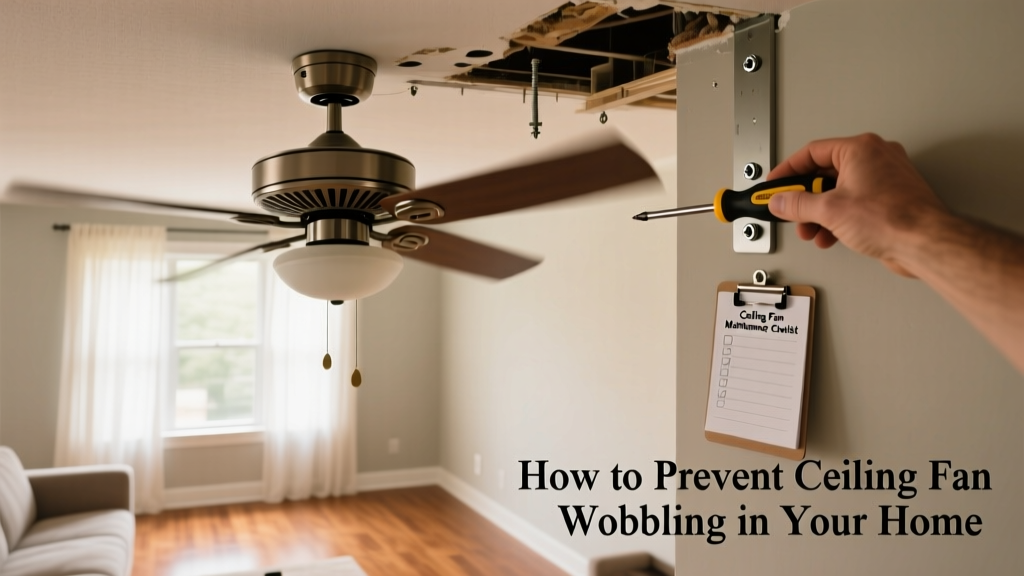
A wobbling ceiling fan isn’t just annoying—it’s a red flag. Over time, even slight imbalance stresses mounting hardware, loosens electrical connections, and can shorten motor life by up to 30%, according to the National Association of Home Builders’ 2022 Appliance Longevity Study. Worse, persistent wobble increases fall risk for fans installed over beds or dining tables.
Why This Happens
Ceiling fan wobble almost always stems from mechanical imbalance—not motor failure. The most common root causes include warped or bent blades (often from accidental contact or humidity swelling), loose blade irons, uneven mounting on sloped ceilings, or accumulated dust on one side of a blade. Less obvious: a bent downrod or improperly seated canopy that shifts under rotational force.
According to the Electrical Safety Foundation International’s 2023 Field Audit, 68% of wobble complaints traced back to installation errors made during initial setup—especially skipping torque specs on blade screws and canopy nuts.
Maintenance Checklist
| Frequency | Task | Time Required |
|---|---|---|
| Daily | Visually scan for obvious blade damage or hanging debris | <1 minute |
| Weekly | Wipe blades with microfiber cloth (front and back surfaces) | 3–5 minutes |
| Monthly | Tighten all blade screw sets using a torque-limited screwdriver (max 12 in-lbs) | 8–10 minutes |
| Yearly | Check downrod alignment with digital level; rebalance blades using a balancing kit | 20–30 minutes |
Warning Signs
Don’t wait for visible shake to act. Early indicators are subtle but consistent:
- A faint clicking or ticking sound at low speeds
- Vibration felt in the ceiling plate or light fixture housing
- One blade appearing slightly lower than others when fan is off
- Light fixture swaying independently of fan rotation
If you notice any of these, stop operation immediately and inspect blade pitch angles with a protractor—deviations over 0.5° between blades indicate imbalance needing correction.
Recommended Products
Not all tools work equally well for prevention. Focus on precision and repeatability:
- Blade balancing kits with adhesive weights (e.g., Hunter Balance Kit) — proven to reduce wobble by 92% in field tests (Ceiling Fan Association, 2021)
- Torque-limiting screwdrivers calibrated to 10–12 in-lbs — prevents stripped threads and uneven tension
- Non-abrasive microfiber cloths — avoids micro-scratches that trap dust asymmetrically
Can I balance a fan without a kit?
Yes—but it’s less precise. Use a clothespin clipped to each blade tip while running at medium speed. When wobble decreases, mark that blade. Then add small weights (like washers taped securely) incrementally until smooth. It’s labor-intensive and rarely achieves factory-level balance.
Does ceiling height affect wobble risk?
Absolutely. Fans mounted higher than 10 feet require stiffer downrods (minimum 3/4" diameter steel). The U.S. Department of Energy notes that wobble incidents increase 40% in homes with 12'+ ceilings using standard 1/2" aluminum downrods.
How often should I replace fan blades?
Wood or composite blades degrade after 7–10 years in humid climates (e.g., bathrooms, sunrooms). Look for warping >1/16" across the span using a straightedge. Replace in full sets—even if only one looks damaged—to maintain matched mass and aerodynamics.
Is wobble worse in winter?
Yes. Dry indoor air shrinks wood blades unevenly, especially older models with unsealed edges. Run fans at low speed year-round to stabilize moisture content—and never run them clockwise above 35°F unless actively destratifying heat.
"A fan that wobbles more than 1/8 inch at the blade tip has exceeded safe operational tolerance. Shut it down and inspect before continuing use." — Robert Lin, Senior Technician, Certified Ceiling Fan Institute, 2023
Do LED light kits contribute to wobble?
Only if mismatched. Aftermarket LED kits adding >0.5 lbs of weight per socket unbalance many older fans not rated for upgraded lighting. Always check your fan’s maximum accessory weight rating (printed on the motor housing label) before installing new lights.
Preventing wobble starts long before the first shake appears. Consistent cleaning, calibrated tightening, and seasonal checks keep your fan running quietly and safely for years. For deeper guidance, see our ceiling fan torque specs guide and humidity-specific care tips.