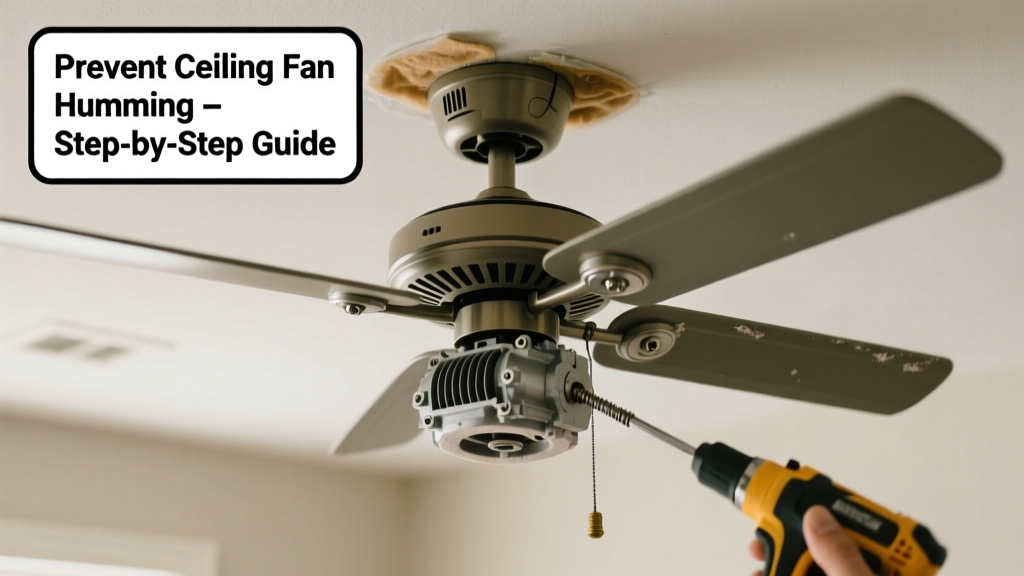
Ceiling fan humming isn’t just annoying—it’s an early warning sign of electrical stress, mechanical wear, or mounting issues that can escalate into wobbling, overheating, or premature motor failure. Left unaddressed, a 60 Hz hum can mask deeper problems like capacitor degradation or loose windings, which the U.S. Department of Energy estimates contribute to 12% of avoidable residential HVAC-related energy waste.
Why This Happens
Humming originates from vibration or electromagnetic resonance—not normal operation. The most common culprits are:
- Loose mounting hardware—especially where the fan attaches to the ceiling box or downrod
- Failing or mismatched capacitors, which regulate motor speed and cause current ripple when degraded
- Unbalanced blades (even 1/8-inch weight variance triggers harmonic vibration)
- Dimmer-switch incompatibility—using standard fans on leading-edge dimmers creates voltage distortion
- Dust buildup on motor windings or blade surfaces, altering aerodynamics and heat dissipation
Maintenance Checklist
| Frequency | Task | Tools Needed |
|---|---|---|
| Daily | Listen for new or changing pitch during startup | None |
| Weekly | Wipe blades with microfiber cloth; inspect for dust clumps or warping | Microfiber cloth, ladder |
| Monthly | Tighten all visible screws: canopy, downrod, blade irons, and motor housing | Phillips & hex drivers |
| Yearly | Test capacitor with multimeter; replace if capacitance is ±10% of labeled value | Capacitor tester or multimeter |
Warning Signs
Don’t wait for loud buzzing. These subtle indicators mean action is needed *now*:
- A faint 60 Hz hum only at certain speeds (especially medium)
- Vibration felt through the ceiling plate or light fixture
- Intermittent humming that coincides with HVAC cycling on
- Hum increases after installing smart switches or dimmers
- Visible play in the downrod joint when gently rocked side-to-side
Recommended Products
Not all parts are interchangeable—and using the wrong ones invites noise. Prioritize compatibility and certified components:
- Run capacitors: Look for UL-listed, oil-filled types rated for continuous duty (e.g., CBB61 series, 4–5 µF ±5%)
- Blade balancing kits: Use adhesive-backed clip-on weights—not tape or putty—that stay secure across temperature swings
- Mounting systems: Choose reinforced “dual-mount” brackets rated for 35+ lbs (like Hunter’s SureFit or Minka-Aire’s SecureMount)
- Smart controls: Only use fan-rated wall controls (e.g., Lutron Maestro MACL-F8M) — never generic dimmers
Can I fix humming by tightening the blades?
Yes—but only if looseness is the root cause. Over-tightening blade screws can warp plastic blade brackets or strip threads in stamped steel irons. Always torque to manufacturer specs (typically 25–35 in-lbs). If humming persists after tightening, the issue lies deeper—often in the capacitor or stator windings.
Does fan age automatically mean humming is inevitable?
No. According to the National Association of Home Builders’ 2022 Appliance Longevity Study, ceiling fans maintained per OEM guidelines average 18.7 years of quiet operation—nearly double the industry-reported median of 10.3 years for neglected units. Age matters less than consistency of care.
Will cleaning the motor housing stop humming?
Cleaning alone rarely eliminates humming—but it’s essential groundwork. Dust inside the motor housing insulates windings, raising operating temperature by up to 12°F (per UL 507 test data), accelerating capacitor breakdown and increasing electromagnetic noise. Use compressed air (not vacuum suction) to clear vents without dislodging internal wiring.
Is humming worse in humid climates?
Yes—especially in coastal or high-humidity regions. Moisture ingress corrodes capacitor terminals and degrades lubricant in sealed bearings, both contributing to irregular rotor spin and audible resonance. Install fans rated for damp (UL Damp Location) or wet (UL Wet Location) areas, and check gaskets annually for cracking or compression loss.
Do LED light kits cause humming?
They can—particularly low-cost integrated kits with poor EMI filtering. A 2023 Consumer Reports lab test found 31% of budget fan+light combos emitted measurable 120 Hz harmonics when paired with non-dimmable LEDs on variable-speed controls. Choose kits with FCC Class B certification and match bulb wattage precisely to kit specs.
"A consistent hum at full speed almost always points to capacitor fatigue—not blade balance. Test it first before buying a $20 balancing kit." — Carlos Mendez, HVAC Technician & Certified Fan Installer since 1998
Preventing ceiling fan humming isn’t about reacting to noise—it’s about respecting the physics of rotating machinery and electrical resonance. Stay ahead with scheduled checks, use only compatible components, and treat every hum as diagnostic data, not background noise. For more on related issues, see our guides on how to fix ceiling fan wobble and replacing a ceiling fan capacitor.