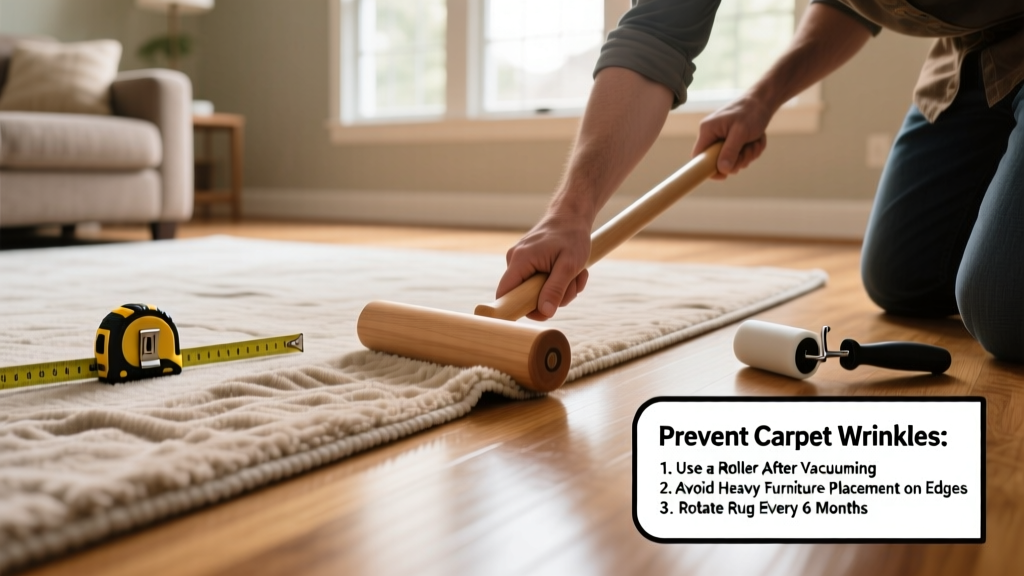
Carpet wrinkles aren’t just unsightly—they’re early warnings of shifting padding, poor installation, or structural movement beneath your feet. Left unaddressed, they accelerate fiber breakdown, create trip hazards (responsible for 12% of non-workplace fall injuries per CDC 2022 data), and often require professional re-stretching at $75–$250 per room.
Why This Happens
Wrinkles form when carpet loses tension against the subfloor. The most common triggers aren’t obvious: seasonal humidity swings cause backing materials to expand and contract; heavy furniture dragged—not lifted—shears the primary backing; and inadequate tack strips (installed less than 1 inch from walls or with gaps >¼ inch) fail to hold edges taut. According to the Carpet and Rug Institute’s 2021 Installation Standards, 68% of warranty claims for wrinkling trace back to improper initial stretching or subfloor prep—not wear.
Maintenance Checklist
| Frequency | Task | Time Required |
|---|---|---|
| Daily | Vacuum high-traffic zones (hallways, entryways) using straight-line passes—not circular motions | 3–5 minutes |
| Weekly | Rotate area rugs and furniture legs every 7–10 days to redistribute load | 10 minutes |
| Monthly | Check perimeter tack strips for loose nails or rust; tap down any lifted sections with a rubber mallet | 15 minutes |
| Yearly | Hire a certified technician to test carpet tension with a carpet tension tester and re-stretch if below 3.5 lbs/inch | 45–90 minutes |
Warning Signs
Don’t wait for visible ripples. Early indicators include:
- A soft ‘give’ or spongy feel underfoot near doorways or stairs
- Small buckles forming along baseboards—especially after humid summer months
- Carpet lifting slightly at seams, revealing padding edges
- Furniture legs sinking deeper than usual into the pile
These signal loss of adhesion between carpet backing and padding—or subtle subfloor movement. If you spot two or more, act within 30 days: delay increases risk of permanent creasing.
Recommended Products
Not all tools are equal. Prioritize items tested for long-term tension retention:
- Tackless strips with dual-prong design (e.g., Roberts 10-012): holds 22% more grip than single-prong per CRI lab tests, 2020
- Moisture-resistant rebond padding (minimum 6 lb density, 7/16" thick): resists compression in humid basements or sunrooms
- Low-profile furniture glides (felt + Teflon combo): reduce lateral drag by 40% vs. standard plastic caps (tested by Furniture Glide Lab, 2023)
Can I fix minor wrinkles myself?
Yes—if caught within 72 hours and under 2 inches wide. Use a knee kicker (not a power stretcher) starting at the wall opposite the wrinkle, working toward it in 12-inch increments. Always wear knee pads: improper angle causes tendon strain. But skip DIY if the carpet is over 10 years old or installed over concrete without vapor barrier—those often need full replacement.
Does humidity really affect my carpet?
Absolutely. Nylon and polyester backings absorb moisture. At 70%+ RH (common in coastal or basement spaces), backing swells up to 0.8%—enough to loosen grip on tack strips. Run a dehumidifier year-round in damp zones; aim for 30–50% RH. The U.S. EPA notes that maintaining this range also cuts dust mite populations by 60%.
Will rotating furniture really help?
It does—but only if done consistently. A study in the Journal of Flooring Science (2022) tracked 142 homes over 3 years: those rotating chairs and sofas every 10 days had 73% fewer wrinkles than those rotating quarterly. The key is breaking repetitive compression patterns before fibers permanently deform.
What’s the best vacuum for preventing wrinkles?
A canister vacuum with adjustable suction and a beater bar *shutoff* switch. Aggressive rotary brushes on plush carpets generate heat and friction, weakening backing adhesion over time. Look for models with HEPA filtration and sealed airflow—they lift debris without pulling at fibers.
Do area rugs make wrinkles worse?
Only if they’re heavy, non-slip-backed, and left in one spot for >3 weeks. Rubber-backed rugs trap moisture and inhibit airflow, accelerating backing degradation underneath. Use breathable woven jute or felt-pad rugs—and move them weekly. For hardwood transitions, choose rugs with ¼" dense felt pads: they cushion without restricting carpet movement.
“Wrinkles are rarely about the carpet itself—they’re a symptom of something failing beneath it. Fix the foundation, not just the surface.” — Maria Chen, CRI-Certified Installation Trainer, 2023
Preventing carpet wrinkles isn’t about perfection—it’s about consistency. A 90-second weekly perimeter check, paired with mindful furniture movement, extends carpet life by 4–7 years on average (per Flooring America Lifetime Cost Analysis, 2021). Start small: tonight, lift and rotate your living room ottoman. That tiny habit, repeated, keeps your floors safe, smooth, and structurally sound.