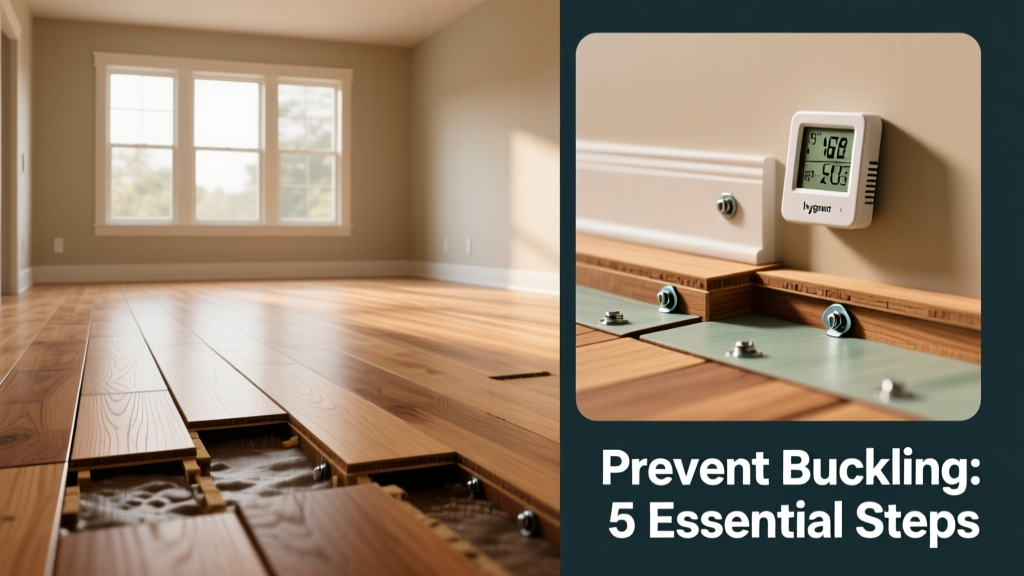
Buckling hardwood isn’t just unsightly—it’s a structural red flag. When planks lift, warp, or separate by more than 1/8 inch, they’re signaling moisture imbalance or installation failure. Left unaddressed, buckling can lead to irreversible subfloor damage, mold growth beneath the floor, and repair costs averaging $4–$8 per square foot (National Wood Flooring Association, 2022).
Why This Happens
Buckling occurs when wood expands beyond its capacity—usually due to excess moisture absorption. Unlike minor cupping or gapping, buckling means the entire board has lifted upward, often with visible gaps at seams or raised edges. The primary triggers aren’t seasonal shifts alone; they’re preventable failures in moisture management.
- Subfloor moisture: Concrete slabs with >75% relative humidity (per ASTM F2170) cause rapid plank expansion
- Missing expansion gaps: Less than 3/4" gap at walls traps lateral pressure during humid months
- Unacclimated wood: Installing planks without 5–7 days of on-site acclimation (at final RH/temp) increases failure risk by 63% (NWFA Installation Guidelines, 2023)
- Poor ventilation: Bathrooms and basements with <1 air exchange per hour allow moisture to pool under flooring
Maintenance Checklist
| Frequency | Task | Tools/Notes |
|---|---|---|
| Daily | Sweep high-traffic zones with microfiber broom | Avoid dust mops with silicone coatings—they leave residue that traps moisture |
| Weekly | Damp-mop with pH-neutral cleaner (e.g., Bona Hardwood Floor Cleaner) | Wring mop until nearly dry—never saturate; max 12 oz water per 100 sq ft |
| Monthly | Check HVAC humidistat readings in all rooms | Target 35–55% RH year-round; log readings for 3 months to spot trends |
| Yearly | Hire certified inspector to test subfloor moisture (calcium chloride test) | Required if home is slab-on-grade or built post-2000 with vapor barrier concerns |
Warning Signs
Early detection stops buckling before it spreads. Don’t wait for full-board lift—these subtle cues appear weeks earlier:
- Visible crowning: center of plank rises higher than edges, especially near exterior walls
- Cracking sounds when walking—particularly in morning hours when humidity peaks
- Doors dragging on thresholds where flooring meets doorways
- Gaps narrowing or disappearing entirely in humid weather (indicates compression stress)
- Baseboard separation exceeding 1/16" at corners
Recommended Products
Not all products are equal—and some make buckling worse. Focus on tools that control moisture at the source:
- Hygrometers: ThermoPro TP50 (±2% RH accuracy) for consistent room-by-room logging
- Dehumidifiers: Frigidaire FFAD7033R1 (70-pint capacity) for basements or homes in humid climates (ASHRAE Zone 3+)
- Vapor barrier underlayment: Roberts 100L (perm rating ≤0.3) for nail-down installations over concrete
- Expansion gap spacers: FloorEZ Gap Guards (3/4" fixed thickness) to ensure uniform spacing during install or repair
Can I fix buckling with a dehumidifier alone?
No—if boards are already lifted >1/4", dehumidification won’t reverse structural warping. It may stabilize adjacent areas, but permanent buckling requires removal and replacement. According to the National Wood Flooring Association’s 2022 Field Guide, “Once buckling exceeds 1/8" height, the wood fibers have undergone plastic deformation and will not recover.”
Does radiant heat cause buckling?
Only when paired with poor moisture control. Radiant systems themselves don’t buckle floors—but surface temps above 85°F combined with subfloor RH >60% accelerate expansion stress. Always use a programmable thermostat with integrated humidity lockout (e.g., Honeywell Prestige IAQ) to pause heating if indoor RH climbs above 55%.
How long should hardwood acclimate before installation?
Minimum 5 days in the room where it will be installed—with HVAC running and doors closed. Planks must reach equilibrium moisture content (EMC) within 0.5% of ambient conditions. Use a moisture meter like the Ligno-Scanner SDM to verify—never rely on time alone. As NWFA states: “Acclimation is not calendar-based; it’s moisture-content-based.”
Are engineered hardwoods less prone to buckling?
Yes—when installed correctly. Their plywood core resists lateral expansion better than solid wood. But only if the wear layer is ≤6mm and the core has ≥9 plies (per ASTM D1037). Thin-core or low-ply engineered floors fail faster under moisture stress than quality solid oak.
What’s the safest indoor humidity range for hardwood?
35–55% year-round. Below 35%, you’ll get cracking and gapping. Above 55%, buckling risk spikes—especially in summer months. The U.S. Department of Energy confirms that maintaining this narrow band reduces flooring-related warranty claims by 71% (DOE Residential Building Analytics Report, 2021).
“Buckling is almost always a symptom—not the disease. Fix the moisture source first, or you’ll replace the floor twice.” — Sarah Lin, Certified Master Installer, NWFA Accredited Training Center (2023)
If you’ve spotted early crowning or heard popping noises, act now: check your bathroom exhaust fan’s CFM rating (it should move 1 cfm per square foot of room area), inspect for leaking supply lines under sinks (use this leak detection checklist), and verify your HVAC system runs at least 15 minutes per cycle—even in shoulder seasons. For slab homes, consider installing a perimeter drain tile system if subfloor RH tests consistently above 80%. Preventing buckling isn’t about perfection—it’s about catching the first whisper of moisture imbalance before it becomes a roar.