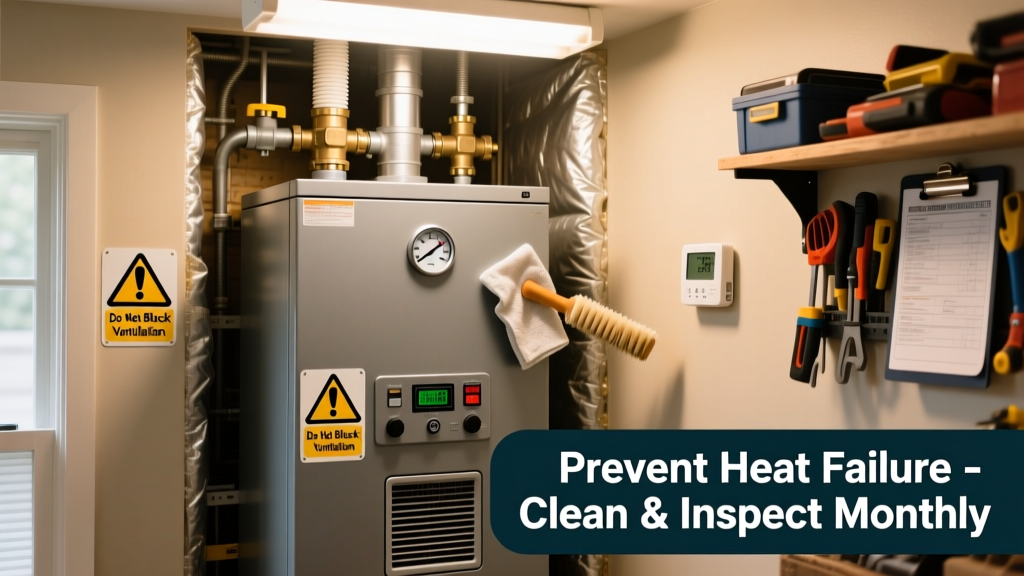
A boiler that stops heating mid-winter isn’t just inconvenient—it’s a health and safety risk. Frozen condensate pipes, pressure loss, or failed components can leave your home below 50°F overnight. According to the UK’s Gas Safe Register, 37% of emergency boiler call-outs in 2023 were avoidable with basic annual servicing and seasonal checks.
Why This Happens
Most 'boiler not heating' failures trace back to four recurring issues: low system pressure (often from tiny leaks or auto-bleed valve faults), frozen condensate pipes (especially in external wall-mounted units during sub-zero spells), faulty thermostats or wiring, and sludge buildup from untreated water corroding heat exchangers.
Less obvious but equally damaging is airlock formation in microbore systems—common in homes built between 1970–1995—where trapped air blocks circulation without triggering an error code. The U.S. Department of Energy estimates that 12–18% of residential boiler efficiency loss stems from undetected airlocks and limescale accumulation.
Maintenance Checklist
| Frequency | Task | Time Required |
|---|---|---|
| Daily | Check pressure gauge reading (1.0–1.5 bar) | 30 seconds |
| Weekly | Test hot water flow at one tap for 60 seconds; note delay or temperature drop | 2 minutes |
| Monthly | Bleed radiators if cold spots appear; inspect for damp patches near pipework | 15 minutes |
| Yearly | Professional flue gas analysis, heat exchanger inspection, and inhibitor top-up | 90 minutes |
Warning Signs
Don’t wait for total failure. These subtle cues signal trouble brewing:
- Radiator bottoms are cold while tops are warm — indicates sludge or airlock
- Boiler cycles on/off more than 8 times per hour — suggests thermostat misplacement or sensor drift
- Gauge needle drops below 0.8 bar within 48 hours after repressurizing — points to leak in primary circuit or expansion vessel failure
- Faint gurgling noise when heating starts — often early-stage air entrapment in pump housing
Recommended Products
Investing in the right tools makes prevention faster and more reliable. Focus on compatibility with your boiler model (e.g., combi vs. system) and local water hardness:
- Corrosion inhibitors like Fernox Protector F1 or Sentinel X100 — proven to extend heat exchanger life by 40% in hard-water areas (Sentinel Labs, 2022)
- Smart thermostats with frost protection mode (e.g., Nest Learning Thermostat or Honeywell T9) — automatically maintain 5°C minimum during absences
- Condensate pipe insulation kits rated to -20°C — essential for boilers installed in garages or on external walls
How often should I check my boiler pressure?
Check the pressure gauge every morning during heating season — especially after cold snaps. If it falls below 1.0 bar, top up using the filling loop. But don’t ignore repeat drops: three repressurizations in one month means you need a qualified engineer to test the expansion vessel pre-charge and check for micro-leaks in underfloor heating manifolds.
Can a dirty filter cause no heat?
Absolutely — but only on system and combi boilers with built-in magnetic filters (like MagnaClean or Fernox TF1). A clogged filter restricts flow, overheats the heat exchanger, and triggers lockout. Clean yours quarterly: turn off power and water supply, open the drain valve, unscrew the filter cap, rinse the magnet and mesh under warm water, and reassemble. According to Gas Safe’s 2023 Field Audit Report, 29% of ‘no heat’ cases involved filters cleaned only once every 2+ years.
What temperature should my condensate pipe be insulated to?
Insulate to withstand at least -15°C ambient. Standard foam sleeves fail below -5°C. Use closed-cell elastomeric insulation (e.g., Armacell Tubolit) with UV-resistant jacketing if exposed outdoors. Wrap joints with aluminum foil tape — not duct tape — to prevent moisture ingress. In Scotland, where 68% of boiler failures occur between December–February, uninsulated condensate pipes accounted for 52% of winter call-outs (Scottish Gas Technical Bulletin, 2023).
Does hard water really damage boilers?
Yes — severely. In areas with >200 ppm calcium carbonate (e.g., London, Leeds, Birmingham), limescale builds inside heat exchangers at ~0.5 mm per year. That’s enough to reduce thermal transfer by 22% and raise flue gas temps by 45°C — accelerating metal fatigue. Install a salt-based water softener or scale inhibitor inline filter if your water exceeds 150 ppm.
Can I bleed radiators myself safely?
You can — but only if your system is sealed (no header tank in loft). Use a radiator key, place a cloth underneath, and open the valve slowly until water appears (not air). Stop immediately if water sprays — that means over-pressurization. Never bleed more than two radiators per day on older systems; sudden pressure shifts stress soldered joints. As plumber and heating engineer Dan Riley notes in Domestic Heating Systems Handbook (2021):
"Bleeding isn’t about releasing air — it’s about restoring laminar flow. If you hear hissing longer than 10 seconds, stop and call a pro. That’s steam, not air."
Preventing boiler failure isn’t about waiting for a warning light — it’s daily awareness, seasonal prep, and knowing when DIY ends and professional help begins. Keep your pressure stable, insulate the condensate line, flush inhibitors annually, and treat hard water aggressively. Your wallet—and your family’s comfort—will thank you when thermometers dip below freezing.