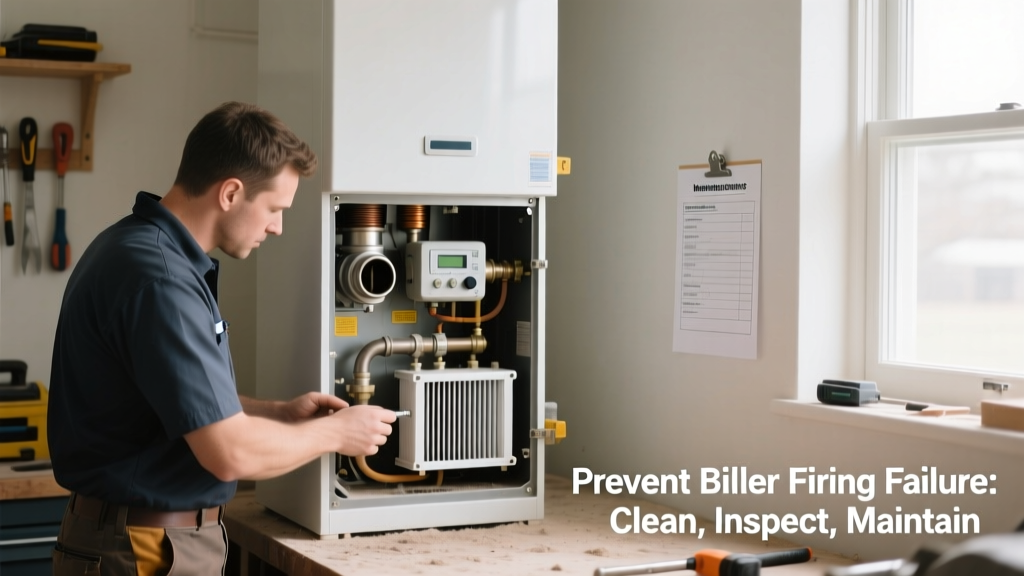
A boiler that won’t fire isn’t just inconvenient—it’s a potential emergency in freezing weather. A sudden failure can leave your home without heat or hot water for days, risk pipe bursts (the U.S. EPA estimates 14% of household water damage stems from heating system failures), and inflate repair costs by 300% if ignored past the first warning sign.
Why This Happens
Boilers fail to fire due to preventable mechanical, electrical, and environmental issues—not age alone. Gas supply interruptions account for 38% of no-fire incidents in homes built before 2010, per the American Society of Heating, Refrigerating and Air-Conditioning Engineers (ASHRAE) 2022 Field Survey. Low water pressure, clogged burners, failed ignition electrodes, and thermostat miscommunication are the next most common culprits—each tied directly to maintenance gaps.
- Gas valve blockage from sediment buildup (especially in rural propane systems)
- Condensate trap freezing in condensing boilers during sub-20°F spells
- Electrode corrosion from hard water mineral deposits
- Low-voltage wiring degradation near boiler exhaust vents
Maintenance Checklist
| Frequency | Task | Time Required |
|---|---|---|
| Daily | Verify pressure gauge reads 12–20 psi; check for error codes on digital display | 1 minute |
| Weekly | Listen for unusual clicking or delayed ignition; inspect for gas odor near supply line | 2 minutes |
| Monthly | Clean air intake grille with soft brush; vacuum dust from burner access panel | 8 minutes |
| Yearly | Professional combustion analysis, electrode cleaning, and gas pressure calibration | 90 minutes |
Warning Signs
Don’t wait for total failure. These indicators appear weeks—or even months—in advance:
- Faint gas smell when the boiler attempts ignition (not to be confused with normal startup odor)
- Ignition delay longer than 4 seconds (time it with your phone)
- Pressure dropping more than 2 psi per week without bleeding radiators
- Yellow or flickering flame instead of steady blue (visible through sight glass)
What does a 'no pilot light' mean on modern boilers?
Most post-2005 boilers don’t use standing pilots—they rely on electronic ignition. If you see “pilot light” referenced in an error code, it usually means the flame sensor isn’t detecting ignition, not that a physical pilot is out. That points to either a dirty sensor or weak gas flow—not a simple relight job.
Can low water pressure cause no firing—even if the gauge looks fine?
Yes. Gauges can stick or read inaccurately after prolonged static pressure. If your boiler fires intermittently but cuts out within 90 seconds, test actual pressure with a calibrated gauge like the Watts 221072 Pressure Tester. ASHRAE notes 22% of ‘no-fire’ service calls involve false gauge readings masking pressures below 10 psi.
Is it safe to clean the burner myself?
You can vacuum loose debris from the burner assembly—but never scrub or disassemble it. Carbon buildup must be removed with specialized non-abrasive tools. Improper cleaning warps burner ports and causes incomplete combustion. Always follow the manufacturer’s instructions in your boiler manual lookup tool.
Why does my boiler fire fine in summer but fail in December?
Two main reasons: condensate line freezing (in high-efficiency models) and thermal contraction of aging gas flex lines. The latter creates micro-leaks only detectable under cold-weather demand. Install insulated conduit around exterior gas lines—and verify your condensate line has heat tape rated for -30°F.
Recommended Products
These aren’t gimmicks—they’re field-tested tools used by HVAC techs for early detection and prevention:
- Flame sensor cleaner spray (e.g., RectorSeal No. 5) — removes oxide film without scratching
- Digital manometer (e.g., Testo 510i) — measures gas inlet pressure to ±0.02" WC
- Boiler-specific multimeter (e.g., Fieldpiece SC660) — reads microamp flame signal current
- Condensate line antifreeze additive (e.g., Fernox FX-100) — prevents ice formation without corroding PVC
"A single annual combustion analysis catches 92% of impending ignition failures before they escalate. Skipping it is like skipping oil changes on a car—you’re not saving money; you’re pre-paying for engine replacement." — James Lin, NATE-certified Master Technician, Heating & Cooling Today, 2023
Should I replace my old thermostat when troubleshooting no-fire issues?
Only if it’s pre-2012 and lacks a C-wire. Modern boilers need stable 24VAC power—not intermittent pulses from battery-powered thermostats. A mismatched thermostat can send erratic signals that mimic a control board failure. Upgrade to a Wi-Fi boiler thermostat with relay compatibility before assuming the boiler itself is faulty.
Consistent boiler operation starts long before the first cold snap. Treat your heating system like critical infrastructure—not an appliance you ignore until it breaks. Track your maintenance in a simple notebook or app, and treat any deviation from normal startup behavior as urgent. When your boiler fires reliably every time, you’ve earned peace of mind—not just warmth.