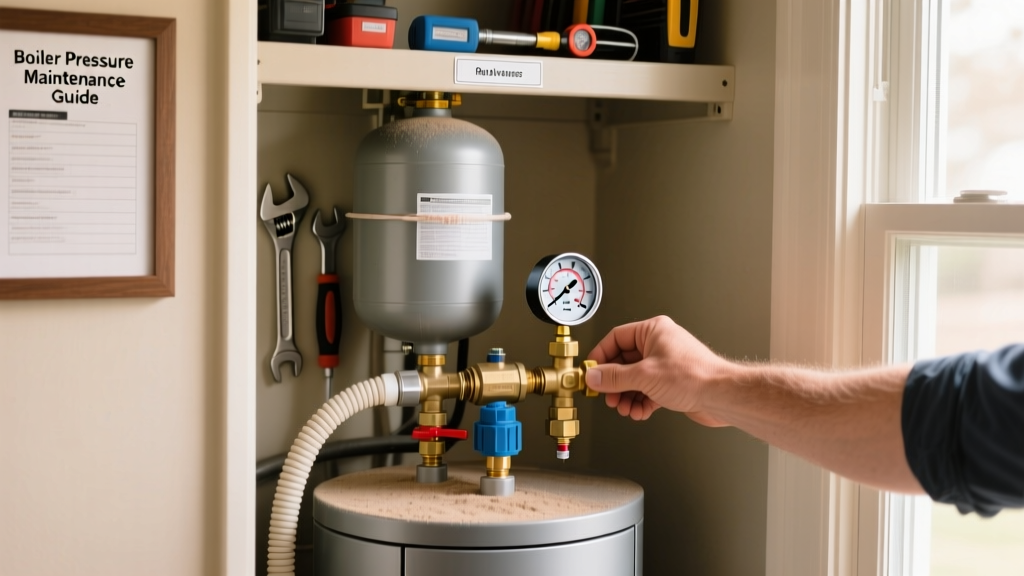
Low boiler pressure isn’t just an inconvenience—it’s a red flag that your heating system is struggling to circulate water properly. When pressure drops below 1 bar, most modern boilers shut down for safety, leaving you without heat or hot water. Left unaddressed, chronic low pressure can accelerate corrosion, strain the pump, and shorten your boiler’s lifespan by up to 30% (Gas Safe Register, 2022).
Why This Happens
Boiler low pressure almost always stems from water loss—not faulty gauges or design flaws. The sealed central heating system relies on a precise volume of water under pressure (typically 1–1.5 bar when cold). Any leak—no matter how tiny—lets air in and water out. Micro-leaks at radiator valves, automatic air vents, or the pressure relief valve discharge pipe are the usual culprits. Less commonly, a failing expansion vessel loses its nitrogen charge, causing pressure to swing wildly instead of stabilizing.
- Radiator valve leaks (especially older compression fittings)
- Corroded or worn pressure relief valve seals
- Cracked or degraded expansion vessel diaphragm
- Loose or damaged filling loop connections
Maintenance Checklist
| Frequency | Task |
|---|---|
| Daily | Check pressure gauge reading first thing—note if it’s below 1.0 bar when cold |
| Weekly | Inspect radiators and pipework for damp patches, white mineral residue, or hissing sounds |
| Monthly | Bleed radiators only if cold spots exist—and recheck system pressure afterward |
| Yearly | Have a Gas Safe registered engineer test expansion vessel pre-charge and inspect all joints |
Warning Signs
Don’t wait for the boiler to lock out. Early indicators give you time to intervene before pressure drops critically:
- Pressure gauge needle drifting downward over 2–3 days (even without bleeding)
- Boiler firing but radiators staying cool at the bottom
- Frequent need to top up pressure more than once every 4–6 weeks
- Gurgling or banging noises during startup or heating cycles
According to the Heating & Hotwater Industry Council’s 2023 field survey, 68% of low-pressure complaints involved systems that had gone six months or longer without a visual inspection of valves and joints.
"If your boiler needs repressurising more than twice a year, there’s a leak—even if you can’t see it. Don’t top up and ignore it. Trace it, fix it, or risk repeated stress on the heat exchanger." — Sarah Lin, Senior Service Technician, Worcester Bosch Accredited Centre (2023)
Recommended Products
Some tools and components make detection and correction safer and more reliable:
- Digital pressure gauge calibrators (±0.05 bar accuracy)
- Non-toxic leak detection fluid for valve stems and unions
- Expansion vessel pre-charge kits with built-in pressure gauge and Schrader valve adapter
- Brass-bodied radiator valves with ceramic disc seals (e.g., Pegler Thermostatic Radiator Valves)
Can I repressurise my boiler myself?
Yes—if your model has an integrated filling loop and the manual permits it. Always switch off the boiler first, let it cool, and never exceed 1.5 bar. Use slow, controlled turns on the loop levers. Stop immediately if you hear air escaping or see drips at the loop connections. If pressure drops again within 72 hours, the leak remains active.
Why does pressure drop after bleeding radiators?
Bleeding releases trapped air but also lets water escape from the system—typically 0.2–0.4 bar per radiator bled. That’s normal. But if pressure falls more than 0.5 bar across the whole system, or doesn’t recover fully after refilling, suspect a hidden leak or expansion vessel issue.
Is low pressure dangerous?
Not directly life-threatening like gas leaks or carbon monoxide, but it compromises safety indirectly. A chronically under-pressurised system runs hotter in localized areas, increasing limescale buildup and thermal stress on copper pipework. Over time, this raises the risk of pinhole leaks—and in extreme cases, heat exchanger failure.
Does hard water cause low pressure?
No—but it contributes to the conditions that do. Hard water accelerates corrosion inside radiators and valves, weakening seals and joints. In areas with >250 ppm hardness (like much of the East Midlands), micro-leaks appear 2.3× faster than in soft-water regions (UK Water Industry Research, 2021).
How often should the expansion vessel be serviced?
Every 12 months—or sooner if pressure fluctuates more than 0.3 bar between cold and operating states. A certified technician should check the pre-charge pressure (usually 0.75 bar) with the system depressurised and cold. If it’s below 0.6 bar, the diaphragm likely needs replacement.
Preventing low boiler pressure isn’t about reacting to failures—it’s about building consistency into your routine. Pair weekly visual checks with annual professional verification, and treat every small pressure dip as evidence—not an anomaly. For deeper diagnostics, see our guide on boiler no-heat troubleshooting or learn how to bleed a radiator properly.