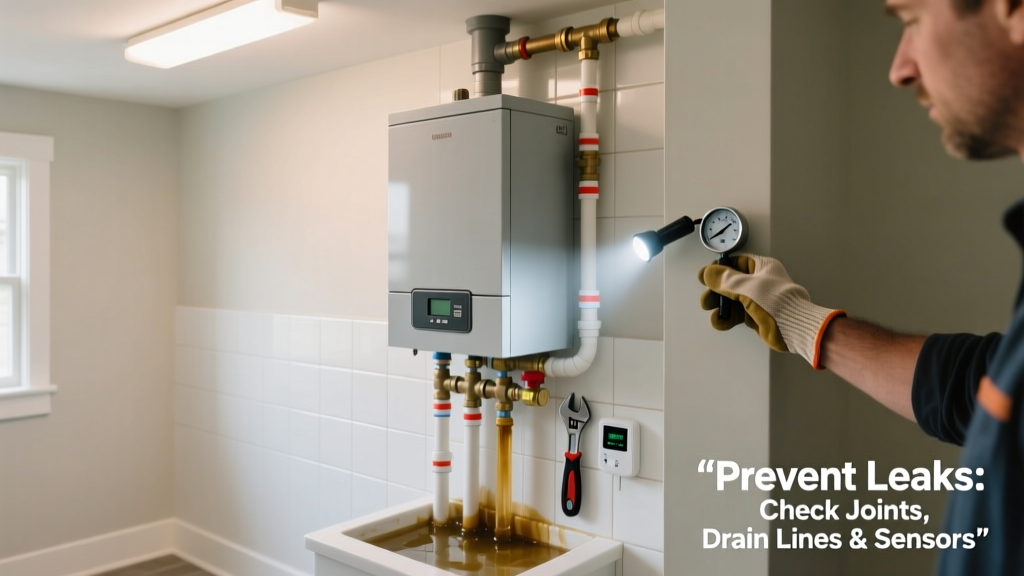
A leaking boiler isn’t just an inconvenience—it’s a red flag for corrosion, pressure imbalance, or component fatigue that can escalate into costly water damage, mold growth, or complete system shutdown. According to the U.S. Department of Energy, 30% of premature boiler failures stem from neglected maintenance—not manufacturing defects.
Why This Happens
Boiler leaks rarely appear out of nowhere. They’re usually symptoms of underlying stress: thermal expansion fatigue at pipe joints, rust buildup in cast iron heat exchangers, failed gaskets due to age or improper water chemistry, or excessive system pressure exceeding 30 psi. Hard water accelerates internal scale and pitting—especially in older steel or copper-tube boilers. Even minor airlocks can cause localized overheating and micro-fractures over time.
- Corrosion from oxygenated or acidic water (pH < 7.0)
- Thermal stress from rapid on/off cycling
- Worn pressure relief valve seals (common after 5+ years)
- Loose or deteriorated threaded connections at circulator pumps or zone valves
Maintenance Checklist
| Frequency | Task | Notes |
|---|---|---|
| Daily | Check pressure gauge reading | Should hold steady between 12–25 psi when cold; fluctuation >3 psi indicates air or leak |
| Weekly | Inspect for wet spots or white mineral residue near base, valves, or pipes | Use flashlight and mirror to examine under-insulated sections |
| Monthly | Test pressure relief valve by lifting lever briefly | Water should discharge cleanly; if it drips afterward, replace valve immediately |
| Yearly | Professional water test + inhibitor top-up | Target pH 8.2–8.5 and dissolved oxygen < 0.005 ppm (per BS 7593:2019) |
Warning Signs
Don’t wait for puddles. Early indicators are subtle but consistent:
- Faint hissing or dripping sounds near the boiler cabinet (not the expansion tank)
- Musty odor near the basement utility area—often mistaken for damp concrete
- White chalky deposits on pipe threads or around flange bolts
- Increased makeup water usage (check your feed valve counter monthly)
- Pressure dropping more than 2 psi per week without bleeding radiators
If you spot two or more of these, shut off the boiler and call a certified heating contractor—don’t reset the pressure or add water blindly.
Recommended Products
Prevention hinges on using the right materials—not just generic hardware. Avoid off-brand inhibitors or non-rated sealants.
- Inhibitors: Fernox MB1 or Sentinel X100 (BS 7593-compliant, tested for 5+ year stability)
- Sealants: Loctite 577 for threaded joints (oil-resistant, rated to 450°F)
- Expansion tanks: Amtrol Extrol #30 (pre-charged to 12 psi, includes diaphragm inspection port)
- Water test kits: Hach DR900 with Hydrazine-free test strips (measures pH, hardness, and chloride)
Can I tighten a leaking valve myself?
Only if it’s a compression fitting with visible looseness—and only with two wrenches (one holding the body, one turning the nut). Never overtighten brass fittings; they crack at ~25 ft-lbs torque. If the leak persists after ¼-turn snugness, replace the valve. For gate or ball valves older than 8 years, replacement is safer than repair. See our boiler valve replacement guide for step-by-step photos.
Does hard water really cause leaks?
Absolutely. The U.S. Geological Survey reports that 85% of U.S. homes have hard water (>120 ppm calcium carbonate). In closed-loop hydronic systems, this forms insulating scale inside heat exchangers—causing hot spots that exceed metal yield strength. One study in ASHRAE Journal (2022) linked untreated hard water to 3.2× higher pinhole leak incidence in copper tubing within 7 years.
How often should I replace my pressure relief valve?
Every 5 years—no exceptions. Even if it looks fine, internal springs fatigue and seals dry out. The National Board Inspection Code (NBIC 2023) requires documented replacement intervals for all safety valves in residential hydronic systems. Keep the old valve’s date stamp photo in your maintenance log.
Is a small drip from the expansion tank normal?
No. Expansion tanks shouldn’t drip at all. A drip means either the diaphragm has ruptured (allowing water into the air chamber) or the pre-charge pressure is too low (<10 psi), causing the bladder to overcompress. Test with a tire gauge—if pressure reads zero or matches system pressure, replace the tank. Learn how to reset expansion tank pressure safely.
What’s the safest way to check for hidden leaks?
Turn off the boiler and let it cool completely. Shut off the main water feed. Mark the pressure gauge reading. Wait 24 hours. A drop >2 psi confirms a leak—even if no moisture is visible. Then isolate zones using manual shutoffs and retest each loop. This method catches micro-leaks behind walls or under floors before drywall staining begins.
"Most 'sudden' boiler leaks begin as invisible corrosion under insulation—visible only with thermal imaging or ultrasonic testing. Monthly visual checks catch 70% of issues before they breach." — James L. Rafferty, NATE-certified Hydronics Specialist, 2023
Preventing boiler leaks isn’t about perfection—it’s about consistency. Stick to your maintenance calendar, trust your pressure gauge over your eyes, and treat every white deposit like a warning flare. When in doubt, document it, shut it down, and consult someone who services boilers weekly—not just during emergencies. For seasonal prep, review our winterize boiler system checklist to ensure your safeguards hold through peak demand.