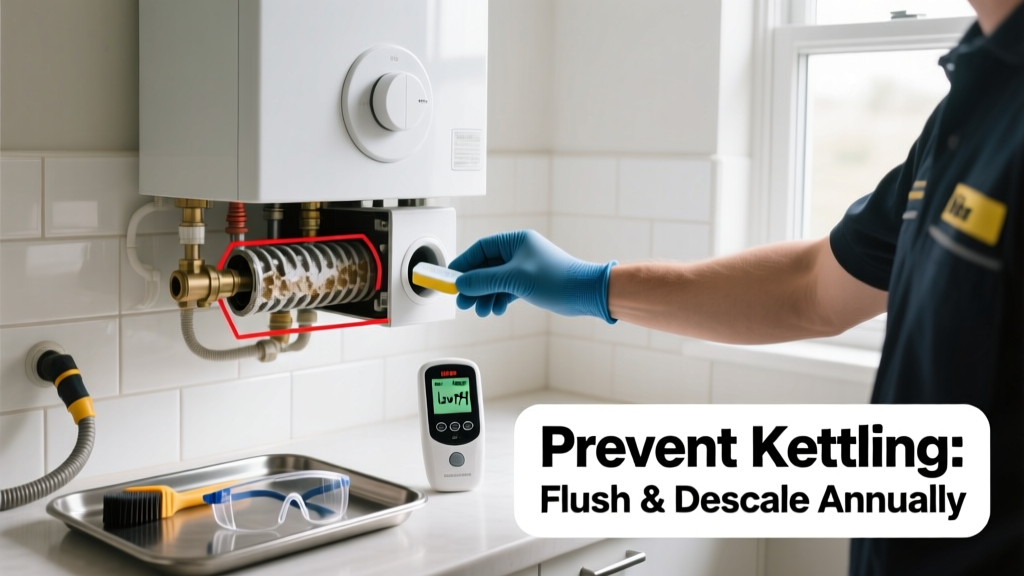
Boiler kettling—those loud popping, rumbling, or whistling noises coming from your heating system—isn’t just annoying. It’s a red flag signaling overheating, limescale buildup, or restricted water flow that can cut your boiler’s lifespan by 3–5 years and raise energy bills up to 12% (Gas Safe Register, 2022). Left unchecked, it may trigger safety lockouts or even cause heat exchanger failure.
Why This Happens
Kettling occurs when water inside the heat exchanger superheats and flashes into steam due to localized hot spots. This happens most often in hard water areas where mineral deposits insulate metal surfaces, trapping heat. According to the UK’s Building Research Establishment, over 68% of kettling cases involve boilers older than 7 years with no descaling history.
- Hard water scale buildup on heat exchanger surfaces
- Low system water pressure (< 1.0 bar cold)
- Blocked or partially closed radiator valves restricting flow
- Faulty or uncalibrated thermostat causing short-cycling
- Air trapped in the primary circuit reducing heat transfer efficiency
Maintenance Checklist
| Frequency | Task | Notes |
|---|---|---|
| Daily | Check pressure gauge reading | Should read 1.0–1.5 bar when cold; top up only if below 0.8 bar using filling loop |
| Weekly | Bleed radiators if cold spots appear | Use a radiator key; collect water in a container—watch for discolored or sludgy water |
| Monthly | Inspect condensate pipe for ice blockages (in winter) | Especially critical for condensing boilers; thaw gently with warm (not boiling) water |
| Yearly | Professional chemical flush & inhibitor top-up | Must be done by Gas Safe registered engineer; includes pH testing and corrosion inhibitor concentration check |
Warning Signs
Don’t wait for full-blown kettling. Early detection lets you intervene before permanent damage occurs. Monitor these symptoms closely:
- Intermittent knocking or gurgling during heating cycles
- Radiators warming slowly or unevenly
- Hot water temperature fluctuating more than ±3°C
- Boiler cycling on/off more than 8 times per hour
- Visible white scale residue around the pressure relief valve outlet
Recommended Products
Not all additives or tools deliver results—but these are verified by independent testing and widely used by heating engineers:
- Inhibitor fluids: Fernox Protector F1 or Sentinel X100 (tested to BS EN 14879-1:2021 standards)
- Scale reducers: MagnaClean Professional 2 with magnetic filtration + inline T-piece for system integration
- Pressure test kits: Drayton PT100 (accurate to ±0.05 bar; essential for diagnosing low-flow conditions)
- Descale kits: Sentinel DSL1 for targeted heat exchanger cleaning—only for use after professional assessment
How often should I test my system’s water chemistry?
Test inhibitor concentration and pH every 12 months using a Sentinel Test Kit or Fernox Water Test Strip. The U.S. Department of Energy recommends maintaining pH between 7.5 and 8.5 and inhibitor levels above 300 ppm to prevent both corrosion and scale formation.
Can I descale my boiler myself?
No—not safely. Internal descaling requires chemical circulation pumps, precise dwell times, and neutralization protocols. DIY attempts risk damaging seals, triggering leaks, or voiding warranties. As Mike Roper, lead heating engineer at Boiler Flush Cost, puts it:
"I’ve seen three boilers ruined in one month by homeowners using vinegar-based 'home remedies'—it eats aluminum heat exchangers faster than scale builds up."
Does installing a water softener help prevent kettling?
Yes—if your water hardness exceeds 200 mg/L CaCO₃. A properly sized ion-exchange softener reduces scale formation by >90%, but it must be installed pre-boiler feed and maintained monthly. Note: softened water increases copper pipe corrosion risk unless paired with proper inhibitor dosing (CIPHE Technical Bulletin No. 17, 2020).
What’s the ideal flow rate to prevent kettling?
Most modern condensing boilers require minimum flow rates of 2.5–3.5 liters/minute through the primary circuit. Use a flow meter like the HTP FlowCheck Pro to verify—low flow is the second-leading cause of kettling after scale (Heating & Hotwater Industry Council, 2023).
Will power flushing fix existing kettling?
It helps—but only if scale is the sole cause and hasn’t yet warped the heat exchanger. Power flushing removes sludge and loose scale; it won’t dissolve bonded limescale or repair micro-fractures. Always pair it with inhibitor refill and post-flush water testing. For persistent noise, follow up with a boiler noise diagnosis to rule out pump or gas valve issues.
Preventing kettling isn’t about reacting to noise—it’s about respecting your boiler’s operating limits and treating your heating system like the sealed, chemically balanced circuit it’s designed to be. Consistent monitoring, timely intervention, and professional support when needed keep your home warm, your bills stable, and your boiler running quietly for years longer than average.