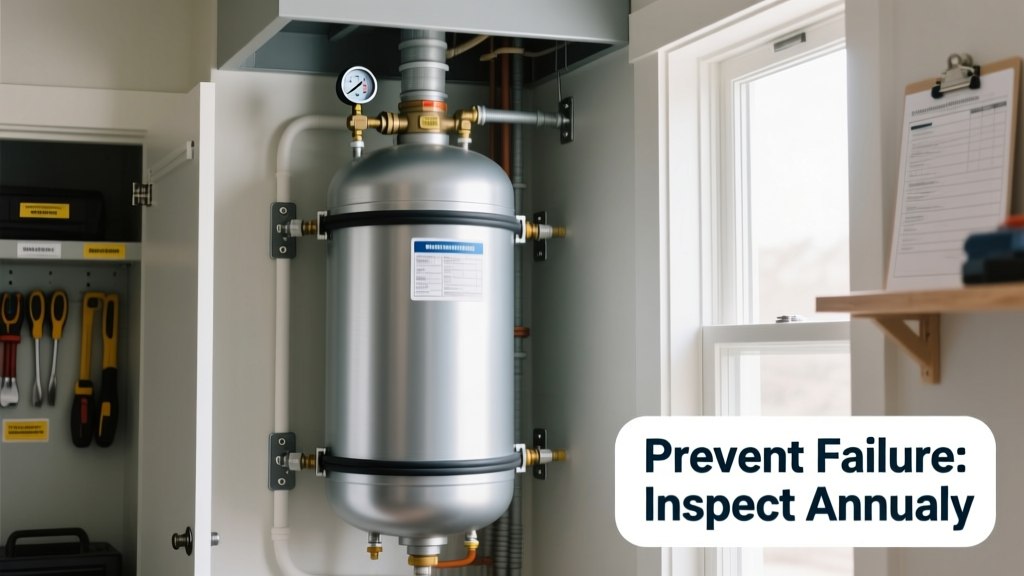
Boiler expansion vessel failure isn’t a matter of if—it’s when, unless you intervene. A failed vessel causes erratic pressure swings, frequent pressure relief valve discharge, and eventual boiler lockout. According to the UK’s Gas Safe Register, 22% of annual boiler call-outs involve pressure-related faults directly tied to neglected expansion vessels (2023 Annual Technical Report). Left unchecked, this leads to corrosion in heat exchangers, premature pump failure, or even unsafe over-pressurization.
Why This Happens
Expansion vessels fail due to three primary mechanisms: loss of pre-charge pressure, diaphragm rupture, and corrosion from poor water chemistry. The air side of the vessel loses pressure over time—typically 0.5–1.0 bar per year—especially if the system uses non-inhibited water or has micro-leaks at the Schrader valve. Diaphragms degrade faster when systems cycle rapidly (e.g., oversized boilers on low-load heating) or when fill pressure exceeds 3.0 bar during commissioning. Corrosion accelerates when pH drops below 7.5 or oxygen ingress occurs through auto-fill valves or open vents.
- Pre-charge pressure drops below 0.75 bar (most common cause)
- Diaphragm fatigue from >15,000 pressure cycles (typical in homes with short boiler cycles)
- Galvanic corrosion between steel vessel body and copper pipework without dielectric unions
Maintenance Checklist
| Frequency | Task | Tools/Notes |
|---|---|---|
| Daily | Check boiler pressure gauge reading (should hold 1.0–1.5 bar cold, max 2.5 bar hot) | No tools needed; log readings weekly in a notebook or app |
| Weekly | Inspect for dampness or white powder residue around Schrader valve base | Use flashlight; white powder = zinc oxide from internal corrosion |
| Monthly | Test pressure stability: isolate boiler, drain 2–3 liters, observe if pressure drops >0.2 bar in 10 minutes | Requires drain valve key and accurate pressure gauge |
| Yearly | Re-pressurize air side to manufacturer spec (usually 0.75–1.0 bar cold); verify diaphragm integrity with 'bounce test' | Use nitrogen or dry air; never oxygen or shop air (moisture risk) |
Warning Signs
Early detection saves hundreds in labor and parts. Don’t wait for a full lockout—these signs appear weeks or months earlier:
- Pressure climbs above 3.0 bar when heating is active, then drops sharply when off
- Pressure relief valve drips or discharges regularly—even after bleeding radiators
- Boiler cycles on/off every 60–90 seconds (short-cycling), especially during shoulder seasons
- Gauge needle vibrates or ‘bounces’ instead of holding steady
- Visible bulge or distortion on the vessel’s cylindrical body (rare but critical)
Recommended Products
Not all products are equal—and cheap replacements often fail within 18 months. Stick with trusted brands that meet BS EN 13831:2016 standards. For DIY checks, use a calibrated digital pressure gauge (±0.05 bar accuracy), not a tire gauge. When replacing, match volume (typically 8L for combi boilers under 40kW) and maximum working pressure (must be ≥6 bar).
- Digital pressure gauges with zero-tare function
- Genuine Grundfos or Spirotherm replacement vessels (not generic imports)
- Inhibitor test strips (e.g., Fernox FX100 kit) to confirm system pH stays 8.2–8.5
Can I check pre-charge pressure myself?
Yes—if your boiler is isolated and cooled to under 35°C. Use a dedicated expansion vessel pressure gauge (not a standard tire gauge) on the Schrader valve. Depress the valve core gently while watching for a hiss of air—not water. If water sprays out, the diaphragm has ruptured and replacement is mandatory. Always re-pressurize with nitrogen; compressed air introduces moisture that corrodes the bladder.
How often should I replace the expansion vessel?
Most last 10–15 years, but lifespan plummets in hard-water areas or systems with frequent pressure topping-up. The U.S. Department of Energy notes that vessels in homes with unconditioned water show 40% higher failure rates before year 8 (2022 Residential Hydronics Survey). Replace proactively at 10 years—or sooner if monthly pressure tests show >0.3 bar loss in 30 days.
Does system inhibitor affect the expansion vessel?
Absolutely. Low-pH inhibitors (<7.0) accelerate rubber diaphragm hydrolysis. Conversely, over-dosing phosphate-based inhibitors creates sludge that clogs the air valve seat. Use only inhibitors certified for sealed systems (e.g., Sentinel X100 or Kamco EcoHeat), and test concentration annually with refractometer or titration kit.
Why does my boiler lose pressure only in winter?
Cold ambient temps reduce air-side pressure inside the vessel (per Gay-Lussac’s law). A vessel charged to 0.75 bar at 20°C drops to ~0.62 bar at 5°C—enough to compromise function. That’s why winter is the peak season for pressure-related faults. Always check and adjust pre-charge in early autumn, before outdoor temps fall below 10°C.
"If your boiler pressure climbs more than 0.8 bar from cold to fully heated, your expansion vessel is either undercharged or ruptured—no exceptions." — Martin Hargreaves, Chartered Engineer, Heating & Ventilation Institute (2023)
What’s the cost difference between repair and replacement?
Re-pressurizing and testing costs £45–£75 with a qualified heating engineer. Replacing the vessel—including draining, refilling, power-flushing, and recommissioning—runs £280–£420. But skip both, and you’ll likely face a £650+ heat exchanger replacement due to sustained overpressure corrosion. Prevention pays for itself in under two years.
Think of your expansion vessel like a car’s timing belt: invisible until it fails—and then everything downstream suffers. Sticking to the monthly pressure stability test and yearly pre-charge verification takes under 10 minutes but extends boiler life by 3–5 years. Pair it with regular full-system maintenance, and you’ll avoid most emergency call-outs before they start.