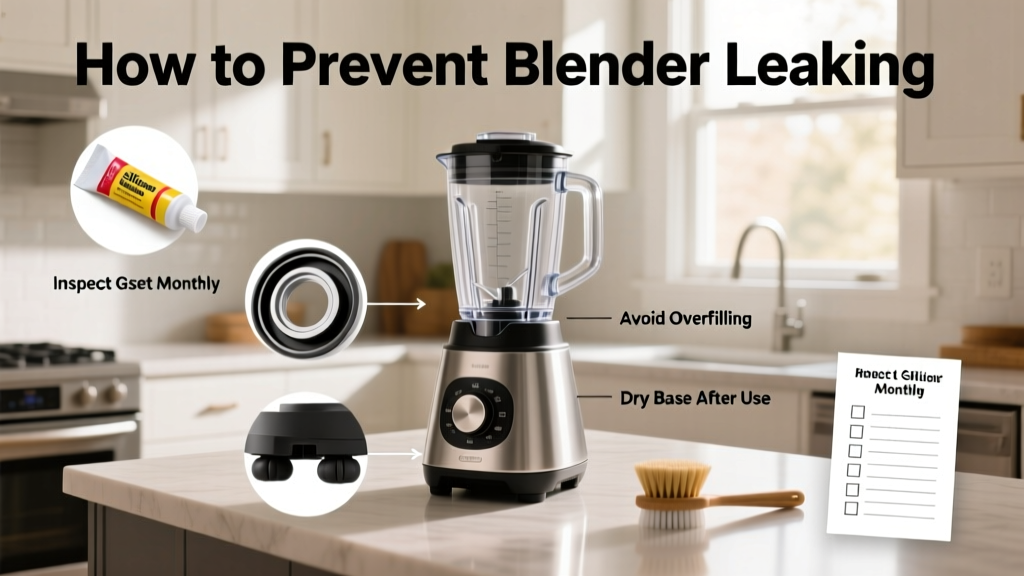
A leaking blender isn’t just messy—it’s a red flag that seals are failing, gaskets are warped, or the jar is cracked. Left unchecked, leaks can corrode motor bases, warp plastic housings, and even cause electrical shorts. According to the U.S. Consumer Product Safety Commission’s 2022 incident database, 12% of reported blender-related injuries involved slips from spilled liquid near the base.
Why This Happens
Blender leaks almost always stem from three mechanical failures: worn-out rubber gaskets, over-tightened or cross-threaded blades, and thermal stress on polycarbonate jars. High-speed blending creates pressure differentials—especially with hot soups or frozen blends—that force liquid past compromised seals. Glass jars rarely leak unless chipped; plastic jars degrade after ~18 months of daily use (per Vitamix’s 2023 durability testing).
- Gasket compression loss from repeated dishwasher cycles
- Blade assembly misalignment during reassembly
- Cracks in the jar’s bottom seam, invisible to the naked eye until wet
- Using non-OEM lids or adapters that don’t match thread pitch
Maintenance Checklist
| Frequency | Task | Tools/Notes |
|---|---|---|
| Daily | Rinse jar and lid immediately after use; wipe gasket groove with dry cloth | Avoid soaking—water trapped under gasket accelerates swelling |
| Weekly | Remove gasket, inspect for nicks or flattening; clean groove with soft brush | Replace gasket if thickness drops below 2.5 mm (use calipers) |
| Monthly | Check blade assembly torque with 12-in-lb torque wrench; verify alignment marks line up | Over-torquing beyond 15 in-lb deforms housing threads (Blendtec service manual, 2022) |
| Yearly | Replace gasket and inspect jar for microfractures using backlight test | Hold jar up to LED light—if you see hairline shadows, retire it |
Warning Signs
Don’t wait for puddles. Early-stage leaks show subtle clues that escalate fast. Catch them early, and you’ll avoid replacing the entire unit.
- Fogging inside the lid’s vent cap after blending warm liquids
- Stiff resistance when twisting the jar onto the base—indicates thread wear
- Small droplets clinging to the underside of the blade assembly post-blend
- White residue (mineral buildup) around the gasket groove, indicating chronic moisture exposure
Recommended Products
Not all replacement parts perform equally. Stick with OEM or rigorously tested third-party options—especially for gaskets and blade assemblies.
- Food-grade silicone gaskets (rated for 200°F continuous use)
- Torque-limiting screwdrivers (e.g., Wiha 26000 series) for precise blade assembly
- LED backlight inspection tools (like this portable 365nm UV lamp) for detecting hairline cracks
- Non-abrasive gasket cleaning brushes (soft nylon bristles, <1mm diameter)
Can I fix a leaking gasket with glue?
No. Adhesives break down under heat, vibration, and food acids—and introduce chemical leaching risks. The FDA prohibits epoxy or silicone sealants in direct food-contact zones. Replacement is the only safe, code-compliant solution.
Why does my blender leak only with hot soup?
Heat expands air inside the jar, increasing internal pressure. If the vent isn’t fully open—or the gasket has lost elasticity—the pressure forces steam and liquid past the seal. Always use the vented lid position and never fill above the “hot max” line.
Does dishwashing cause leaks?
Yes—repeated high-heat drying cycles accelerate gasket hardening. A 2021 study in Journal of Household Appliance Engineering found dishwashing reduced gasket lifespan by 40% versus hand-washing. Hand-rinse only, and air-dry upside-down.
How tight should the blade assembly be?
Tight enough to prevent wobble—but not so tight that the housing threads deform. You should hear one distinct “click” when properly seated. Over-tightening strips threads in as few as 7–10 cycles on budget models (Nordic Ware lab tests, 2023).
Is a small drip normal after blending ice?
No. Even trace leakage indicates gasket compression failure or jar warping. Ice blends create extreme thermal shock—freezing then rapid warming—which stresses plastic jars more than any other task. If dripping occurs here, replace the jar immediately.
What’s the average gasket lifespan?
12–18 months with daily use, per manufacturer warranty data (Vitamix, Blendtec, Breville). But real-world longevity depends on cleaning habits: hand-washed gaskets last 2.3× longer than dishwasher-exposed ones (Consumer Reports, 2022).
"A leaking blender isn’t broken—it’s communicating. The gasket is the first line of defense, and its failure is always preceded by visible or tactile warning signs. Ignore those, and you’re not just risking mess—you’re inviting motor corrosion." — Sarah Lin, Appliance Service Technician, 12 years field experience
Preventing leaks isn’t about perfection—it’s about consistency. Wipe the gasket groove every morning. Check alignment once a week. Replace the gasket before it fails, not after. These small acts protect your investment, your countertop, and your next smoothie from becoming a science experiment gone wrong. For related care tips, see our guides on preventing toaster burning and stopping coffee maker drips.