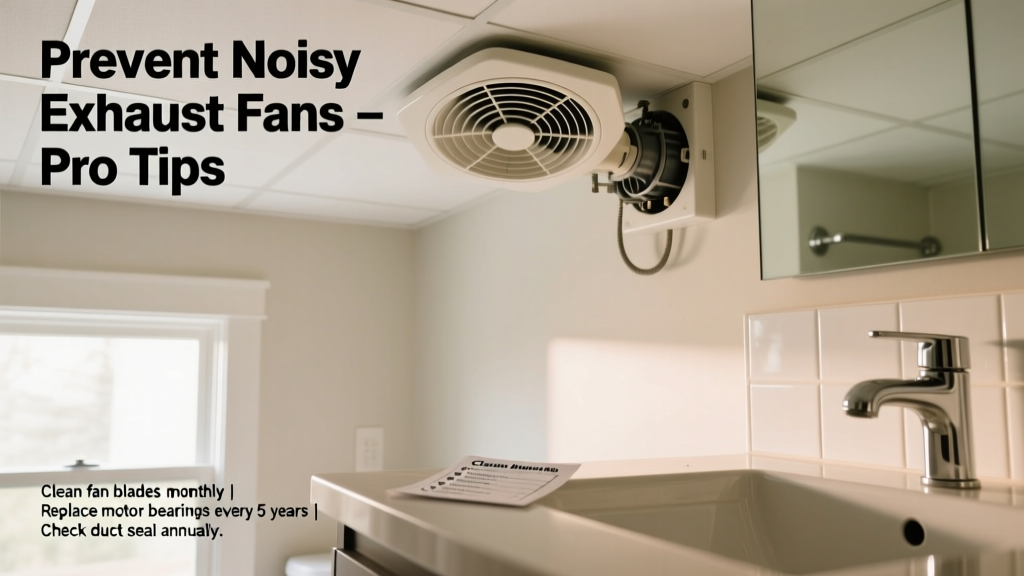
A noisy bathroom exhaust fan isn’t just annoying—it’s a red flag. Excessive vibration, grinding, or whining often signals failing bearings, loose components, or accumulated debris. Left unaddressed, these issues reduce airflow efficiency by up to 40% (U.S. Department of Energy, 2022) and can shorten the fan’s lifespan by half. Worse, poor ventilation increases humidity, raising mold risk behind walls and ceilings.
Why This Happens
Noise rarely appears out of nowhere. Most bath fan sounds stem from mechanical wear or installation flaws—not age alone. Dust buildup on the blower wheel throws off balance. Worn motor bearings generate grinding or squealing. Loose mounting screws cause rattling against drywall or joists. And undersized or kinked ductwork creates turbulent airflow that amplifies hum and vibration.
- Motor bearing wear (most common after 5+ years)
- Dust and lint clogging the blower wheel or grille
- Loose or corroded mounting hardware
- Poorly sealed or sagging flexible ducts
- Incorrect fan CFM rating for room size
Maintenance Checklist
| Frequency | Task | Time Required |
|---|---|---|
| Daily | Run fan for full shower cycle (minimum 20 minutes) | 0 min — automatic |
| Weekly | Wipe grille with damp microfiber cloth | 2 minutes |
| Monthly | Vacuum grille and visible duct opening; check for loose screws | 5 minutes |
| Yearly | Remove fan unit, clean blower wheel with soft brush + isopropyl alcohol; lubricate motor shaft *only if manufacturer-approved* | 30–45 minutes |
Warning Signs
Catch problems early—before they escalate into failure. A sudden change in sound is more telling than gradual noise increase. Pay attention to pitch, rhythm, and timing:
- High-pitched squeal during startup: worn motor bearings or belt tension issue (on older belt-drive models)
- Rattling only when fan first turns on: loose grille, housing screw, or duct connector
- Low hum that intensifies over time: dust accumulation on impeller or degraded insulation inside housing
- Intermittent clicking: failing capacitor or wiring contact issue
Recommended Products
Not all fans are built for quiet longevity—and not all accessories deliver real value. Prioritize products tested for durability and acoustic performance:
- ECM (electronically commutated) motors: 30–50% quieter than standard PSC motors; use 60% less energy (ENERGY STAR® Certified Fans, 2023)
- Rigid metal ducting (4” smooth-walled): eliminates vibration transfer and airflow restriction vs. flexible plastic duct
- Vibration-isolating mounting brackets: e.g., Broan QTXE series mounts or Panasonic WhisperMount kits
- Backdraft dampers with silicone seals: prevent flapping noise and cold air infiltration
Can I lubricate my bath fan motor myself?
Only if your fan’s manual explicitly permits it—and only with the lubricant type specified (usually ISO 10 or 22 synthetic oil). Over-lubrication attracts dust and gums up bearings faster. Most modern sealed-bearing fans (like Panasonic FV-08VKM2 or Delta BreezSlim) are permanently lubricated and should never be oiled. Attempting to open them voids warranties and risks misalignment.
Why does my fan get louder after cleaning?
If noise spikes post-cleaning, you likely disturbed settled dust without fully removing it—or reinstalled the blower wheel slightly off-center. Always mark the wheel’s orientation before removal. Also verify the grille is fully seated: a 1/16” gap can trigger resonance at certain RPMs. Use a torque screwdriver set to 2.5 in-lbs for mounting screws—overtightening warps housings.
Does duct length affect noise?
Absolutely. Every 90° elbow adds ~15 ft. of equivalent duct length in resistance. A 6-ft run with three bends performs like a 51-ft straight run—forcing the motor to work harder and vibrate more. According to the Home Ventilating Institute (HVI, 2021), duct runs over 25 ft. total equivalent length increase audible noise by 3–5 dB(A), pushing it above the recommended 0.3 sones threshold for bathrooms.
Will a higher-CFM fan always be noisier?
Not necessarily—but it depends on design. A well-engineered 110-CFM fan like the Panasonic WhisperGreen Select can operate at 0.3 sones, while a cheap 70-CFM model may hit 2.5 sones. Look for the sone rating, not just CFM. For most 50–70 sq. ft. bathrooms, 50–80 CFM is sufficient—and quieter models in that range exist.
How often should I replace the entire fan unit?
With consistent maintenance, quality fans last 10–12 years. But if your unit is over 8 years old and requires frequent cleaning to maintain airflow, consider replacement—even if it’s still running. Newer models cut noise in half and improve moisture removal by 20% (ASHRAE Journal, 2022). Delaying replacement raises long-term mold remediation costs far beyond the $120–$220 unit price.
What’s the #1 mistake homeowners make with bath fans?
"Most people treat their bath fan like a light switch—not a ventilation system. They flip it on for 30 seconds, then off. That’s like brushing your teeth once a month: technically done, but functionally useless." — HVAC Technician Maria Lin, 18-year field service lead at DuctPro Solutions, 2023
Preventing noise starts with respecting how the system works—not just fixing what breaks. Keep grilles clear, ducts tight and short, and run fans long enough to remove moisture, not just steam. Pair routine checks with smart upgrades, and your bathroom stays quiet, dry, and healthy for years. For deeper help diagnosing persistent noise, see our guide on bathroom fan not ventilating properly or bathroom mold prevention strategies.