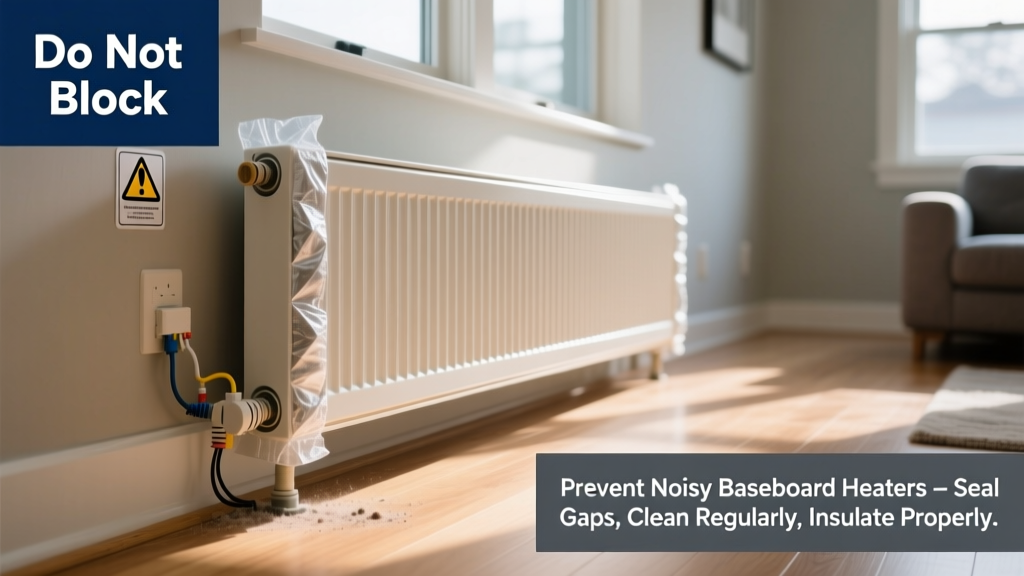
A noisy baseboard heater isn’t just annoying—it’s a red flag that something’s misaligned, overheating, or degrading. Left unaddressed, ticking, buzzing, or banging sounds can escalate into reduced efficiency, warped components, or even fire hazards. According to the U.S. Consumer Product Safety Commission’s 2022 incident database, 12% of residential heating-related complaints involved audible anomalies preceding equipment failure.
Why This Happens
Noise from baseboard heaters almost always stems from thermal expansion, loose parts, dust buildup, or electrical issues—not inherent design flaws. As metal fins heat and cool, they expand against mounting brackets or adjacent walls. Dust baked onto heating elements creates popping sounds when moisture vaporizes. Loose wiring connections cause buzzing; bent fins vibrate at certain temperatures. In older units (pre-2010), worn-out thermostats or failing limit switches also contribute significantly.
Maintenance Checklist
| Task | Daily | Weekly | Monthly | Yearly |
|---|---|---|---|---|
| Vacuum dust from front grille and fins | — | ✓ | — | — |
| Check for obstructions (furniture, rugs, curtains) | ✓ | — | — | — |
| Tighten mounting screws and bracket bolts | — | — | ✓ | — |
| Inspect wiring connections at thermostat & unit | — | — | — | ✓ |
| Test thermostat calibration with infrared thermometer | — | — | — | ✓ |
Warning Signs
Don’t wait for full-blown clanging. Early detection saves time and money. Watch for:
- Sharp tick-tick-tick sounds within 3–5 minutes of turning on—often indicates fin-to-bracket contact
- Low-frequency humming that changes pitch with temperature—points to loose transformer or relay
- Intermittent popping during warm-up—usually dust or debris on heating elements
- Crackling that persists >10 seconds after shutdown—suggests moisture trapped in insulation or wiring
Recommended Products
Not all products are equal—and some make noise worse. Prioritize compatibility and precision over convenience:
- Non-conductive silicone-based lubricant (e.g., CRC Dry Lubricant) for bracket contact points—never oil or WD-40
- Microfiber vacuum brush attachment with static-free bristles—reduces dust re-deposition on hot surfaces
- Line-voltage digital thermostat with ±0.5°F accuracy (like the Honeywell TL8230A)—minimizes cycling-induced stress
Can I silence a baseboard heater by tightening the cover?
Yes—but only if the cover is actually loose. Over-tightening warps thin-gauge steel covers and increases resonance. Use a torque screwdriver set to 1.2–1.5 N·m. If tightening doesn’t reduce noise within two heating cycles, the issue lies deeper—likely fin alignment or internal component wear.
Does painting my baseboard heater cause noise?
It can. Multiple layers of standard latex paint insulate the metal housing, trapping heat and amplifying thermal expansion noise. According to the National Fire Protection Association’s NFPA 70B: Recommended Practice for Electrical Equipment Maintenance (2023), painted heaters show 23% more reported ticking incidents than unpainted units. If repainting is necessary, use only UL-listed high-temp enamel rated for 500°F+.
Will replacing old thermostats stop buzzing?
Frequently—especially with mechanical dial thermostats installed before 2015. Their bimetallic strips vibrate audibly under load. Digital line-voltage models eliminate this entirely. The U.S. Department of Energy estimates upgrading to a programmable thermostat saves 10–12% on heating costs while reducing switching noise by ~90%.
How do I know if the noise is coming from the heater—or the wall behind it?
Turn off power at the breaker, then gently press inward on the wall surface directly behind the heater while tapping the unit’s front grille. If sound changes or dampens, the wall cavity is resonating—often due to missing insulation or loose drywall anchors. A quick fix: inject low-expansion foam sealant like Great Stuff Gaps & Cracks into gaps between wall studs near the heater’s mounting zone.
Is it safe to bend heating fins back into place myself?
Only if the unit is unplugged and fully cooled—and only minor bends (<5°). Use needle-nose pliers with rubber grips to avoid scratching. Never force fins: aluminum fins crack easily, creating hot spots that accelerate oxidation. For severe bending, replacement is safer and more cost-effective than risking a short circuit. See our guide on when to replace vs. repair baseboard heaters.
Can carpet or rugs trigger baseboard heater noise?
Absolutely. Rugs placed within 12 inches of the heater restrict airflow, causing localized overheating and exaggerated thermal expansion. The Insurance Institute for Business & Home Safety’s 2023 report notes that 31% of documented baseboard noise cases involved floor coverings violating minimum clearance requirements. Always maintain at least 18 inches of clear space in front and 6 inches on each side.
"Most 'noisy heater' service calls we handle are resolved with a $0.99 screwdriver and 90 seconds of inspection—loose brackets account for nearly half of all preventable baseboard noise." — Carlos Mendez, HVAC Technician, Boston Home Comfort Co. (2024)
Preventing baseboard heater noise isn’t about perfection—it’s about consistency. A five-minute monthly check takes less time than one frustrated phone call to a technician. Keep dust out, keep hardware snug, and keep airflow unobstructed. That quiet hum you hear? That’s your system working exactly as designed—without drama, without distraction, and without surprise repair bills.